Category:Scraping ToolsView as Markdown
Top 5 Apify Alternatives for Web Scraping and Crawling in 2026

Head of Marketing


Prague, 2015. Jan Curn and Jakub Balada build a service that takes any scraper, wraps it in a hosted unit you can rent by the run, and calls it an Actor.
Ten years later the Store lists 37,223 of them, and Apify is the biggest brand in scraping: DR 80 and about 33k brand searches a month.
The pain arrives with the invoice: five meters on one bill, a 19.5 s average wait per request across 20 domains, and compute charged whether the page came back or not.
You opened this page because one of those three bit you.
So here are five alternatives to Apify, measured on the same 20 domains and URLs in a sweep of 1,000 trials, with Apify as the baseline row. Want an Apify alternative that fixes one specific complaint? The last column names it. No vendor pricing page did the ranking.
| Provider | Success rate (20 domains) | Avg response | Blended cost per 1K | Entry plan | Pain points relieved |
|---|---|---|---|---|---|
| Apify (baseline) | 95.3% | 19.5 s | $7.04 | $29 = $29 of compute | baseline |
| Scrape.do | 99.4% | 4.19 s | $0.23 | $29 = 250,000 credits | cost, speed, failed-request billing, endpoint simplicity, Amazon |
| Bright Data | 94.7% | 14.6 s | $1.55 | Pay as you go, no commitment | cost, failed-request billing, Actor quality, proxy stack |
| Decodo | 95.9% | 11.9 s | $0.68 | $19 | cost, Amazon, AI cost opacity |
| Scrapfly | 93.4% | 4.78 s | $2.69 | $30 | cost, speed, failed-request billing, endpoint simplicity |
| Zyte | 83.0% | 11.5 s | $1.04 | Pay as you go | speed on hard targets, Actor breakage, the DIY path |
Method in one line: 16 providers, 20 domains, identical URLs, cheapest qualifying tier per domain, and Apify measured through the best available Actor per domain (junglee for Amazon, voyager for Booking, ivanvs for Bing). The full method is in the best web scraping API benchmark.
What Apify Does Well
Credit first. Apify covered 20 of 20 domains with zero genuine failures once we locked in the right Actor per domain, and it scored 100% on Instagram, LinkedIn, X, Capterra and Indeed, the exact domains where ScraperAPI, Firecrawl or Zyte fail outright.
And if your target is a niche site with a working Actor today, Apify is often the only place that has it.
The Store: 37,000 Actors and 20/20 Coverage
The marketplace is the real product. Most of the 37,223 Actors are community built, and their authors earn rental fees on every run (yes, scrapers have landlords now), so almost every benchmark domain had a prebuilt scraper waiting. Instagram: 100% at $2.60 per 1K and 6.6 s through the official apify/instagram-profile-scraper. LinkedIn: 100% at $4 per 1K and 8.9 s.
Bing tells the other half. No generic Actor cleared bing.com in the first batch; then one community Actor, ivanvs/bing-scraper, delivered 30/30 at $0.0061 per run. Coverage recovered because one developer published the right Actor, and one developer can also reprice it or abandon it.
Crawlee and the Hosted Runtime
Crawlee, Apify's open source crawler library, has 25k+ GitHub stars, and the hosted runtime around it bundles what a scraper on your own server lacks: scheduling, datasets, key-value stores, request queues and webhooks, with no DevOps on your side. Scrapy spiders run on the platform too.
The MCP Server and the AI-Agent Story
mcp.apify.com is the most mature hosted MCP server in scraping, and the RAG Web Browser and the Website Content Crawler hand an agent markdown a model can read.
Reviews back the brand: Trustpilot 4.8, G2 4.7, and about 115k organic visits a month. None of that fixes the invoice, and none of it fixes the 19.5 s average.
Downsides of Apify
Those strengths are why teams adopted Apify. These five problems are why you're looking for the exit.
Five meters, one bill, and a container cold start on every request.
Apify Pricing: Five Meters on One Invoice
Here is the stack on a single job. Compute units cost $0.20 per CU on Free and Starter ($0.13 on Business), and one CU is 1 GB of RAM for one hour. Multiply that by the Actor author's fee, then add residential proxy at $8/GB, storage at $1 per 1K GB-hours, transfer at $0.20/GB, and a separate SERPs proxy line at $2.50 per 1K. Apify's usage and resources documentation has the compute unit formula.
Across the 20 domains the blend came out at $7.04 per 1K, with a 90x spread inside one account: $0.47 per 1K on Trustpilot, $13.75 on G2, $44 on Reddit, where Actor authors charge for the browser rendering Reddit forces on them. Apify is the only major provider we track with no cost per 1K requests at all, because nobody can price a compute unit run before it finishes.
The Apollo Actor is the cautionary tale: about $1.50 per 1K leads, then $30 per 1K leads, then suspended. Reddit users sum up compute plus proxy usage in three words, "costs spiral quickly", and builders called the recent monetization changes "unfair".
Slow: 19.5 Seconds on Average
19.5 s average response across 20 domains, the highest of any top five provider in the sweep, because every request is an Actor run and every run begins with a container cold start.
The long tail is worse. Booking averaged 52.4 s, TripAdvisor 54.4 s, and Walmart 56.0 s with an 84.0 s p90, the longest response we measured for any provider on any domain. The Google Maps Actor needs 23 s per search, 40 s p90, and 107 s p90 on reviews.
The fastest alternative below averages 4.19 s on the identical 20 domains, and two of the five come in under 5 s.
You Pay for the Failed Runs Too
Most Actors bill compute units by memory times runtime rather than by HTTP result, so a run that ends in a block still consumed a container, and the container is what you pay for.
Amazon shows the arithmetic. The marketplace Amazon Actor succeeded on 80% of trials (16 of 20) at a $5 per 1K headline; the failed 20% still burned compute units, so the effective rate on the pages you received is about $6.25 per 1K.
Four of the five alternatives below bill on success only (Decodo prices per request by tier). On Apify, the retry is your problem and your bill.
Actors Break, Get Repriced, or Vanish
37k community Actors run from excellent to abandoned, and Apify itself owns the highest usage ones, which tells you where the maintenance attention goes.
We ran into this in the benchmark. The G2 run had 5 of 20 target slugs die mid-run and needed a re-run with a fix, and the first eBay Actor paginated listing URLs until the 120 s timeout before we swapped it out.
There is no unified input schema either. Each Actor has its own input JSON and output shape, so switching Actors for the same target is a small migration every time, and repricing is a third party's decision.
A Platform When You Wanted an Endpoint
Actors, compute units, datasets, request queues, storage: an afternoon to get comfortable with, for a job that is one GET request with a URL and a token everywhere else.
On Amazon that showed up as 80% success at 14.5 s average and 21.8 s p90, which kept Apify out of the 550-trial stress test (the audit cut-off was 100%).
The MCP server is free, but the docs say only "monitor your usage", so an agent can't reason about what a tool call will cost. And the proxy stack is thin: no mobile or ISP proxies advertised, and a residential discount of about 12.5% at the $999 tier ($8/GB down to $7/GB).
For a Single Scraping Endpoint
If your Apify job was "fetch this URL through something that gets past the WAF", these two replace the whole platform with one API key and a price per request, which is why both sit near the top of the best web scraping APIs list. Section numbers follow reading order; the table at the top is the ranking, which is why Scrapfly is second here and fourth there.
1. Scrape.do
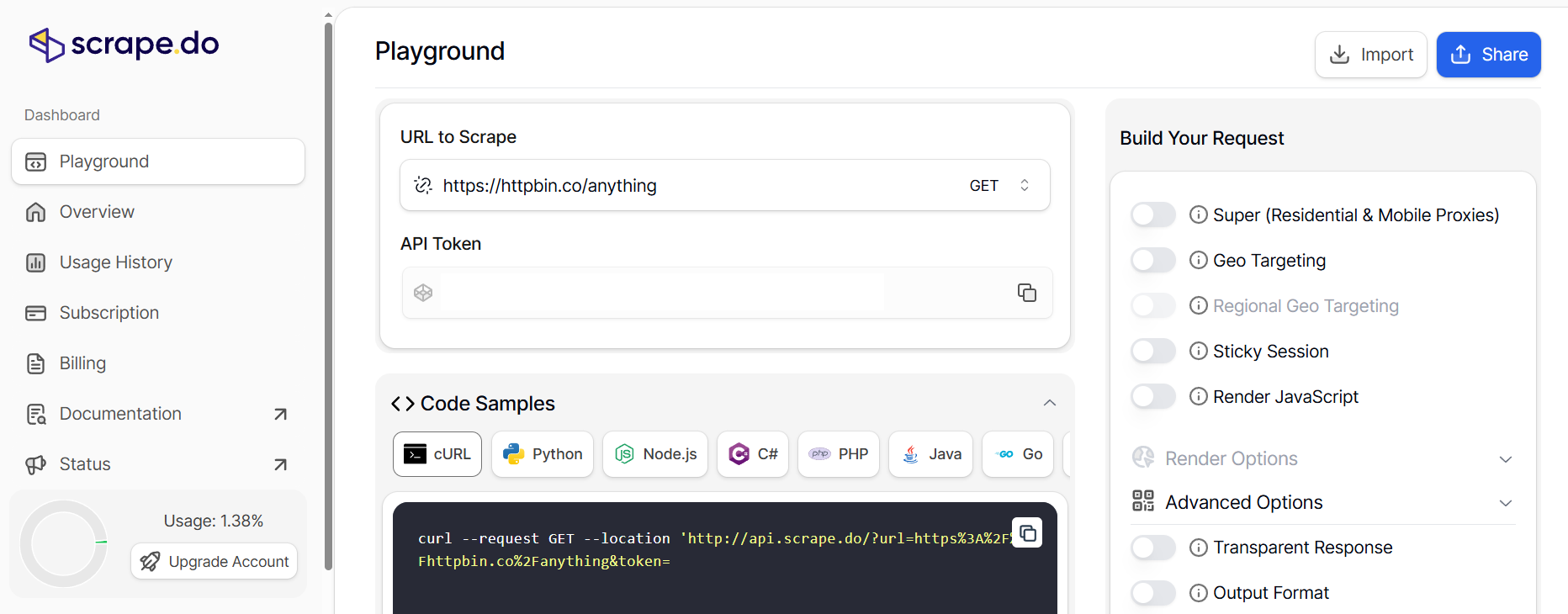
Start with the like-for-like $29. Apify's Starter is $29 of compute. Scrape.do's Hobby plan is $29 for 250,000 credits, and you spend a credit only on a 2xx, 400, 404 or 410 response.
Same price, opposite invoice.
On the same 20 domains it's 99.4% success against Apify's 95.3%, 4.19 s against 19.5 s, and $0.23 per 1K against $7.04. On the published article's 7 domains it's 98.61% against 97.14%, and where Apify is slowest the gap widens: Walmart product pages at a 2.25 s p50 against the Walmart Actor's 56 s average, and Google SERP at 1.85 s against 12.65 s, at $0.11 per 1K against $1.50, with one caveat on sample size (Scrape.do's 99.5% is n=1,000, Apify's 100% is n=30).
Amazon is the wedge. 550/550 in the June 2026 stress test with zero retries and no trouble from Akamai, a test Apify's 80% did not qualify for (full run in the Amazon scraper API benchmark). In the AIMultiple replication it finished first or tied first in all four categories: unblocker 92.5%, e-commerce 90.5%, reviews and real estate 100%.
The company is bootstrapped, keeps engineers (founders included) on support around the clock, counts 80%+ of its customers as enterprise, and claims about 500M requests a day.
Pros
- Highest success rate of the 16 providers on the same 20 domains: 99.4% mean, 11 domains at 100%, 0 genuine failures.
- 4.7x faster than Apify on average (4.19 s vs 19.5 s), with a 3.3 s p50 on Amazon product pages and 2.25 s on Walmart.
- Billing on success only with a published credit table (1 for datacenter, 5 with rendering, 10 with super, 25 for both), so a 100K-page job has a known ceiling before it runs.
- Prebuilt JSON endpoints for Amazon, Walmart (with store pinning) and seven Google APIs; Google Maps reviews at 100% where Apify's Actor scored 66.7% in the Google Maps API benchmark.
Cons
- No marketplace. Structured endpoints cover Amazon, Walmart and Google only, so TikTok, Glassdoor and the niche long tail stay with Apify Actors or Bright Data datasets.
- No MCP server, no extract endpoint, no LangChain integration, no official Python or Node SDK.
output=markdownis the entire AI story, and Amazon plugin concurrency is 1 per token. - Protected domains auto-upgrade the credit cost (Google, Indeed and Reddit 10 credits; G2 25; LinkedIn 30), so a mixed workload blends to $0.87 per 1K rather than the $0.11 headline; read the
scrape.do-request-costresponse header. Even $0.87 is 8x under Apify's $7.04.
Apify vs Scrape.do
Apify is a place to run scrapers. Scrape.do is a place to send URLs.
Pick Apify if a community Actor already covers a niche target, or if your workflow needs the hosted MCP server; Scrape.do has neither. Pick Scrape.do when you can name the pages and the invoice has to match the estimate. The full benchmark of all 16 providers has the per-domain rows, and 1,000 free credits cover a test on your own URLs.
2. Scrapfly
Scrapfly is Apify's platform shape without the compute units: Scrape API, browser sessions, a crawler, an Extract API for LLM extraction and screenshots, all behind one credit balance, with the rates printed on the pricing page ($0.10 per 1K basic, $0.60 with JS, $2.50 residential on Pro).
You get 1,000 credits at signup with no card and no expiry, Discovery is $30 for 200,000 credits, Pro $100 for 1M, and it is the only scraper API we track with positive Reddit sentiment and no cost complaint on record. The Scrapfly alternatives post has the reverse view.
Pros
- Second fastest of the five at 4.78 s average against Apify's 19.5 s, with 20/20 domains covered and 0 genuine failures.
- Documented credit matrix and billing on success only: a basic fetch is 1 credit, JS is 6, residential is 25, and a failed request is 0.
- One key across scrape, browser sessions, crawl and LLM extraction, the closest mirror of Apify's product surface behind a single API.
- Compliance and ToS monitoring plus an observability dashboard built in; the audit trail Apify scatters across per-Actor logs is one screen here.
Cons
- SERP is the weak spot: 63.3% on Google in the sweep, so pipelines heavy on Google stay on Apify's SERP Actor or move to Scrape.do.
- Measured blended cost is $2.69 per 1K, well above the $0.10 headline, because protected domains push the tier up.
- Small brand (DR 73, about 11k organic visits a month), so there is no marketplace and no community of the Apify kind to lean on when a target changes.
Apify vs Scrapfly
Both sell "one platform for everything scraping". Scrapfly prices it per credit with failures free; Apify prices it per gigabyte hour with failures billed.
Pick Scrapfly for a pipeline you build yourself that needs browser sessions and extraction under one key, on targets that are not Google. Pick Apify for Google-heavy work, or when the value is a prebuilt Actor rather than the pipeline.
For a Full-Stack Platform Replacement
If you use Apify for the prebuilt scrapers, the datasets, the proxies and the AI hooks together, these two carry that whole surface at a fixed price per request. The trade is breadth for speed in one case, and a default tier trap in the other.
3. Bright Data
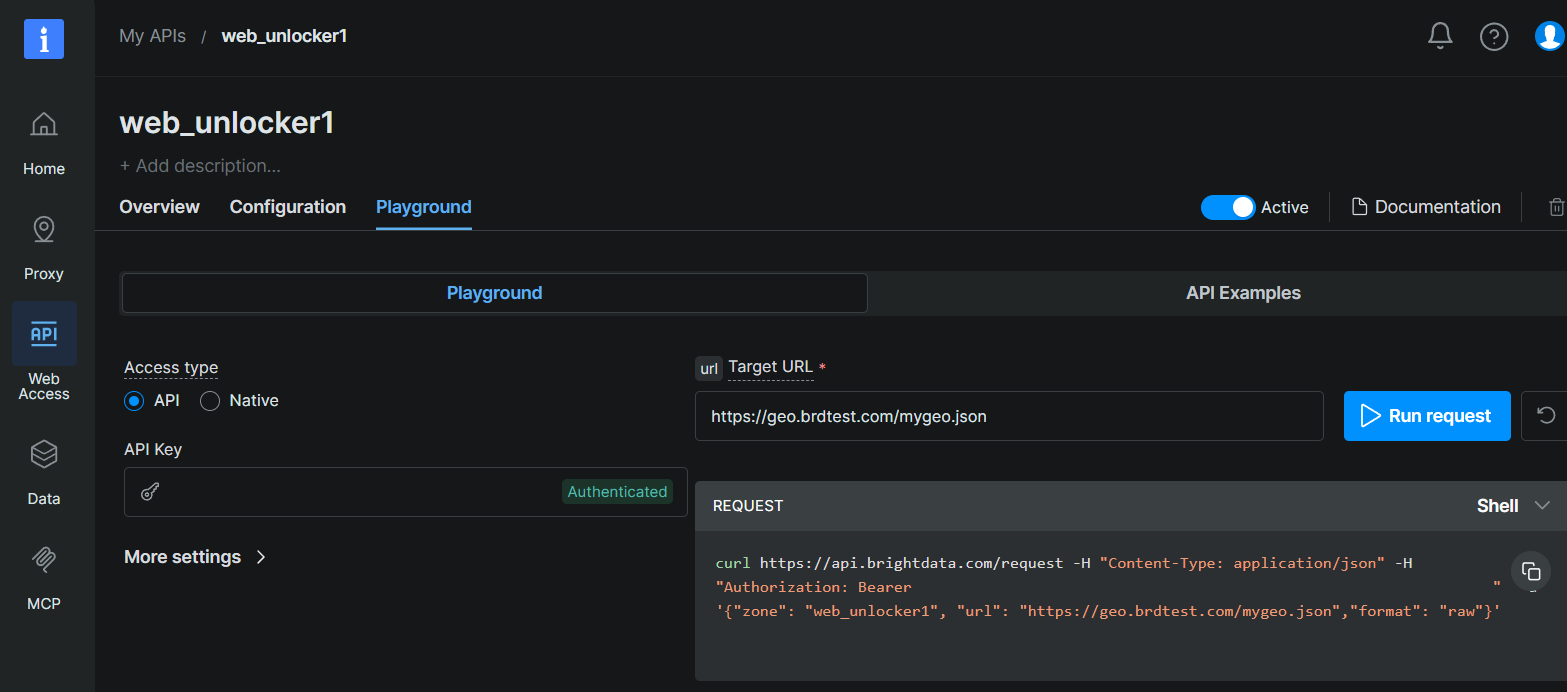
Bright Data is the only vendor that replaces every Apify product line at once: hundreds of vendor-maintained Web Scraper APIs, a Datasets marketplace, Web Unlocker, Scraping Browser, a SERP API, and residential, datacenter, ISP and mobile proxies.
The price is flat: $1.50 per 1K requests, $2.50 on 87 premium domains, billed on success, no commitment. The Bright Data alternatives post covers where that flat price stops making sense.
In the sweep: 94.7% at 14.6 s average, 20/20 domains, 0 genuine failures, 100% on Indeed, GitHub, Zillow and Google, a win over DataDome on G2 and Capterra, and the highest success rate of anyone on the published article's 7 domains at 98.87%.
Pros
- Scrapers maintained by the vendor replace community Actors, so nobody outside Bright Data can reprice or abandon the scraper your pipeline depends on.
- One flat price you can multiply: $1.50 per 1K, or $2.50 on the 87 premium domains, billed on success.
- The widest proxy stack of the five, mobile and ISP included, where Apify advertises neither.
- Enterprise cover Apify's marketplace can't match: SOC 2, court wins against Meta and X, and a datasets marketplace next to the scrapers.
Cons
- 14.6 s average across the 20 domains (12.7 s on the article's 7), 27 s p50 on e-commerce and 17 to 24 s in the AIMultiple runs; the speed complaint survives the move.
- $1.50 for pages other providers fetch at $0.10 to $0.23, and Reddit has threads dedicated to cutting the bill: predictable, but the floor is high.
- Free tier limited to the Unlocker API (5K requests a month, no card) and the SERP API, with no free credits across the wider platform, plus trust dents from the unannounced mobile proxy sunset in April 2026 and the consent questions around the SDK-sourced residential network.
Apify vs Bright Data
Same breadth, different maintenance model, different bill. Apify's Actors are cheaper on easy targets ($0.47 per 1K on Trustpilot) and far more expensive on hard ones ($44 on Reddit); Bright Data is $1.50 or $2.50, full stop.
Pick Bright Data when you need the whole platform at enterprise scale with a forecast your finance team can sign, and 14.6 s a request is a price you can pay. Pick Apify for niche Actors and the MCP server.
4. Decodo
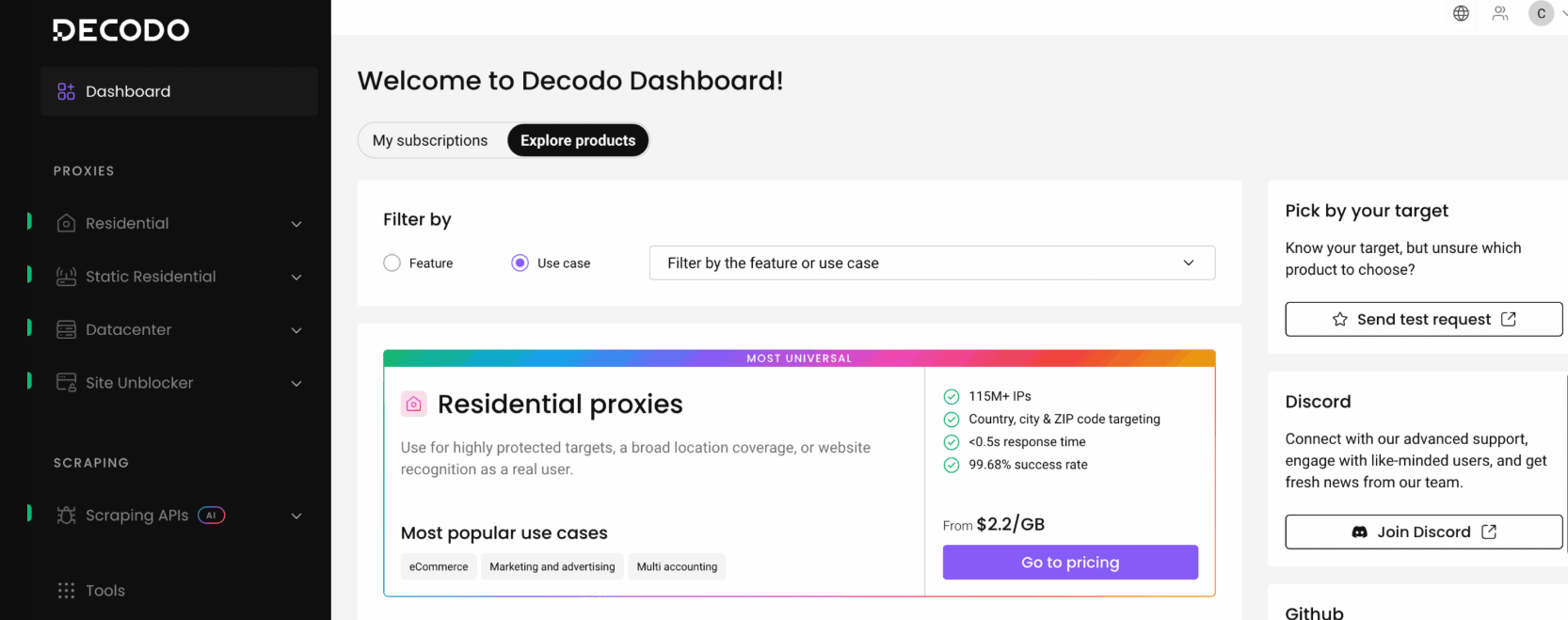
Decodo is Apify's AI story at a fixed price per request: open source MCP server, free AI Parser, markdown output, none of it marked up, where Apify's MCP is free but blind to cost.
Four published tiers, $0.50 / $0.75 / $1.00 / $1.50 per 1K, for standard, standard plus JS, premium, and premium plus JS. $19 buys 38K standard requests, and the 1.5x JS multiplier is the tightest of any provider we track.
In the sweep it finished #2 at 95.9%, with 15 of 20 domains at 100% (Instagram, LinkedIn, Indeed, Walmart, TripAdvisor and Capterra among them) at an 11.9 s average, and SERP came in at 99%, 2.86 s and $0.50 per 1K. The network is a 125M+ residential pool with state-level US geo targeting; Decodo is the former Smartproxy, a Tesonet subsidiary alongside Oxylabs.
Pros
- Lowest entry price of the five at $19, with a free plan of 2K standard requests a month.
- The only alternative here with an MCP server that costs nothing extra, plus a free AI Parser and markdown output.
- Amazon product pages at 100% (500/500, 3.1 s p50), the only provider that matched Scrape.do on /dp/ pages.
- Built-in parsers for Amazon, Google, Walmart, YouTube, Reddit and Bing, so JSON comes back without an Actor and without selectors.
Cons
proxy_pooldefaults to premium, so a bare call bills $1.00 per 1K rather than $0.50, and a mixed workload blends to $0.86 per 1K ($0.68 in the sweep at the cheapest qualifying tier). Set the pool yourself.- Amazon bestseller pages went 0/15 with internal code 613, and G2 dropped to 60% under concurrent load.
- Zillow averaged 38.9 s, the slowest single domain in the fleet, and the glowing posts in small subreddits read like affiliate copy.
Apify vs Decodo
Both hand structured JSON to an agent. Decodo states the price before the run; Apify reports it after.
Pick Decodo for AI pipelines on mainstream targets with a fixed budget, with proxy_pool set by hand. Pick Apify when the target only exists as a community Actor.
For Teams Going Back to Their Own Crawlers
The Reddit thread titled "Apify is slow and expensive" ends with a team rewriting on Scrapy. This is the vendor that path lands on.
5. Zyte
Zyte is the architectural mirror. Apify has Crawlee underneath and Actors on top; Zyte has Scrapy, the most used Python scraping framework, underneath and Scrapy Cloud plus the Zyte API on top. The Zyte alternatives post is the mirror image of this section.
Automatic extraction with no rules (one of two providers Reddit credits with it) means there is no per-site Actor to break. And it's fast: 1.1 s p50 on the Tranco unblocker set, and the fastest Amazon product p50 of any provider in the stress test.
Cost: $1.04 per 1K blended, third cheapest of the five. Pay as you go starts at $0.13 per 1K for an HTTP body on simple sites, and a $500 monthly commitment takes that to $0.06. Proxyway's flagship test across 15 sites put Zyte at 93.14%, and the "your devs or ours" managed data service is the direct replacement for Apify Professional Services.
Pros
- Own the crawler (Scrapy) instead of renting an Actor, with the framework's maintainer running the cloud.
- Automatic extraction with no selectors to maintain, so a site redesign is Zyte's problem rather than an abandoned Actor's.
- Fastest Amazon product p50 in the stress test at 2.1 s.
- Billing on successful responses only, with published per-tier rates and no minimum on pay as you go.
Cons
- 83.0% in the sweep with 18/20 coverage: G2 and LinkedIn (451 policy block) failed outright, and Amazon search hit 76% under the Akamai interstitial.
- No permanent free tier. You get a 30-day trial with $5 of credit, and the discounted rates need a $100 monthly commitment.
- Pricing complexity and automatic tier selection you can't force cheaper: Apify's disease in a milder form, and Zyte's own top complaint on Reddit.
Apify vs Zyte
Same shape, opposite ecosystems: Node and Crawlee on one side, Python and Scrapy on the other.
Pick Zyte if your team writes its own spiders, wants the framework's maintainer running the cloud, and can live with 18/20 coverage. Pick Apify if what you're paying for is the 37k prebuilt Actors rather than the code.
Why Not Firecrawl, ScrapingDog, or the Other Apify Competitors
Google's own autocomplete pairs "apify vs" with firecrawl, outscraper, brightdata, apollo, rapidapi, playwright, tavily, scrapy and serpapi. Two of those made the five above; the rest either repeat Apify's problems or were never benchmarked on the same domains.
| Candidate | Measured on the 20 domains | Why it did not make the five |
|---|---|---|
| Firecrawl | 66.5% success, $16.70 per 1K (highest measured), 0% on Google | The biggest brand rival to Apify's AI angle (18.1k brand searches, and it runs its own firecrawl vs apify pages), but it repeats the complaints: 57.5% markdown accuracy against Scrape.do's 71.7%, and Reddit calls it expensive at scale and says the build you host yourself gets no attention. See Firecrawl alternatives. |
| ScrapingDog | 80.5% success, 542 retries on Amazon, G2 FAIL; fastest article average at 4.0 s | Closest clone of Apify's ready endpoint catalogue (40+ endpoints, $0.09 to $0.90 per 1K), but its headline Reddit complaint is silent downtime, the "Actors break" pain in a different wrapper; in that thread users recommend Apify instead. |
| Oxylabs | 93.4% success, $7.00 per 1K | The same bill as Apify, and ScrapingBee now sits inside Oxylabs. See Oxylabs alternatives. |
| ScrapingBee / ZenRows / ScraperAPI | 85.1% / 81.5% / 75.5% success | Credit multiplier complaints identical to Apify's (ZenRows' 1M requests at $99 fall to 40k once residential is on). See ScrapingBee alternatives, ZenRows alternatives and ScraperAPI alternatives. |
| Olostep | Not benchmarked | The purest pitch against compute units (one request equals one page, failed requests free, $9 entry), and Reddit records it as an Apify alternative, but DR 35 with an astroturf pattern. On the watch list. |
| Octoparse / Browse.ai / ScrapeCreators | Not benchmarked | No-code and social vertical substitutes, the r/n8n crowd's options rather than this reader's; Octoparse carries scam accusations and pricing threads, and ScrapeCreators distributes through Apify. |
If your requirement is "no code at all", the Gumloop and Thunderbit style lists on the SERP serve you better; this article assumes a developer with a URL list.
What to Pick?
Five tools, three jobs. The table did the ranking; this is the routing.
For a Single Scraping Endpoint
Scrape.do, best overall: 99.4% success, 4.19 s average, $0.23 per 1K, billed on success only. Scrapfly if the pipeline also needs browser sessions and LLM extraction under one key and Google is not in the mix.
For a Full-Stack Platform Replacement
Bright Data for enterprise breadth at a flat $1.50 per 1K ($2.50 on premium domains), with the 14.6 s average as the known price of that breadth. Decodo for AI pipelines on a $19 budget with a free MCP server, as long as you set proxy_pool by hand.
For Teams Going Back to Their Own Crawlers
Zyte, caveat included. 83.0% on the 20 domains with G2 and LinkedIn out, but the fastest Amazon product p50 at 2.1 s and Scrapy's maintainer running the cloud.
The Bottom Line
Apify's strengths are real: 20/20 coverage with zero genuine failures, the most mature hosted MCP server in scraping, and Crawlee at 25k+ stars with a runtime that needs no DevOps.
But three numbers hold on the same 20 domains: 4.7x slower than the fastest alternative, about 30x more expensive than the cheapest, and billed on failed runs where four of the five are not. For most developers leaving Apify, that points at Scrape.do.
$29 buys 250,000 successful requests instead of $29 of compute.
FAQ
Is there a free Apify alternative?
Apify Free is $5 of platform usage a month with no card, and access stops when the $5 runs out. Among the five: Scrape.do gives 1,000 credits with no card and every feature enabled, Scrapfly 1,000 credits that never expire, Decodo 2K standard requests a month, and Bright Data 5K requests a month on the Unlocker API only. Zyte has a 30-day trial with $5 of credit rather than a permanent tier.
What is the cheapest alternative to Apify?
On the same 20 domains, at the cheapest qualifying tier per domain, the blended cost per 1K ranks like this:
| Provider | Blended cost per 1K |
|---|---|
| Scrape.do | $0.23 |
| Decodo | $0.68 |
| Zyte | $1.04 |
| Bright Data | $1.55 |
| Scrapfly | $2.69 |
| Apify | $7.04 |
Scrape.do and Decodo both auto-upgrade the tier on protected domains, which is why the mixed workload figures are $0.87 and $0.86 per 1K in the review runs; both still sit far under Apify.
Does Apify charge for failed requests?
Yes, on most Actors. Apify bills compute units by memory times runtime, so a blocked run costs the same container time as a successful one. Scrape.do (2xx/400/404/410 only), Scrapfly (failed requests free), Bright Data and Zyte bill on success; Decodo bills per request by tier.
Apify vs Scrapy: what is the difference?
Scrapy is an open source Python framework your team hosts and runs. Apify is a hosted platform whose own open source framework is Crawlee, written for Node. Scrapy spiders deploy on Apify too, and Zyte's Scrapy Cloud is the Scrapy-native equivalent of Apify's runtime, run by Scrapy's maintainer. The Scrapy tutorial is the place to start on that route.
On the same 20 domains and the same URLs, Apify came in at 95.3%, 19.5 s and $7.04 per 1K, and the top alternative at 99.4%, 4.19 s and $0.23. Same $29 entry price on both sides: 250,000 successful requests on one, $29 of compute on the other.
Head of Marketing