Categories:Scraping Tools,ProxyView as Markdown
2026's Top 5 Oxylabs Alternatives for Proxies and/or Web Scraping

Lead Software Engineer


Are Oxylabs' prices outside your budget?
Or is their scraping tools falling short on performance?
No worries! Here are 5 alternatives split between proxy providers and scraping APIs that match or beat Oxylabs in at least one way.
What Oxylabs Does Well
Before we cover alternatives, here's what makes Oxylabs a top proxy and web scraping solution:
Fastest Proxy Network with High Success Rates
Oxylabs achieved 99.82% success rates with 0.41-second average response times in testing, the fastest proxy response measured across all providers.
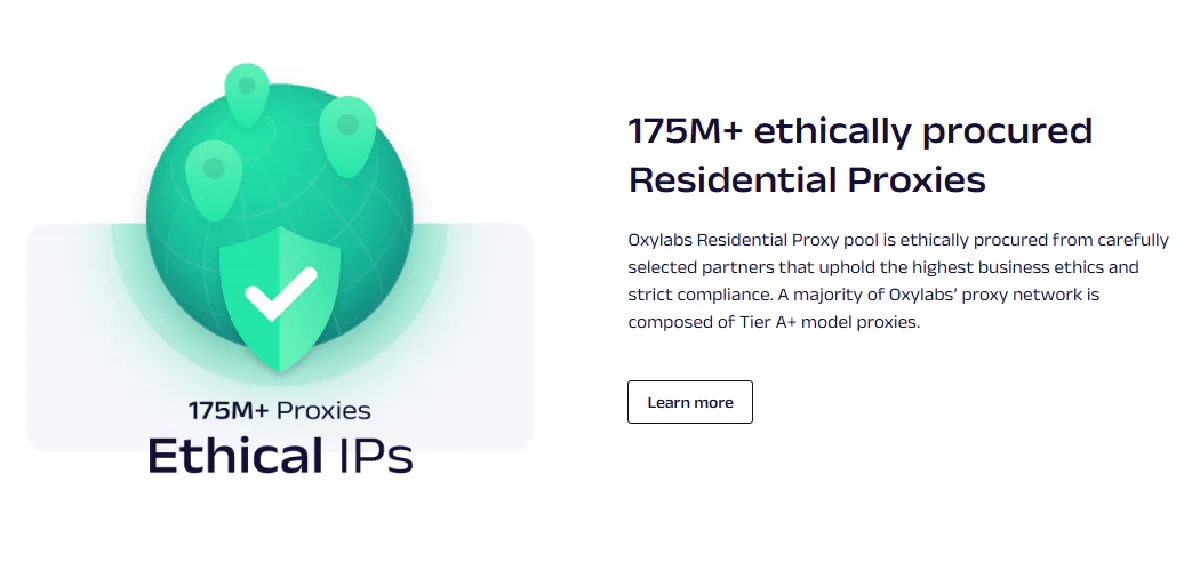
The platform operates 175M+ proxies across 195 countries, spanning residential, datacenter, ISP, and mobile networks. This gives you one of the largest pools in the industry with deep geographic targeting down to city and ASN levels.
AI Studio for Automated Data Extraction
Oxylabs' AI Studio provides AI-powered tools to crawl and scrape websites automatically, accessing targets that other AI agents struggle with and building large datasets without manual selector maintenance.
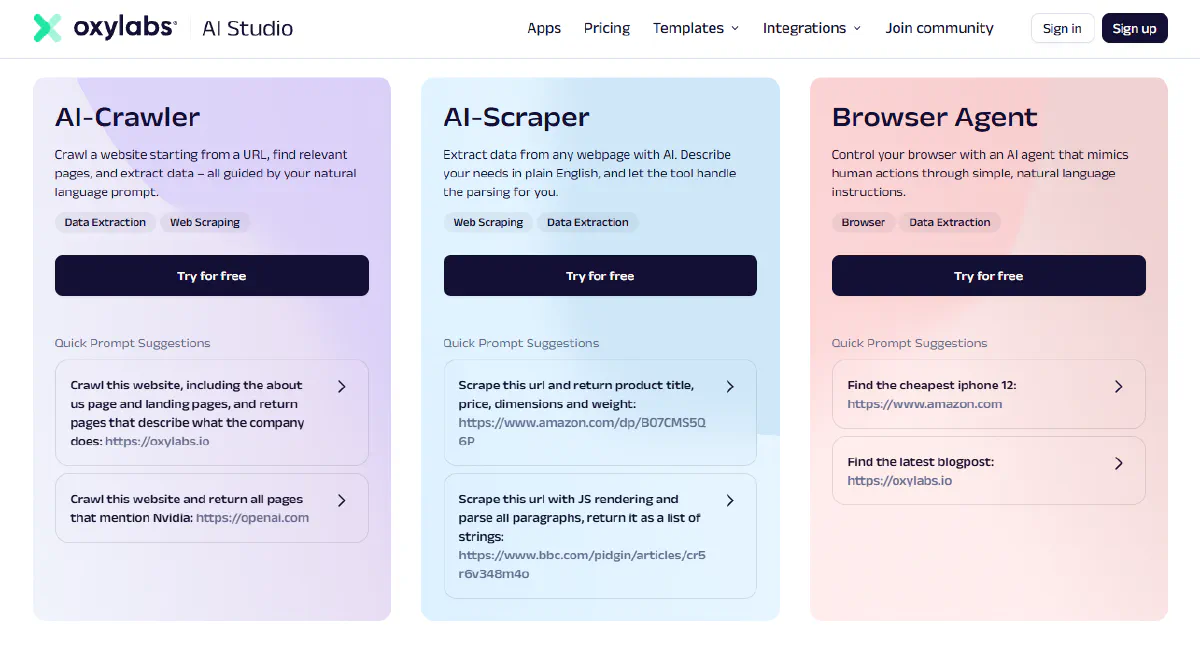
The system handles site structure changes and establishes scraping workflows that don't break when target pages update their HTML. This reduces the ongoing maintenance burden for teams running continuous data collection operations.
Enterprise-Grade Reliability and Support
The proxy network uses ethically sourced proxies with transparent policies, meeting compliance requirements for enterprise customers operating in regulated industries.
Support is consistently praised across review platforms, with dedicated account managers for larger plans and responsive technical assistance when issues arise. For teams where downtime costs real money, the support quality justifies premium pricing.
Downsides of Oxylabs
Despite the technical strengths, Oxylabs' pricing model and API performance create friction for many users.
Pricing Targets Enterprise Customers Only
Oxylabs web scraper requires $75 upfront for 8GB to start testing, the highest entry point among major proxy providers. This creates a barrier before you know if the API works for your specific use case.
Residential proxies has no entry cost, $8 per GB with pay-per-GB billing that varies wildly based on page sizes, which is higher than most proxy providers out there.
Custom plans require contacting sales rather than simple pay-as-you-go options, adding friction before you can even start. For small to mid-sized projects needing a few hundred thousand requests monthly, the $75 minimum and enterprise-focused pricing structure feels overkill.
Web Scraping API Underperforms Dedicated Alternatives
If you're evaluating Oxylabs for the Web Scraper API rather than raw proxies, the performance gap becomes obvious immediately.
The API delivered 92.52% success with 17.5-second average response times in testing. Compare that to Bright Data's 98.44% success at 10.6 seconds or Scrape.do's 98.19% at 4.7 seconds, and the reliability gap plus significantly slower speeds make Oxylabs uncompetitive for API use cases.
Pricing compounds the problem: $6.39 per 1,000 requests average compared to Scrape.do's $0.80 means you're paying dramatically more for objectively worse performance.
Oxylabs built its reputation on proxy infrastructure, and the API offering reflects that: proxies are the core strength, scraping APIs are an afterthought.
Datacenter and Residential Proxy Alternatives for Oxylabs
These proxy providers deliver comparable or better performance than Oxylabs' proxy network, with more accessible pricing that removes the $75 barrier and offers transparent per-GB costs for budget planning.
| Provider | Datacenter Price (per IP) | Residential Price (per GB) | Proxy Pool Size | Avg. Success Rate | Avg. Response Time |
|---|---|---|---|---|---|
| Oxylabs | $1.2/IP | $8/GB | 175M+ Proxies | ~99.82% | ~0.41s |
| Bright Data | $1.40/IP | $8/GB | 1.3M DC / 150M+ Res | ~98.96% | ~1.12s |
| SOAX | $0.62/GB (IP price N/A) | $3.6/GB | 191M+ Proxies | ~99.73% | ~0.90s |
| Decodo | $0.035/IP | ~$3/GB | 100K+ DC / 115M+ Res | ~99.86% | ~0.63s |
| IPRoyal | $1.57/IP (unlimited) | $7/GB | 32M+ Residential | ~98.22% | ~1.36s |
Pricing data is based on the cheapest starting plans, bigger packages will have more affordable per IP/GB numbers. Success and speed rates provided by proxyway.com
1. SOAX
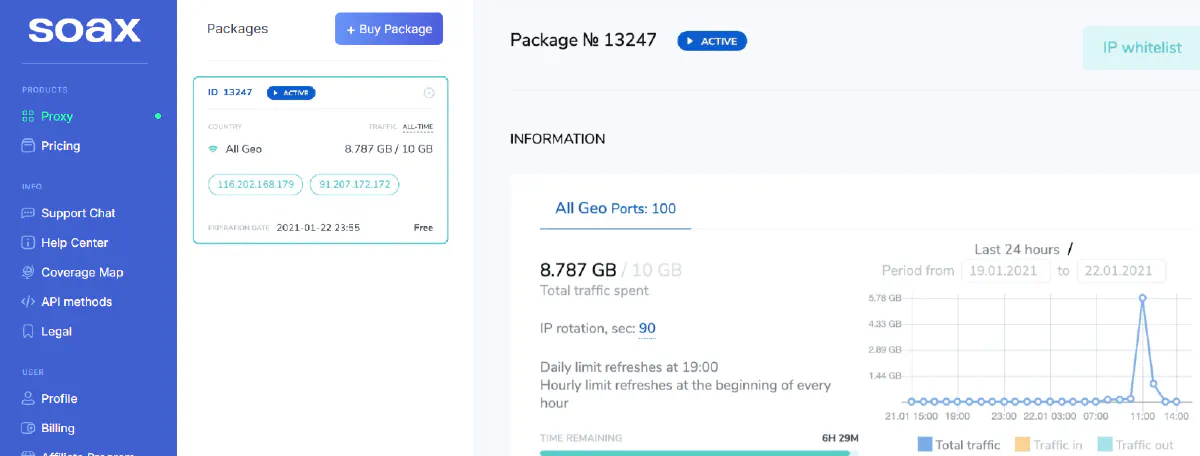
SOAX operates 191M+ proxies across 195+ locations with unified pricing across both datacenter and residential proxy types.
The network achieved 99.73% success rates with 0.90-second average response times in testing, delivering the largest proxy pool among all alternatives tested, beating even Oxylabs' 175M pool by 16 million IPs.
Pricing is $3.60 per GB for both datacenter and residential proxies, eliminating the complexity of separate pricing tiers.
Pros
- Largest proxy pool available: 191M+ IPs beats Oxylabs' 175M, providing extreme geographic diversity and reducing duplicate IP risks even at massive scraping volumes.
- Unified pricing simplicity: Single $3.60/GB rate for both datacenter and residential proxies removes pricing complexity entirely. You don't need to calculate different costs based on proxy type selection.
- Significantly cheaper than Oxylabs: $3.60 vs $8/GB residential makes it much more accessible while delivering nearly identical success rates (99.73% vs 99.82%).
- Precise geo-targeting down to city/ISP level: Target specific cities or ISPs for localized scraping, SEO monitoring, and region-specific data collection that requires granular location control.
Cons
- $99/month entry point: Higher than some alternatives, though still lower than Oxylabs' $75 for 8GB. The 25GB plan ($99) provides more volume but requires monthly commitment.
- No pay-as-you-go option: Requires monthly plan commitment, reducing flexibility compared to Oxylabs' pay-as-you-go model for testing different target domains.
- Mobile proxies drop occasionally: Users report intermittent disconnections during long sessions when using mobile proxies, though this affects a minority of use cases.
Oxylabs vs SOAX
SOAX's 191M proxy pool beats Oxylabs' 175M while costing significantly less ($3.60 vs $8/GB), but Oxylabs delivers faster response times (0.41s vs 0.90s) and slightly higher success rates (99.82% vs 99.73%).
Oxylabs wins on: Speed, success rates, and pay-as-you-go flexibility for testing.
SOAX wins on: Largest pool available, unified pricing simplicity, and much lower cost. For projects where scale matters more than absolute fastest response times, SOAX provides better value with the industry's largest proxy network.
2. Decodo
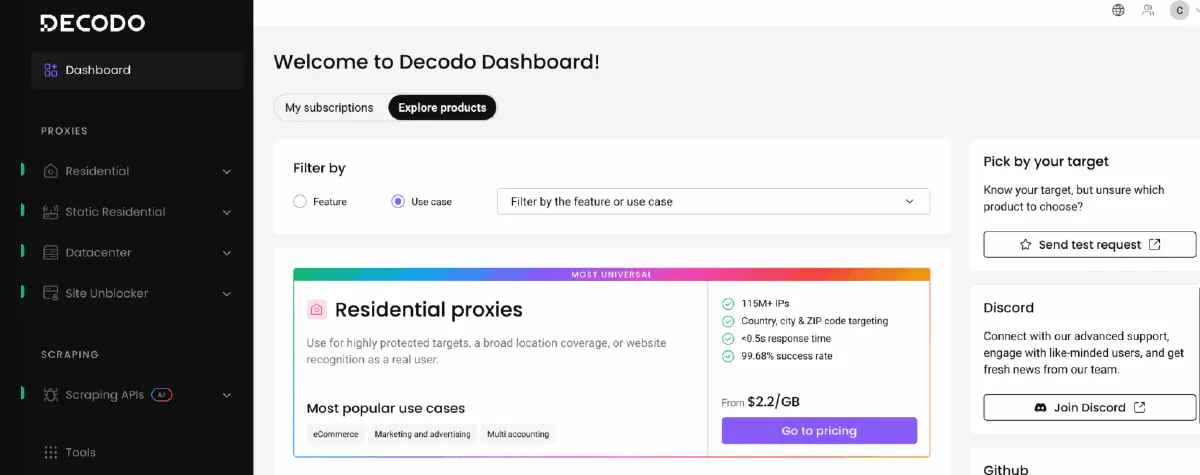
Decodo (formerly Smartproxy) provides 100K+ datacenter and 115M+ residential IPs across global locations with flexible rotation options.
The service achieved 99.86% success rates with 0.63-second response times in testing, delivering the highest success rate among all providers measured: including Oxylabs.
Pricing starts at $3 per GB for residential proxies, significantly cheaper than Oxylabs while outperforming on reliability.
Pros
- Highest success rate tested: 99.86% beats Oxylabs' 99.82%, making it the most reliable proxy provider measured across all alternatives for consistent connection success.
- Significantly cheaper than Oxylabs: $3 vs $8/GB for residential proxies while delivering objectively higher success rates creates exceptional value for mid-sized operations.
- Extremely intuitive dashboard: Setup takes minutes with clear controls. Non-technical users can configure proxies without extensive documentation or support tickets.
- Large residential pool: 115M+ residential IPs provides strong geographic diversity, though smaller than SOAX's 191M and Oxylabs' 175M.
Cons
- Smaller pool than top-tier providers: 115M residential vs Oxylabs' 175M and SOAX's 191M. Geographic coverage is broad but IP density per region is lower.
- Slower than Oxylabs: 0.63s vs 0.41s response times. The 0.22-second difference compounds at scale but remains competitive compared to most alternatives.
- APIs not included by default: Scraping API features cost extra beyond base proxy plans, adding complexity if you need both proxy access and API functionality.
Oxylabs vs Decodo
Decodo delivers the highest success rate measured (99.86%), beating Oxylabs' 99.82%, while costing significantly less ($3 vs $8/GB). Oxylabs counters with faster response times (0.41s vs 0.63s) and a larger proxy pool (175M vs 115M).
Decodo wins on: Success rates (best tested), cost savings, and ease of use for teams prioritizing reliability over absolute speed.
Oxylabs wins on: Speed, pool size, and enterprise features. For projects where every fraction of a second matters or you need extreme IP diversity, Oxylabs justifies the premium. For most use cases, Decodo's higher success rate at much lower cost makes it the better choice.
3. IPRoyal
IPRoyal offers 32M+ residential IPs with datacenter proxies sold per IP starting at $1.57/IP monthly and residential proxies from $7/GB.
The platform achieved 98.22% success rates with 1.36-second response times in testing. IPRoyal's standout feature is unlimited bandwidth on datacenter proxies, eliminating per-GB fees that create unpredictability with Oxylabs and other providers.
Pros
- Slightly cheaper than Oxylabs: $7/GB residential vs Oxylabs' $8/GB provides modest savings, but the unlimited datacenter bandwidth at $1.57/IP creates significant value for high-volume scraping.
- Unlimited bandwidth on datacenter proxies: Flat per-IP pricing with no bandwidth limits removes cost unpredictability entirely. Run high-volume operations without worrying about GB overages.
- Solid e-commerce performance: Consistent success on Shopify, Footsites, and moderate anti-bot protection. The proxies handle most commercial targets without constant failures.
Cons
- Smallest proxy pool: 32M residential IPs vs Oxylabs' 175M and SOAX's 191M. Geographic diversity is limited in less common regions, impacting projects requiring extreme location variety.
- Lower success rates: 98.22% vs Oxylabs' 99.82%. The gap becomes noticeable on heavily protected sites where every failed request costs retry time and credits.
- Slower response times: 1.36s vs Oxylabs' 0.41s. The speed difference significantly impacts throughput when scraping thousands of pages.
Oxylabs vs IPRoyal
Oxylabs dominates on infrastructure: 175M vs 32M IPs (much larger pool), 0.41s vs 1.36s response (significantly faster), and 99.82% vs 98.22% success (notably higher). IPRoyal counters with slightly cheaper residential pricing and unlimited datacenter bandwidth that eliminates overage concerns.
IPRoyal wins on: Budget-friendly pricing with unlimited datacenter bandwidth for high-volume scraping where response time isn't critical.
Oxylabs wins decisively on: Pool size, speed, and success rates. For projects requiring reliability at scale, Oxylabs justifies the modest premium. IPRoyal works for cost-conscious operations where you can tolerate slower speeds and occasional failures.
Web Scraping API Alternatives for Oxylabs
Oxylabs' Web Scraper API has improved meaningfully in our latest benchmark, but it still trails dedicated scraping APIs on both speed and cost. These alternatives are purpose-built for web scraping rather than raw proxy access, and the numbers reflect that focus.
| API Name | Avg. Success Rate | Avg. Response Time | Starting Price | Avg. Price per 1K Requests |
|---|---|---|---|---|
| Oxylabs | 95.40% | 11.3s | $75 | $7.00 |
| Scrape.do | 98.61% | 5.5s | Freemium | $0.60 |
| Bright Data | 98.87% | 12.7s | Pay-as-you-go | $1.50 |
| Apify | 97.14% | 14.2s | Freemium | $5.48 |
The table above compares Oxylabs' Web Scraper API with three tested alternatives based on independent benchmark data from the best web scraping APIs run across Amazon, Indeed, GitHub, Zillow, Capterra, Google, and X (Twitter). All APIs were tested under identical conditions with validation of actual page content, not just status codes.
Updated May 2026: refreshed the table with our latest benchmark numbers and added Apify, which slots in as the natural "platform" alternative to Oxylabs' big-infra play.
4. Scrape.do
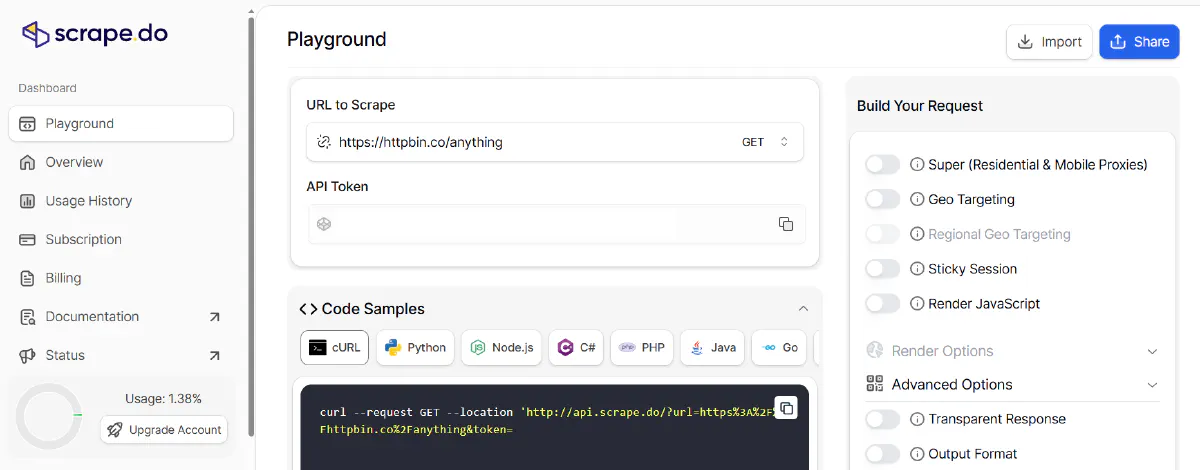
Scrape.do delivered near-perfect success rates and the fastest average response times in our latest tests — roughly twice as fast as Oxylabs' API and an order of magnitude cheaper per request.
The platform operates 150M+ IPs across datacenter, residential, and mobile networks with transparent credit multipliers (5x for rendering, 10x for premium proxies, 25x for both). The freemium plan includes 1,000 requests monthly with no phone verification required, and the $29 starter package provides 250K requests with clear, consistent pricing across all domains.
Pros
- Roughly twice as fast as Oxylabs' API: When you're scraping thousands of pages, the speed gap translates directly into higher throughput and faster data delivery.
- Higher success rate: A few percentage points ahead of Oxylabs across the seven-domain benchmark, which means fewer retries and less wasted budget.
- Dramatically cheaper per request: More than ten times less per 1K on average, which turns a million-request project from a thousands-of-dollars line item into something closer to a dinner tab.
- Transparent opt-in pricing: Parameters are disabled by default. You enable rendering or premium proxies explicitly, and credit multipliers apply consistently. No surprise charges on simple pages like Oxylabs' flat API rates.
- No verification freemium access: Test with 1,000 free requests without phone verification, unlike many competitors requiring contact details before trial access.
Cons
- No official SDKs: Community SDKs exist for popular languages, but there are no officially maintained libraries. Teams requiring enterprise SDK support need custom wrappers.
- Limited ready-to-use scrapers: Provides domain-specific examples and working code for popular sites but not the breadth of pre-built no-code solutions that enterprise platforms like Bright Data offer.
Oxylabs vs Scrape.do
Scrape.do dominates on API performance across every metric: roughly twice as fast, a few points higher on success rate, and more than ten times cheaper per 1K on average. The performance gap makes this comparison straightforward.
Oxylabs' strength is proxy infrastructure—175M IPs with 0.41s response and 99.82% success on raw proxy access. If you need proxies, Oxylabs excels.
For web scraping API use cases, Scrape.do is the clear winner. The speed, reliability, and cost advantages are substantial enough that there's no scenario where Oxylabs' API makes sense over Scrape.do unless you're already locked into Oxylabs for proxy infrastructure and want single-vendor management.
Check in-depth comparison of Scrape.do vs Oxylabs or start free with Scrape.do and see the difference for yourself.
5. Bright Data
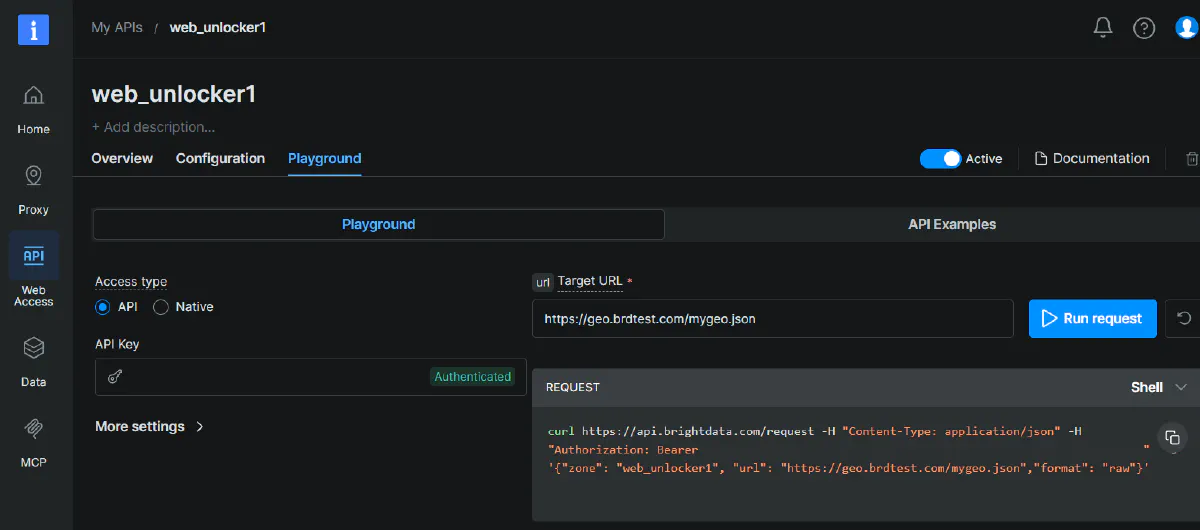
Bright Data's Web Scraper API delivered the highest success rate in our latest benchmark, leading the field by a small margin.
The platform operates over 150 million IPs and offers 120+ ready-made no-code scrapers for popular websites including Amazon, LinkedIn, Walmart, and social media platforms. Pricing is $1.50 per 1,000 requests for standard domains and $2.50 for premium targets, with automatic parameter selection through Web Unlocker that handles proxy rotation, browser fingerprints, and CAPTCHA solving behind the scenes.
Pros
- Highest API success rate tested: Bright Data led the seven-domain benchmark on reliability, with perfect runs on several of the harder-protected targets.
- Faster than Oxylabs' API: A few seconds quicker per call on average, which adds up at scale.
- Cheaper per request: Bright Data's flat $1.50 per 1K is well under Oxylabs' average, even though it's still positioned as the premium provider in the space.
- 120+ no-code scrapers: Pre-built data collectors for Amazon, LinkedIn, Walmart eliminate custom parsing work entirely. Non-technical users can schedule tasks through the web interface.
- Automatic parameter selection: Web Unlocker determines whether residential proxies, JavaScript rendering, or specific retry logic is needed for each request. You send the URL and receive results without parameter experimentation.
Cons
- Fixed pricing regardless of complexity: $1.50 per 1K charges the same for static HTML and JavaScript-heavy pages, penalizing simple scraping where lighter parameters would suffice.
- Slower than Scrape.do: Still meaningfully faster than Oxylabs, but you'll feel the gap against Scrape.do when running high volumes.
- Pay-per-GB proxy model creates unpredictability: Like Oxylabs, the residential proxy product charges $8/GB with bandwidth-based billing that varies based on page sizes, making budget forecasting difficult.
Oxylabs vs Bright Data
Bright Data's Web Scraper API leads Oxylabs across every metric in our benchmark: notably higher success, faster average response, and dramatically cheaper per 1K. The 120+ no-code scrapers and automatic Web Unlocker parameter selection are features Oxylabs' API lacks entirely.
On proxy infrastructure, Oxylabs holds advantages: 175M vs 150M IPs (larger pool), 0.41s vs 1.12s response (faster), and 99.82% vs 98.96% success (higher reliability). Both deliver strong proxy networks suitable for enterprise operations.
The difference: Bright Data built competitive web scraping APIs alongside its proxy business. Oxylabs built world-class proxy infrastructure and added APIs as an afterthought. If you need proxies, either works. If you need a web scraping API, Bright Data wins decisively on performance, features, and cost.
6. Apify
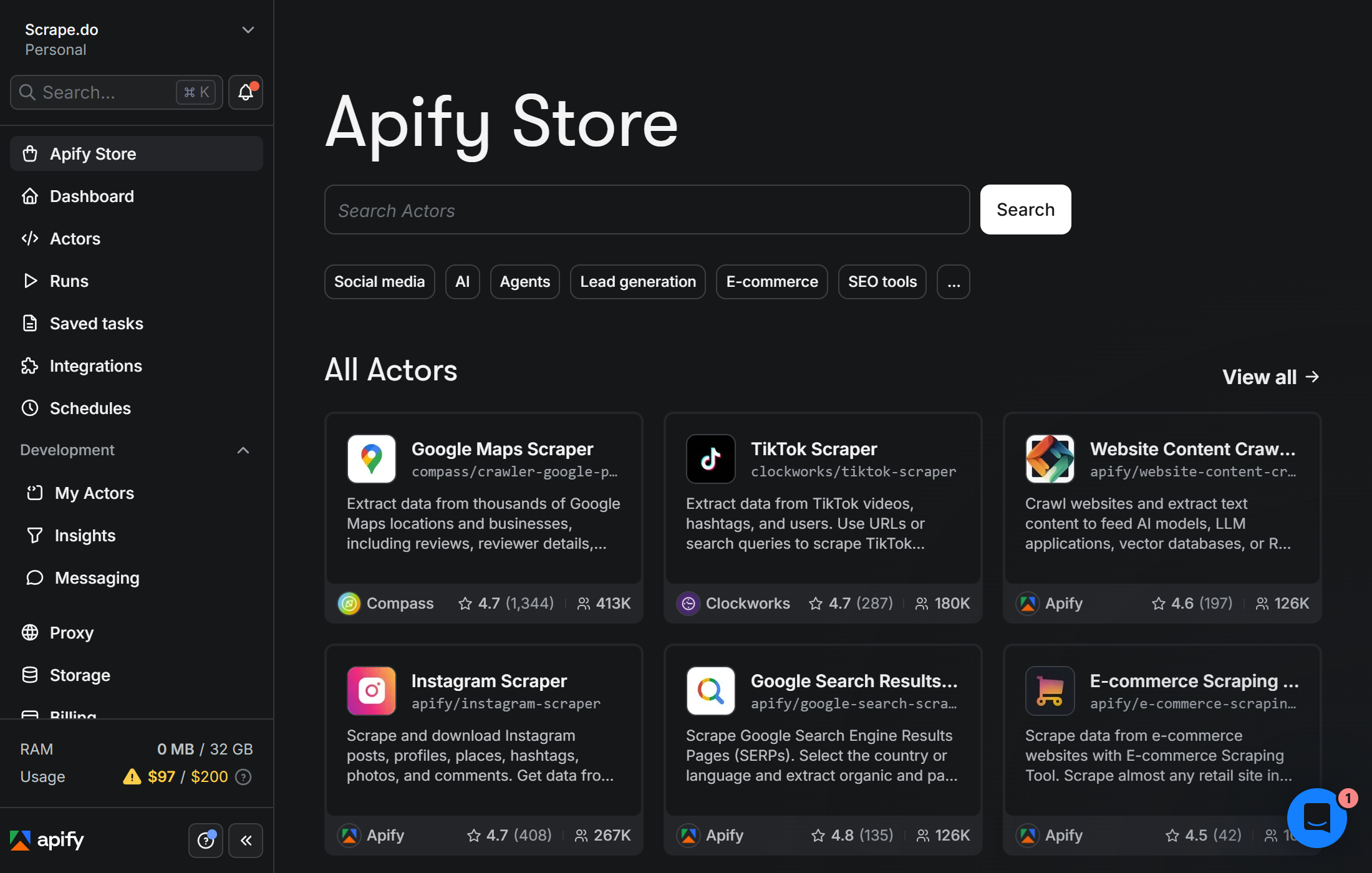
Apify approaches scraping from a completely different angle than Oxylabs: instead of selling proxy infrastructure with an API on top, it sells a managed platform plus a marketplace of 30,000+ pre-built scrapers (Actors). For teams that don't want to assemble their own pipeline from raw proxies, that shape of product can save weeks of integration work.
In our latest benchmark, Apify came back with strong overall reliability and modest per-1K costs on its native pay-per-result actors. It's slower per call than dedicated scraping APIs because actors are full programs spinning up on managed compute, not single anti-bot endpoints.
Pros
- Marketplace of 30,000+ pre-built Actors: For most common targets, someone has already solved the anti-bot, parsing, and pagination problem. You configure inputs and run.
- Free tier you can actually test with: $5 in platform credit every month, free plan never expires, no card required. Lets you verify a target before committing.
- Pay-per-result on popular targets: Many actors charge a flat rate per 1,000 results with proxies, retries, and rendering all included, which is far more predictable than Oxylabs' per-GB billing.
- Native AI tooling: Built-in MCP server and direct integrations with LangChain, LlamaIndex, n8n, and Zapier. Useful if your scraping feeds an agent or RAG pipeline.
Cons
- Slower per call than dedicated APIs: Each actor is a managed program with startup overhead, so individual requests take longer than a single-endpoint API like Scrape.do.
- Marketplace quality varies: With tens of thousands of actors, you have to vet community-maintained ones before trusting them in production. Apify-maintained actors are reliable; the long tail is hit or miss.
- Compute-unit pricing on non pay-per-result actors: Some actors bill on memory × runtime plus proxy traffic, which is harder to forecast than a flat per-call rate.
Oxylabs vs Apify
Apify and Oxylabs solve different problems. Oxylabs sells you proxy infrastructure and a Web Scraper API on top. Apify sells you a managed platform plus a catalog of ready-made scrapers for popular sites. Picking between them is less about benchmarks and more about how much pipeline you want to own.
Choose Oxylabs if you need raw proxies as a building block in your own infrastructure, or your workload is heavy enough that GB-based pricing is competitive. Choose Apify if you'd rather skip building scrapers for sites someone else has already solved, or you're feeding LLMs and agents.
What to Pick?
- For largest proxy pool with better pricing: SOAX's 191M IPs beats Oxylabs' 175M at significantly lower cost ($3.60/GB vs $8/GB) with unified pricing across datacenter and residential proxies.
- For highest success rate among alternatives: Decodo delivers 99.86% success—outperforming even Oxylabs' 99.82% at much lower cost ($3/GB vs $8/GB) with an intuitive dashboard that takes minutes to configure.
- For unlimited bandwidth on budget: IPRoyal's flat per-IP pricing with unlimited datacenter bandwidth at $7/GB residential (slightly cheaper than Oxylabs) eliminates overage concerns for high-volume operations.
- For highest web scraping API success rate: Bright Data led our latest benchmark on reliability and is meaningfully faster and cheaper than Oxylabs' API, plus 120+ no-code scrapers with automatic parameter selection.
- For fastest web scraping API: Scrape.do is roughly twice as fast as Oxylabs' API and a fraction of the cost per 1K, making it the superior choice for speed-focused scraping operations.
- For ready-made scrapers and AI workflows: Apify ships 30,000+ pre-built Actors plus a native MCP server, which is the right shape of product when you'd rather configure a tested scraper than build one on top of proxies.
Scrape.do combines near-perfect success rates, the fastest response times tested, and the most affordable per-request cost, all with transparent opt-in pricing and a generous free tier to test before committing.
Lead Software Engineer