YouTube Scraper API
YouTube Search Results
as Structured JSON
YouTube Search Results as Structured JSON
Pull videos, channels, playlists, and Shorts straight from YouTube as clean, ready-to-use JSON. View counts and subscriber numbers come back as actual integers, with no parsing, no headless browsers, and no cookie walls to deal with.
Start scraping today with 1000 free credits. No Credit Card Required
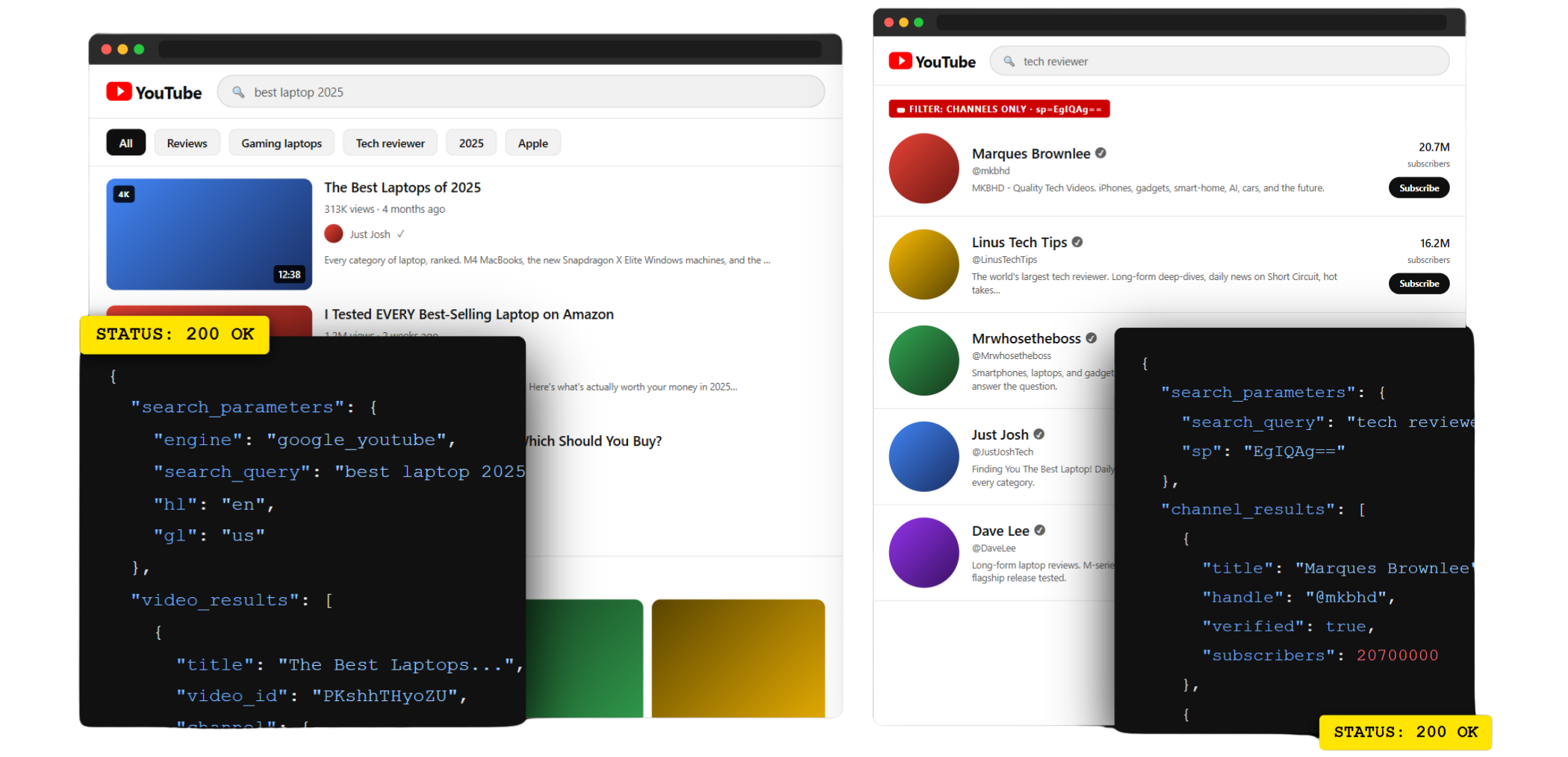

Every Result Type in a Single Call
Search YouTube once and get back videos, channels, playlists, and Shorts, each as its own clean array. Build a channel directory, a playlist library, or a Shorts feed without juggling separate scrapers.
Every video arrives with the fields you'd otherwise extract by hand: views as a real integer, channel handle and verified badge, duration, upload date, thumbnails, and visual tags like 4K, HD, LIVE, and CC.

Precision Filters, Built In
Pull the top-rated 4K nature documentaries from Germany this week, or just channels above a subscriber threshold, or only long-form videos sorted by views. Every filter YouTube exposes is a single parameter away.
Sort by relevance, rating, upload date, or view count. Restrict by duration, upload window, video quality, or live status. Pagination uses the same parameter, so one helper handles filtering and continuation.
How It Works
Select a Target
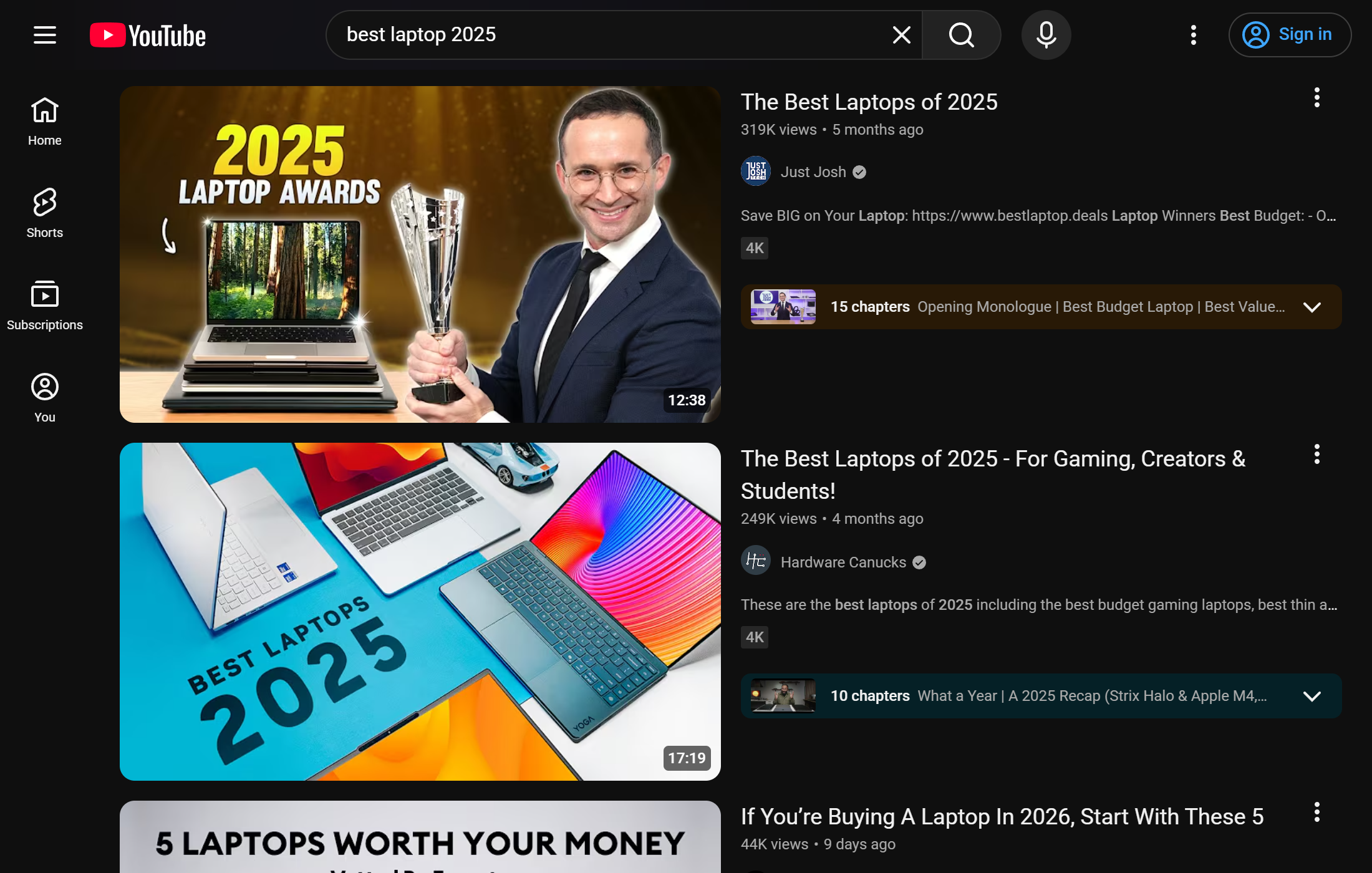
Send API Request
import requests
import json

token = "<SDO-token>"

url = f"https://api.scrape.do/plugin/google/youtube?token={token}&search_query=best+laptop+2025"

response = requests.request("GET", url)

print(json.dumps(response.json(), indent=2))Get Structured JSON
{
  "search_parameters": {
    "engine": "google_youtube",
    "search_query": "best laptop 2025",
    "gl": "us",
    "hl": "en"
  },
  "search_information": {
    "total_results": 16406969
  },
  "video_results": [
    {
      "position_on_page": 2,
      "title": "The Best Laptops of 2025",
      "link": "https://www.youtube.com/watch?v=PKshhTHyoZU",
      "video_id": "PKshhTHyoZU",
      "channel": {
        "name": "Just Josh",
        "link": "https://www.youtube.com/@JustJoshTech",
        "verified": true,
        "thumbnail": "https://yt3.ggpht.com/..."
      },
      "published_date": "4 months ago",
      "views": 313829,
      "length": "12:38",
      "description": "Save BIG on Your Laptop: ...",
      "extensions": ["4K"],
      "thumbnail": {
        "static": "https://i.ytimg.com/vi/PKshhTHyoZU/hqdefault.jpg"
      },
      "live": false
    }
  ],
  "shorts_results": [
    {
      "position_on_page": 5,
      "shorts": [
        {
          "title": "Top 3 Laptops",
          "link": "https://www.youtube.com/shorts/abc123",
          "views": 2100000,
          "video_id": "abc123"
        }
      ]
    }
  ],
  "related_searches": [
    { "query": "best laptop 2025 under 1000" },
    { "query": "best gaming laptop 2025" }
  ],
  "pagination": {
    "next_page_token": "EqwDEhBiZXN0..."
  }
}
How many YouTube Scraper API calls per plan?
Every YouTube Scraper API call costs 10 credits. Here's what each plan buys you.
All plans include automatic anti-bot bypass, residential proxies, and a 99.98% success rate. See full plan details.
Scrape.do has been a game-changer with powerful scraping tools, but what truly sets them apart is their excellent customer support.

CTO


Average Response Time
No tickets connect with expert engineers.

Success rate

Ethically sourced proxies

Faster gateway than the closest competitor.







Reliable, Scalable,Unstoppable Web Scraping
Frequently Asked Questions
The YouTube Data API has a strict daily quota (10,000 units default), and a search call costs 100 units, which works out to 100 searches per project per day. It also doesn't return Shorts shelves, ads, or discovery rails the way the search page does. This plugin scrapes the public results page: no quota, returns the full page layout (videos, channels, playlists, Shorts, related rails), and you pay per successful request.
sp is YouTube's opaque filter token. Short values control sort (rating, upload date, view count), result type (videos-only, channels-only, playlists-only), duration (under 4min, 4–20min, over 20min), features (4K, HD, LIVE, CC), and upload date (hour, today, week, month, year). The same parameter accepts continuation cursors for pagination; the plugin routes filter tokens and pagination tokens automatically based on length.
Yes, when YouTube renders them. Shorts come back as shorts_results[], an array of shelves. Each shelf has a position_on_page (so you know where it sat in the result list) and a shorts[] array of individual Short videos with title, link, thumbnail, views (parsed to integer + original display string), and video id. Shorts shelves are unpredictable; expect 0, 1, or multiple per query depending on the topic and locale.
Every response that has more pages includes pagination.next_page_token. Pass that value back as the sp parameter on a new request to fetch the next page. The same sp parameter handles both filter tokens and pagination cursors: short values filter, long values paginate, and the plugin routes them automatically. Continuation is stable for tens of pages; very deep pagination (>50 pages) may start returning empty video_results as YouTube exhausts the feed.
You can list channels and playlists via sp=EgIQAg== (channels filter) and sp=EgIQAw== (playlists filter). Each response gives handle, subscriber count (parsed integer), avatar, description for channels; lead video, total video count, and cover thumbnail for playlists. Deep channel-page or playlist-contents scraping isn't covered by this plugin today; it's the search results API.
Yes. hl controls the language of published_date ("4 months ago" → "vor 4 Monaten"), length ("12:38" stays numeric, but units like Std. / Std. localize), and view-count suffixes ("1.2M views" → "1,2 Mio. Aufrufe"). gl influences ranking and which shelves render. Match hl to gl for the cleanest locale experience (hl=de&gl=de).
Promoted entries come back in ads_results[] when YouTube renders them, with title, link, advertiser channel info, description, and thumbnail. YouTube runs many ad layouts in parallel, and unknown layouts are skipped rather than returned as partial objects, so ads_results may be empty even when ads were shown in the page HTML.
No. Every request to the plugin is 10 credits flat, regardless of which sp token (or none) is passed. Filtering, sorting, and pagination don't add cost. There's no render fee, because the plugin doesn't run JavaScript.
YouTube reorders search results continuously. Even with identical parameters, consecutive calls can return a 60–95% overlap depending on the query. This is inherent to the surface, not the plugin. Sort modes (sp=CAM== for view count, sp=CAI== for upload date) give more stable orderings than default relevance.
The YouTube API documentation covers the full parameter list, response schema for every result type (videos, channels, playlists, Shorts, ads, discovery rails), the complete sp token table for sort/type/duration/features/upload-date, and pagination patterns.