Category:Scraping ToolsView as Markdown
Top 6 ScraperAPI Alternatives for Web Scraping in 2026

Lead Software Engineer


ScraperAPI has rebuilt its endpoints over the past year — it's faster and cheaper than it used to be. The problem now is reliability: in our latest benchmark, it dropped to one of the worst success rates in the field on protected sites.
Here are 7 alternatives that deliver better reliability, transparent pricing, and comparable or better speed.
| API Name | Avg. Success Rate | Avg. Response Time | Starting Price | Avg. Price per 1K |
|---|---|---|---|---|
| ScraperAPI | 72.57% | 5.6s | $49 | $4.25 |
| Scrape.do | 98.61% | 5.5s | Freemium | $0.60 |
| Bright Data | 98.87% | 12.7s | Pay-as-you-go | $1.50 |
| ZenRows | 96.29% | 6.7s | $69 | $3.32 |
| ScrapingBee | 96.62% | 13.7s | $49 | $1.77 |
| Oxylabs | 95.40% | 11.3s | $75 | $7.00 |
| ScrapingDog | 89.14% | 4.0s | $40 | $0.47 |
| Octoparse AI | N/A (visual RPA) | N/A (visual RPA) | Free | Pay-as-you-go |
The table above compares ScraperAPI with seven alternatives. The first six are based on independent benchmark data from the best web scraping APIs; run across Amazon, Indeed, GitHub, Zillow, Capterra, Google, and X (Twitter). Octoparse AI is included as a different approach — a visual RPA tool rather than a traditional scraping API.
Updated May 2026: refreshed every row with our latest benchmark numbers and added ScrapingDog after it became one of the fastest and cheapest reliable picks in the test set.
What ScraperAPI Does Well
Before we cover alternatives, here's where ScraperAPI still delivers value.
Fast on the Endpoints That Work
ScraperAPI's response times have improved dramatically since our earlier benchmarks. When a request succeeds, it now comes back in single-digit seconds, putting it among the faster providers in the field.
Pre-built Templates
ScraperAPI includes templates for common use cases like SERP and e-commerce scraping that handle pagination, rate limiting, and data extraction patterns automatically.
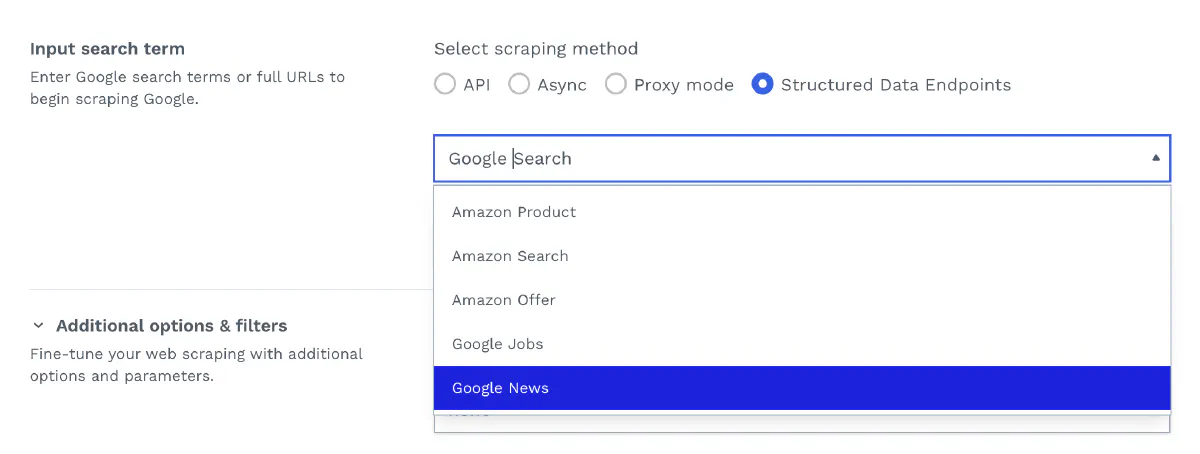
These templates save you from building code from scratch, especially useful if you're new to web scraping.
Downsides of ScraperAPI
ScraperAPI is faster and cheaper than it used to be, but its reliability is the new problem.
Inconsistent Success on Protected Sites
In our most recent benchmark, ScraperAPI dropped to one of the lowest overall success rates in the field. Mainstream e-commerce and developer sites still work, but heavily protected targets — the ones where you most need a scraping API to actually scrape — increasingly fail.
When more than a quarter of your requests come back without usable data, the headline "cheap" rate goes out the window: you're paying for the retries too.
Credit Multipliers on the Tier You'll Actually Need
The base $0.49 per 1K rate is fine for static HTML, but protected domains push you onto premium and ultra-premium proxy tiers that multiply credit cost by 10x to 75x. That's how the per-1K average lands well above the headline rate.
Certain domains can spike to much higher costs, making it expensive precisely on the sites where you need the most help.
1. Scrape.do
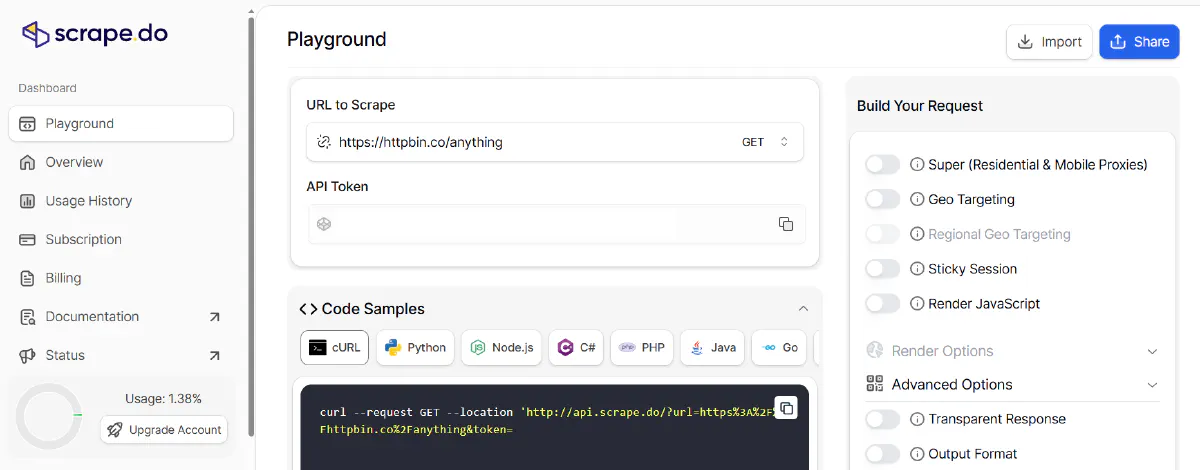
Scrape.do delivers the fastest response times and highest success rates in the industry.
It combines unmatched speed with 98+% success rate and transparent pricing that doesn't surprise you with hidden costs.
The main limitation is that it doesn't offer pre-built templates for specific platforms like ScraperAPI does.
Pros
- Unmatched speed and reliability: near-perfect success rate with the fastest average response time across all providers in independent testing, and a notable success gap over ScraperAPI on protected sites
- Generous freemium plan: 1,000 requests monthly for free with no credit card required
- Transparent pricing: Large plans available at affordable rates without hidden multipliers
Cons
- Missing platform-specific APIs: No pre-built templates for SERP or e-commerce like ScraperAPI offers
ScraperAPI vs Scrape.do
Scrape.do is significantly faster and more reliable with transparent pricing that won't surprise you.
ScraperAPI has pre-built templates that can save development time for common use cases.
Check in-depth comparison of Scrape.do vs ScraperAPI or start free with Scrape.do and see the difference for yourself.
2. Oxylabs
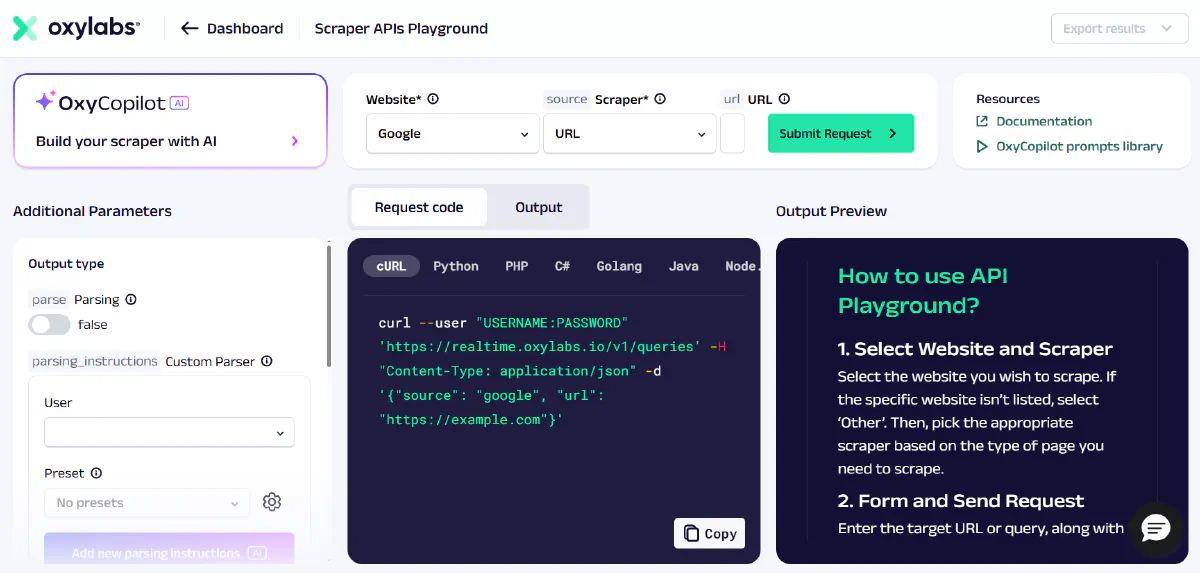
Oxylabs offers enterprise-grade infrastructure with a massive proxy network covering every possible use case.
It delivers solid success rates across various products designed for different scraping needs. The bandwidth-based pricing model still makes it difficult to predict costs, and the $75/month starting price is steep for smaller operations.
Pros
- Solid success rate: 92.52% average success rate across all tested domains
- Comprehensive proxy network: Various products and huge proxy network covering all geographic regions and use cases
Cons
- Bandwidth-based pricing: Charges by bandwidth instead of successful requests, making cost prediction difficult
- High starting price: $75/month for just 8GB, which translates to roughly 20K requests with rendering enabled
ScraperAPI vs Oxylabs
Oxylabs has better pricing for large-scale operations once you understand the bandwidth model.
ScraperAPI has more predictable per-request pricing that's easier to budget for.
Both have similar success rates but completely different pricing approaches.
3. ScrapingBee
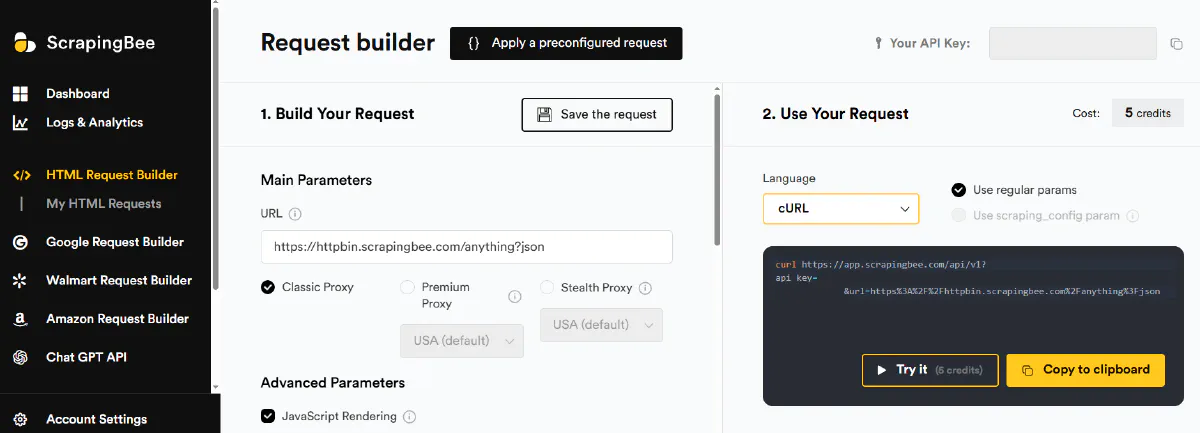
ScrapingBee combines reliable scraping with AI-powered data extraction capabilities.
It posts strong success rates and works on almost every popular website with its AI extraction engine that accepts plain-English instructions. The trade-offs are slower-than-average response times and a stealth-proxy tier that can push the per-1K cost into double-digit territory on specific protected domains.
Pros
- Strong success rate: reliable across almost every popular website in our latest benchmark
- AI-powered extraction: Has an AI extraction engine that accepts plain-English instructions for data parsing
Cons
- Slower performance: response times trail most other alternatives in this list
- Unpredictable pricing spikes: Base price of $0.20 per 1K can jump to $15 for popular domains
ScraperAPI vs ScrapingBee
ScrapingBee has AI extraction capabilities that can save significant development time.
ScraperAPI has pre-built templates for common scraping patterns.
Both have similar success rates but different approaches to pricing spikes and data extraction.
4. ZenRows
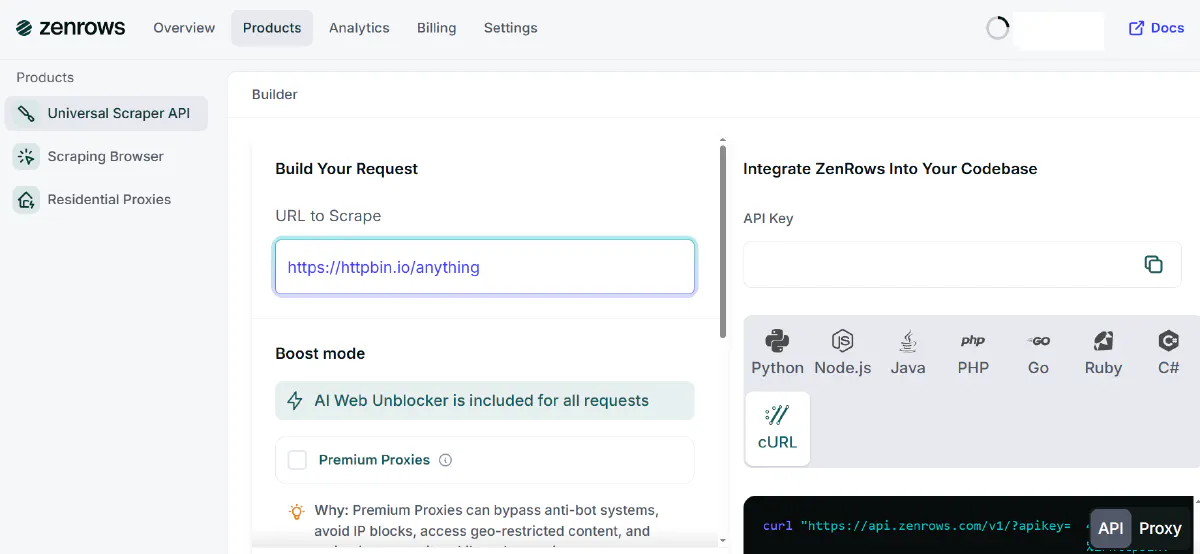
ZenRows offers faster response times than ScraperAPI with more predictable pricing.
It delivers strong success rates with response times in the single-digit-seconds range and no surprise parameter traps. The $69 starting price is higher than ScraperAPI, and ZenRows still forces render and premium parameters on certain domains, which inflates per-call credit costs.
Pros
- Faster than ScraperAPI on protected sites: ZenRows' average response holds up where ScraperAPI's reliability falls off
- No forced parameter traps: Unlike some competitors, it doesn't force expensive parameter combinations
Cons
- Higher starting price: $69/month starting price is more expensive than ScraperAPI's $49
- Forced parameter combinations: Some domains require both render and premium parameters, costing 25 requests per call
ScraperAPI vs ZenRows
ZenRows offers faster response times and better overall value for most use cases.
ScraperAPI has pre-built templates that can accelerate development for common patterns.
Both have similar success rates but different pricing models and speed characteristics.
5. Bright Data
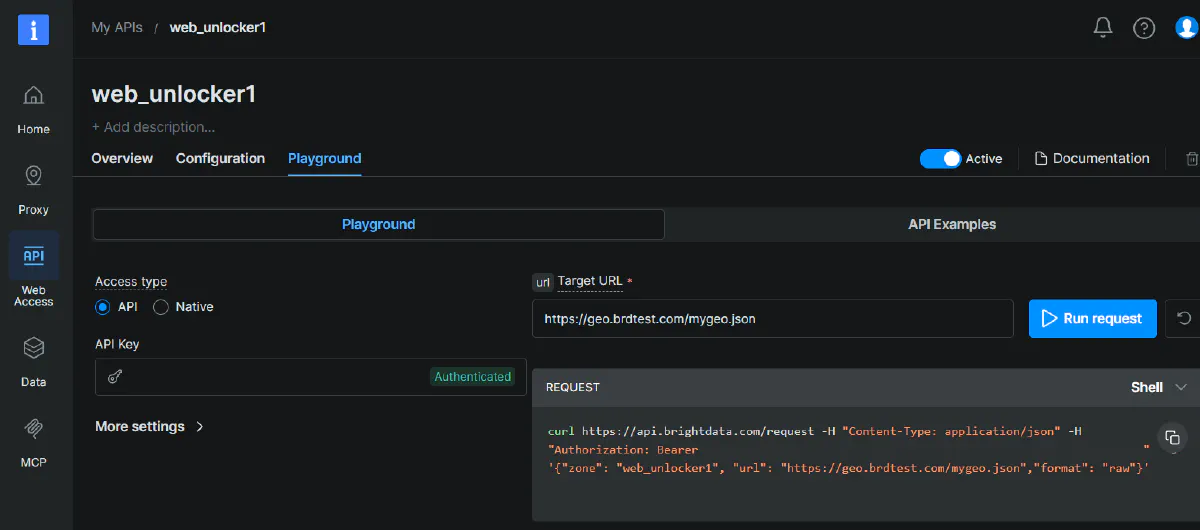
Bright Data delivers the highest success rate in the industry with completely predictable pricing.
It posts the highest success rate in our latest benchmark, with static pricing that removes guesswork on difficult domains. The static pricing model hurts on basic sites where you pay the same flat rate even for simple pages, and there's no free tier available.
Pros
- Industry-leading success rate: the highest among all providers in our latest benchmark
- Predictable static pricing: a flat $1.50 per 1K removes guesswork on difficult domains
Cons
- Expensive for simple sites: Static pricing means you pay the same flat rate even for basic pages where competitors charge cents
- No free tier: Only offers free trials, no ongoing free usage like other providers
ScraperAPI vs Bright Data
Bright Data has significantly higher success rate and more predictable pricing for enterprise use.
ScraperAPI has pre-built templates that can speed up development for common use cases.
Bright Data is better for enterprise operations that need maximum reliability and can afford the static pricing model.
6. ScrapingDog
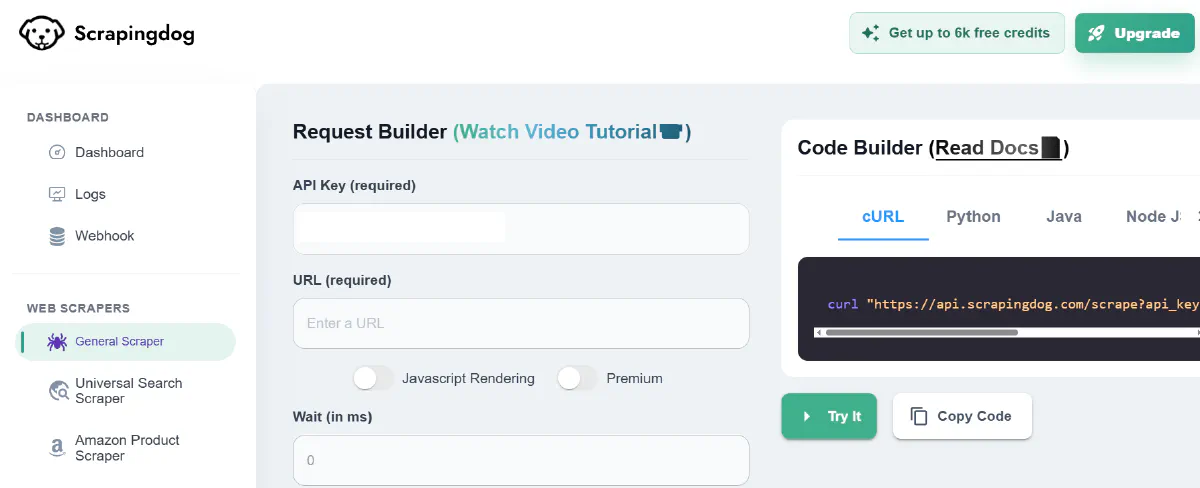
ScrapingDog is a cost-focused scraping API built around dedicated endpoints for popular targets — Amazon, Google, Indeed, Zillow, X, LinkedIn, YouTube, Walmart, eBay, and more. Instead of running everything through one generic endpoint, you call the right endpoint for each target and ScrapingDog handles the proxy and rendering decisions behind it.
In our latest benchmark it came back as one of the fastest providers and the cheapest reliable option in the test set. Reliability still trails the top tier, but for workloads that map onto the dedicated catalog it's a strong value pick.
Pros
- Cheap on the right endpoints: per-1K rates land at a fraction of ScraperAPI's average when your targets fall inside the dedicated catalog
- Fast when it works: sub-five-second average response across the seven-domain benchmark
- Domain-specific structuring: endpoints like
/amazon/productreturn parsed JSON, saving the selector-maintenance step
Cons
- Reliability still below the top tier: harder targets need verification on the free trial before you trust the endpoint in production
- Generic endpoint is weaker: targets outside the dedicated catalog fall back to a general path that performs less consistently
ScraperAPI vs ScrapingDog
ScrapingDog is the budget play if your scraping maps cleanly onto its catalog. It's meaningfully cheaper per 1K than ScraperAPI's average and notably more reliable on the protected sites where ScraperAPI now stumbles. ScraperAPI still wins on having one consistent API surface rather than a list of endpoints to wire up.
7. Octoparse AI
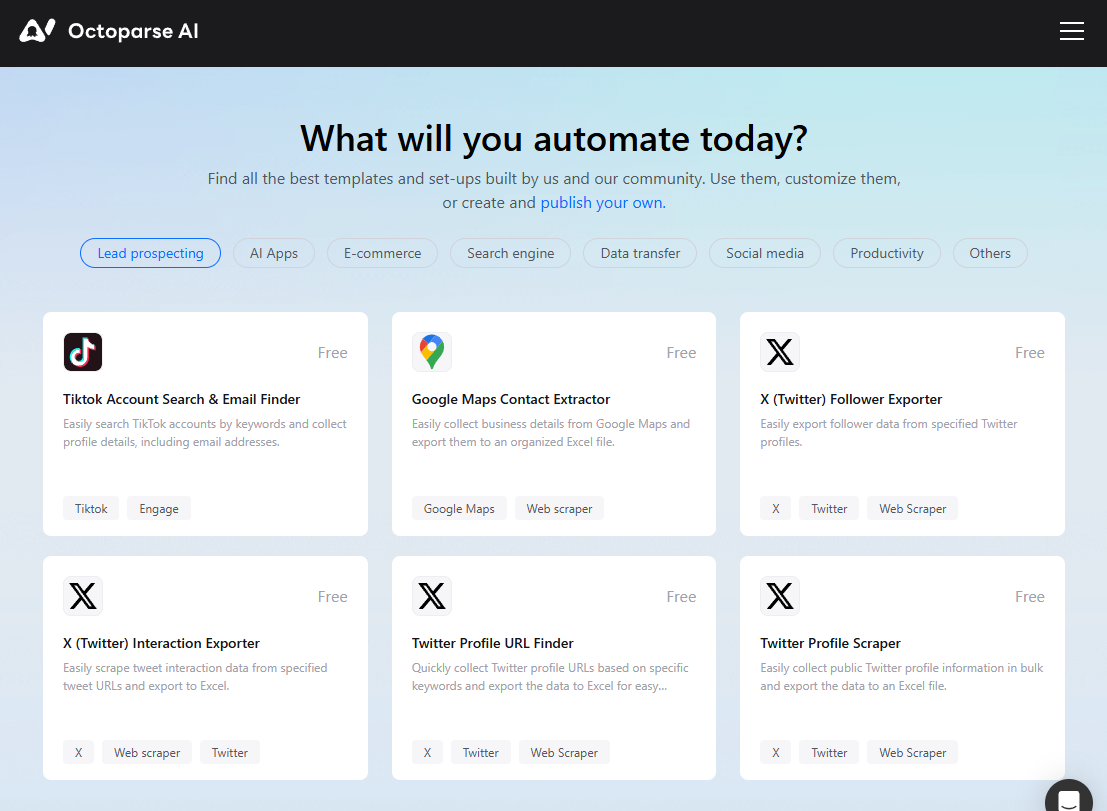
Octoparse AI takes a fundamentally different approach to web scraping compared to ScraperAPI and the other API-based tools on this list.
Instead of sending HTTP requests through a proxy API, Octoparse AI is a desktop-based RPA (Robotic Process Automation) tool that uses visual workflows and AI to automate browser interactions, including web scraping, data extraction, and cross-platform automation.
It's trusted by over 1.2 million users and is built by the team behind Octoparse, one of the most recognized names in the web scraping space.
Pros
- No-code visual builder: Drag-and-drop workflow editor with an AI Copilot that turns plain-English instructions into working automations
- Free forever core features: Unlimited basic workflows at no cost, with $5 in free AI credits for every new user
- Built-in CAPTCHA and anti-bot handling: Native CAPTCHA solving, OCR, and AI-powered text processing embedded directly into workflows
- Pre-built templates: App Store with ready-made templates for Amazon, Google Maps, TikTok, and more popular platforms
- Cross-platform automation: Connects web pages, Windows apps, and data files in a single workflow without needing separate APIs
Cons
- Windows only: Currently available only on Windows, which limits access for Mac and Linux users
- Desktop-based, not API-based: Runs locally rather than in the cloud, so it doesn't offer the same scalability as API-based scraping services for high-volume concurrent requests
- No independent benchmark data: Since it's an RPA tool rather than a proxy API, it doesn't appear in standard API-based scraping benchmarks
ScraperAPI vs Octoparse AI
Octoparse AI is best for users who prefer a visual, no-code approach to scraping and need to automate beyond just data extraction—combining web scraping with desktop apps, Excel processing, and other workflows.
ScraperAPI is better suited for developers who need a simple API endpoint to integrate into their existing codebase for high-volume, programmatic scraping.
If you're a non-technical user or need end-to-end automation that goes beyond raw HTML extraction, Octoparse AI's free plan is worth trying.
What to Pick?
- Scrape.do: Best overall value with unmatched speed, reliability, and transparent pricing
- Bright Data: Highest success rate and predictable pricing for enterprise operations
- ZenRows: Good balance of speed and reliability with reasonable pricing
- ScrapingBee: AI extraction capabilities for complex data parsing needs
- Oxylabs: Comprehensive proxy network for specialized geographic or use case requirements
- ScrapingDog: Cheapest reliable option when your targets fit its dedicated-endpoint catalog
- Octoparse AI: Visual no-code automation for users who need scraping combined with broader workflow automation
For most developers, Scrape.do offers the best combination of speed, success rate, and value, with transparent pricing and a freemium plan that doesn't expire.
Lead Software Engineer