Category:Scraping Tools
Best SERP APIs in 2026: 8 Google Search APIs Compared

Head of Marketing


SERP APIs are a game-changer in the AI-first marketing era.
Sure, my Claude Code can do web searches and ChatGPT can do a deep research and list me all the content.
But at scale, I'm talking 1000s of requests every day, no AI assistant alone can do the job.
A good API on the other hand can scale to a million queries daily, no problem; and that's what we're going after today.
The table below summarizes every provider. Scroll past it and we'll get to the full breakdown of each Google Search API, including code examples, output samples, and the specific trade-offs that matter for your pipeline.
| API Provider | Cost / 1K | Avg Speed | AI Overview | Output Richness | Starting Price | Best For |
|---|---|---|---|---|---|---|
| SerpApi | $25.00 | 1.96s | 68% | 3.8 (sitelinks, dates, PAA answers, discussions, videos) | $25/mo | Richest output across all SERP features |
| Scrape.do | $1.16 | 1.73s | 60% | 3.6 (news, PAA, videos, AI Overview refs, local) | Freemium | Best value (speed + cost + depth) |
| WebScrapingAPI | $2.80 | 5.17s | 40% | 2.8 (videos, PAA, AI Overview refs, shopping) | $28/mo | Video + AI Overview coverage |
| ScrapingDog | $2.00 | 2.52s | 48% | 2.4 (PAA, related, local) | $40/mo | Budget + AI Overview |
| ScrapingBee | $2.94 | 3.70s | 36% | 2.2 (PAA, sitelinks, dates, local) | $49/mo | Deepest organic result details |
| ScraperAPI | $12.25 | 11.20s | 0% | 1.8 (PAA, related only) | $49/mo | Reliable but basic |
| ZenRows | $2.80 | 8.84s | 0% | 0.2 (organics + ads only) | $69.99/mo | If you only need organics |
| Zyte | $0.43 | 5.29s | 0% | 0.0 (organics only, zero extras) | Pay-as-you-go | Cheapest raw extraction |
1. SerpApi
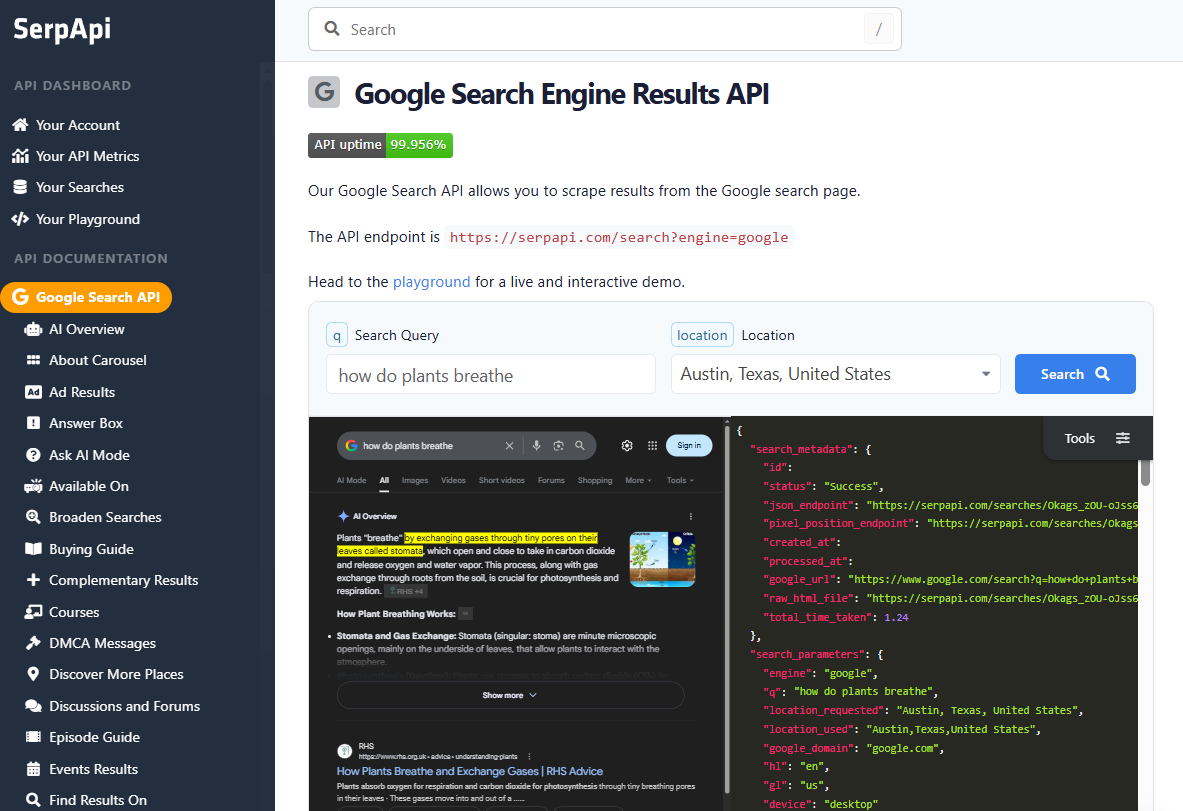
SerpApi is the industry standard for SERP data. They're literally pioneering the industry right now, being the first scraper API to be sued by Google.
The platform launched as a dedicated Google Search API and remains the most recognized name in the space, with a branded keyword volume north of 7,500 monthly searches. That reputation exists for a reason: the output depth is unmatched.
Every response includes parsed sitelinks, publication dates, discussion forums, video carousels, People Also Ask answers with full text, and AI Overview references when Google serves them. No other provider in this benchmark returns this breadth of structured elements from a single request.
Benchmark numbers: $25.00 per 1,000 requests. 1.96s average response time. 100% success rate. 68% AI Overview detection (highest among all eight providers). 3.8 output richness score (also highest).
The per-element breakdown tells the story. Sitelinks appeared in 80% of queries, dates in 80%, PAA answers in 48%, discussions in 48%, videos in 76%. No other provider came close to matching this coverage across all element types.
The trade-off is cost. At $25.00 per 1,000 requests, SerpApi costs 21x more than the cheapest rich-output alternative. For a deeper look at SerpApi alternatives and who to switch to, that is a separate comparison. Each search consumes 1 credit, and the $25/month starter plan caps at 1,000 searches. At 100K queries per month, the bill hits $2,500.
import requests

params = {
    "api_key": "<your_token>",
    "q": "best web scraping api",
    "engine": "google",
    "gl": "us",
    "hl": "en",
}
response = requests.get("https://serpapi.com/search", params=params)
data = response.json()
print(data["organic_results"][0]["title"]){
"organic_results": [
{"title": "10 Best Web Scraping APIs in 2026", "link": "https://example.com/...", "position": 1, "date": "Mar 15, 2026", "sitelinks": [{"title": "Pricing", "link": "..."}]},
...
],
"ai_overview": {"text": "Several web scraping APIs offer structured data extraction...", "references": [{"title": "...", "link": "..."}]},
"people_also_ask": [{"question": "Which web scraping API is best?", "answer": "The best web scraping API depends on..."}],
"related_searches": [{"query": "web scraping api free"}]
}The response includes every SERP element Google displays. Sitelinks nest inside each organic result. AI Overview text ships with reference links. PAA answers include the full expanded text, not the question alone.
Why Choose SerpApi
Richest output depth. A 3.8 richness score, the highest in the benchmark. Sitelinks, dates, discussions, video results, and PAA answers all parsed and structured in one response. No post-processing or secondary requests needed.
Highest AI Overview detection. 68% of queries returned AI Overview data with reference links and source attributions. For tracking how AI Overviews reshape organic CTR, SerpApi captures more of this data than any competitor.
Fast for a premium provider. 1.96s average, second overall behind Scrape.do at 1.73s. The speed advantage over mid-tier providers like WebScrapingAPI (5.17s) or ZenRows (8.84s) is 3-4x.
Mature ecosystem. Dedicated client libraries for Python, Ruby, Java, PHP, Node.js, and Go. A playground for testing queries before writing code. Extensive documentation that actually matches the API behavior.
The cost question is real. At 100K queries/month, SerpApi bills $2,500 while Scrape.do bills $116. That 0.2-point richness gap between 3.8 and 3.6 costs 21x more per request.
2. Scrape.do
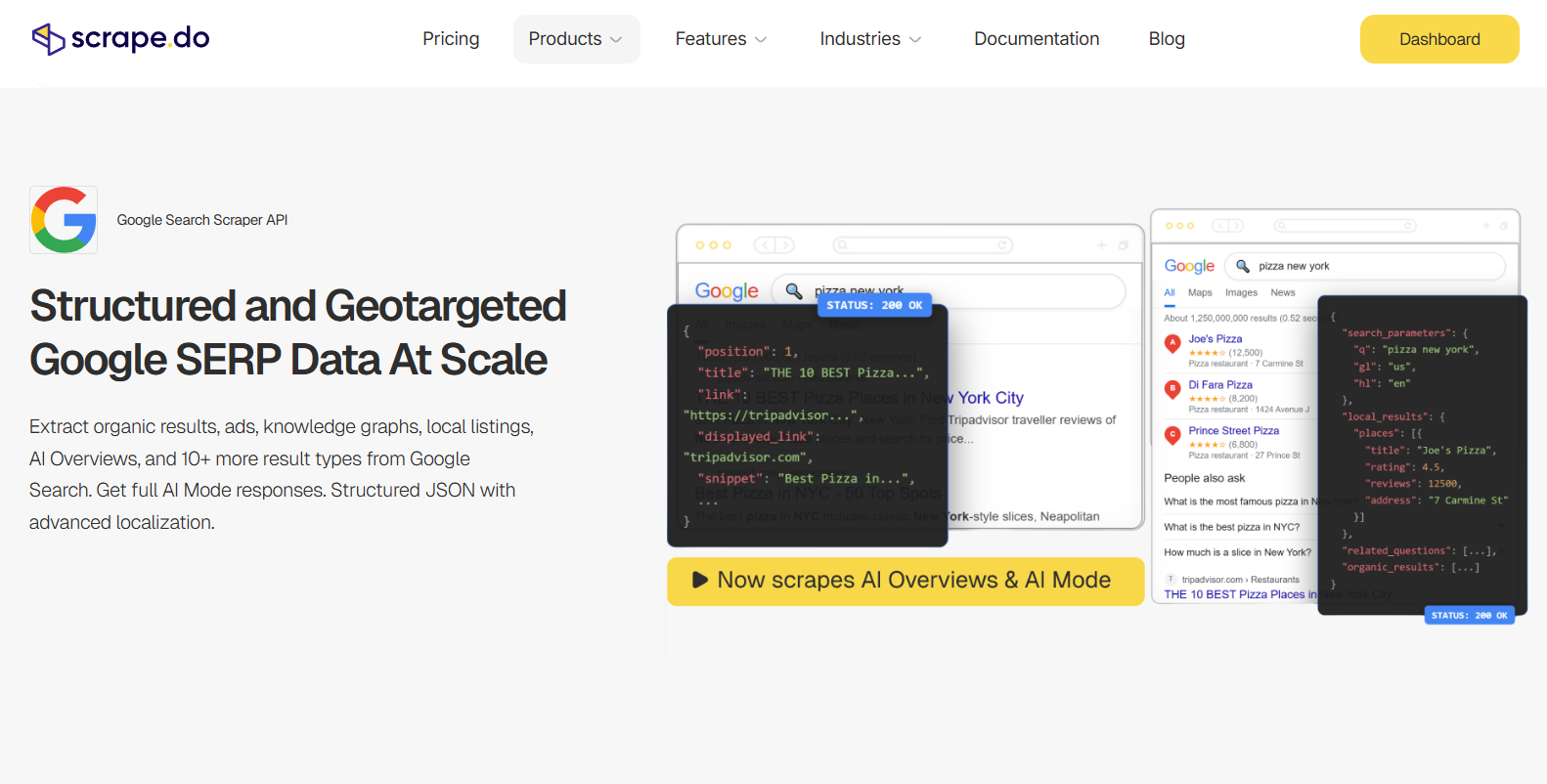
Scrape.do returns structured JSON from Google Search through a dedicated /plugin/google/search endpoint. The API parses 15+ element types: organics, ads, PAA, news, videos, local packs, shopping results, and AI Overview content.
Fastest provider in the benchmark at 1.73s average response time. That beats SerpApi (1.96s) and every other provider tested. Combined with $1.16 per 1,000 requests, the speed-to-cost ratio has no equivalent in this comparison.
Benchmark numbers: $1.16 per 1,000 requests. 1.73s average. 100% success rate. 60% AI Overview detection (44% inline + additional via async deferred endpoint). 3.6 output richness score.
AI Overview handling works in two steps. Initial requests return inline AI Overviews when available, which covered 44% of queries. For deferred AI Overviews (where Google loads them asynchronously), a secondary endpoint at /plugin/google/search/ai-overview resolves the remaining results. Total coverage: 60%. The async call costs 5 extra credits per deferred query.
Per-element breakdown: news results in 68% of queries, PAA in 76%, videos in 48%, AI Overview references in 24%, local results captured. The freemium tier starts with 1,000 free credits monthly.
The platform also functions as a general-purpose web scraping API. Teams already using Scrape.do for scraping Google Search results with raw HTML can add structured SERP data without managing a separate subscription or API key. For local business data, the same platform handles Google Maps scraping.
import requests

params = {
    "token": "<your_token>",
    "q": "best web scraping api",
    "gl": "us",
    "hl": "en",
}
response = requests.get("https://api.scrape.do/plugin/google/search", params=params)
data = response.json()
print(data["organic_results"][0]["title"]){
"organic_results": [
{"title": "10 Best Web Scraping APIs in 2026", "link": "https://example.com/...", "position": 1},
...
],
"ai_overview": {"text": "Web scraping APIs automate data collection from websites...", "references": [{"title": "...", "link": "..."}]},
"people_also_ask": [{"question": "What is a web scraping API?", "answer": "A web scraping API is a service that..."}],
"news_results": [{"title": "Web Scraping Market Grows 30%...", "source": "TechCrunch"}],
"related_searches": [{"query": "best web scraping tools 2026"}]
}The response structure covers organics, AI Overviews with references, PAA with answers, news carousels, and related searches. All in a single call, all structured JSON.
Why Choose Scrape.do
Best value ratio. $1.16 per 1,000 requests at 1.73s average speed. The next cheapest provider with comparable output depth (ScrapingDog at $2.00/1K) costs 72% more and responds 46% slower.
AI Overview with async fallback. The two-step approach captures 60% of AI Overviews. Only SerpApi (68%) detects more, at 21x the price.
15+ parsed element types. News carousels, video results, local packs, shopping snippets, PAA questions with answers, AI Overview text and references. The 3.6 richness score trails only SerpApi's 3.8 across all 8 providers.
Freemium entry. 1,000 free credits monthly with no expiration. Enough to test the full workflow and validate output quality before committing to a paid plan.
Unified platform. The same API token and dashboard handle both general web scraping and SERP requests. One account, one billing system, one set of credentials.
Get 1000 free credits and start scraping with Scrape.do
3. ScrapingDog
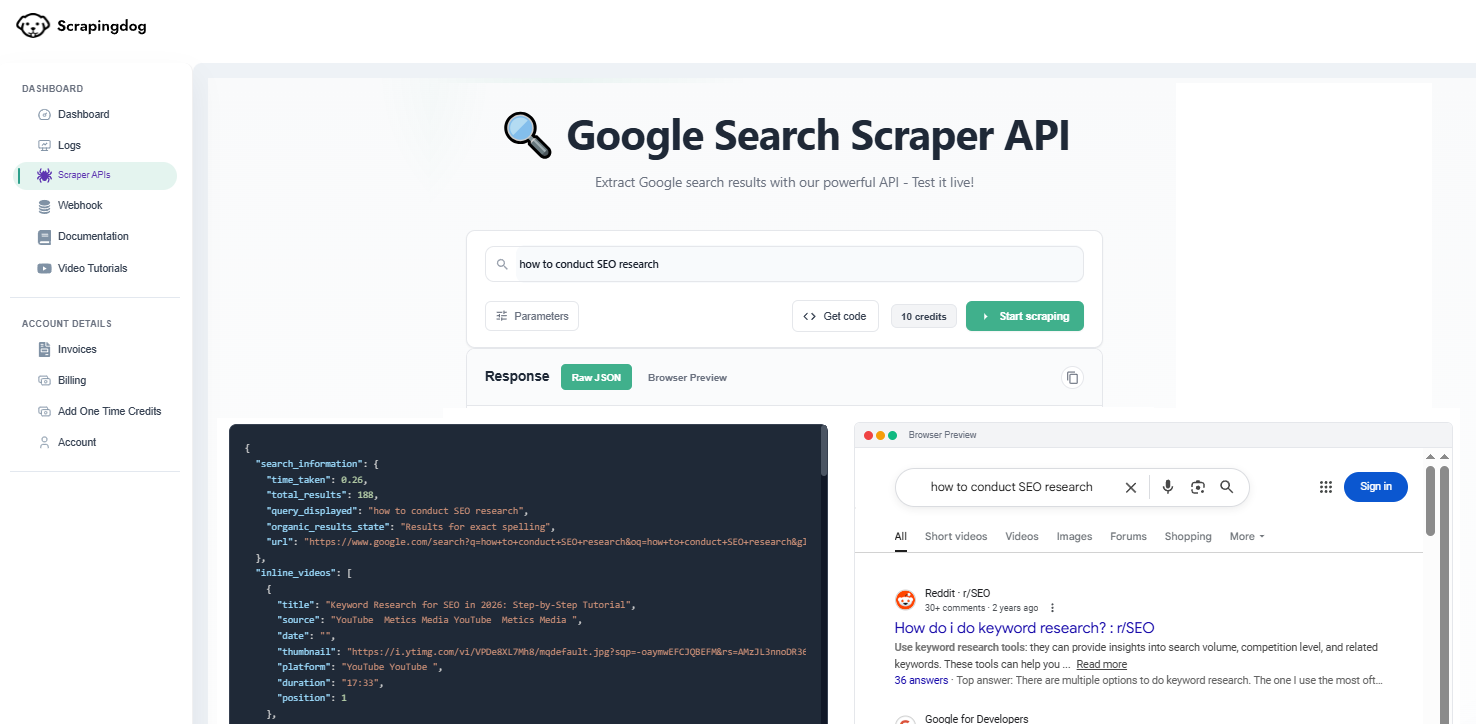
ScrapingDog offers a dedicated Google SERP API returning structured JSON with organic results, People Also Ask, related searches, and local pack data. Each SERP request consumes 10 credits from the standard pool.
Worth noting: ScrapingDog also has a "Google Light Scraper API" at 5 credits per request, but it returns significantly less structured content. This benchmark used the full 10-credit endpoint for a fair comparison.
Benchmark numbers: $2.00 per 1,000 requests. 2.52s average (third-fastest). 100% success rate. 48% AI Overview detection. 2.4 output richness score.
The speed is competitive. At 2.52s average, ScrapingDog sits behind only Scrape.do (1.73s) and SerpApi (1.96s), making it viable for near-real-time SERP monitoring.
Per-element breakdown: PAA returned in 72% of queries, related searches in 100% of queries (highest for this element across all providers), local results in 12%. Notable gaps exist though: no sitelinks, no publication dates, no video carousels, no news results, no discussion forums. The 2.4 richness score reflects a focused but narrow element set.
The $40/month starting plan includes 200,000 credits, translating to 20,000 SERP requests at 10 credits each.
import requests

params = {
    "api_key": "<your_token>",
    "query": "best web scraping api",
    "country": "us",
    "language": "en",
}
response = requests.get("https://api.scrapingdog.com/google", params=params)
data = response.json()
print(data["organic_results"][0]["title"]){
"organic_results": [
{"title": "10 Best Web Scraping APIs in 2026", "link": "https://example.com/...", "position": 1},
...
],
"ai_overview": {"text": "There are several popular web scraping APIs available..."},
"people_also_ask": [{"question": "What is the best API for web scraping?"}],
"related_searches": [{"query": "web scraping api python"}, {"query": "free web scraping api"}]
}The output covers organics, AI Overviews, PAA, and related searches. Clean structure, no extra nesting. Related searches return at a 100% rate, the highest of any provider for that element.
Why Choose ScrapingDog
Budget AI Overview coverage. At $2.00/1K, ScrapingDog is the cheapest provider returning AI Overview data (48% detection). The next cheapest with AI Overview support is WebScrapingAPI at $2.80/1K.
Fast response times. 2.52s average competes with the top tier. ScrapingDog processes queries 2-4x faster than ScraperAPI (11.20s) or ZenRows (8.84s).
Complete related searches. 100% of queries returned related search data, the highest rate for this element. Useful for keyword expansion and content gap analysis.
Predictable pricing. 10 credits per SERP request with no hidden multipliers. The $40/month starter plan provides exactly 20,000 SERP queries.
4. ScrapingBee
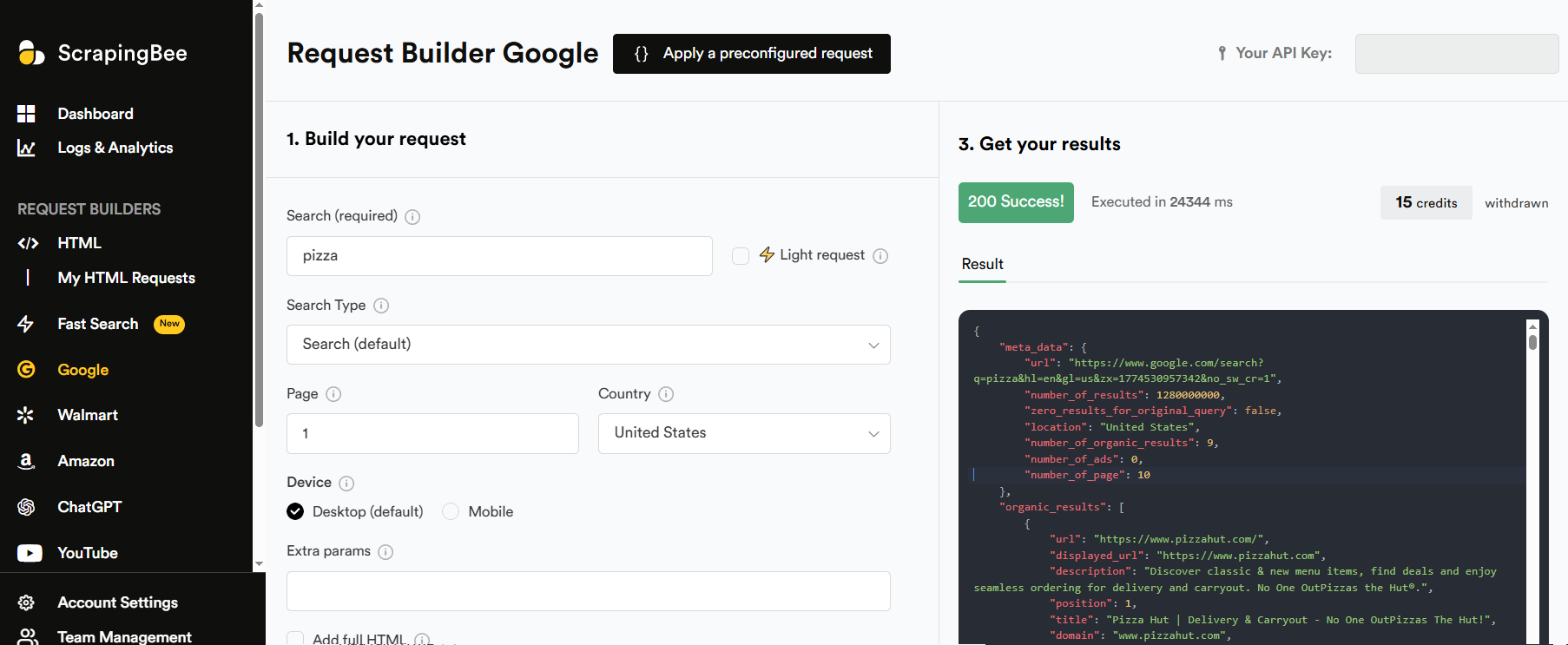
ScrapingBee's Google Search API focuses on organic result depth. The API parses sitelinks, publication dates, and PAA answers with full text. Most mid-tier providers skip these elements entirely.
Two request tiers exist: a light request (default) at 10 credits and a regular request at 15 credits with light_request=false. The regular tier can return more organic results and improved AI Overview detection. This benchmark used the default light tier for a fair cost comparison.
Benchmark numbers: $2.94 per 1,000 requests. 3.70s average. 100% success rate. 36% AI Overview detection. 2.2 output richness score.
Per-element breakdown tells the real story: sitelinks returned in 64% of queries, publication dates in 76% (highest among mid-tier providers), PAA answers with full text in 64%, AI Overview text in 36%. The strength is depth within organic results, not breadth across element types.
ScrapingBee is the only mid-tier provider ($1-5/1K range) returning sitelinks, dates, AND PAA answers together in a single response. Missing from the output: video carousels, news results, discussion forums. The 2.2 richness score reflects strong organic depth paired with limited SERP feature coverage.
import requests

params = {
    "api_key": "<your_token>",
    "search": "best web scraping api",
    "country_code": "us",
    "language": "en",
}
response = requests.get("https://app.scrapingbee.com/api/v1/store/google", params=params)
data = response.json()
print(data["organic_results"][0]["title"]){
"organic_results": [
{"title": "10 Best Web Scraping APIs in 2026", "link": "https://example.com/...", "position": 1, "date": "Mar 15, 2026", "sitelinks": [{"title": "Pricing"}]},
...
],
"ai_overview": {"text": "Web scraping APIs allow developers to extract..."},
"people_also_ask": [{"question": "Which is the best web scraping API?", "answer": "The best web scraping API depends on your specific needs..."}]
}Notice the date and sitelinks fields inside each organic result. That level of detail per result is what separates ScrapingBee from other providers at this price point.
Why Choose ScrapingBee
Deepest organic result details. Sitelinks (64%), publication dates (76%), and PAA answers with full text (64%) in one response. No other provider in the $1-5/1K price range returns all three together.
Publication date extraction. 76% date coverage is the highest among all providers except SerpApi (80%). Critical for freshness-sensitive use cases like news monitoring or content decay analysis.
AI Overview text capture. 36% of queries returned actual AI Overview text content, not referral links alone. Useful for tracking how Google summarizes topics in AI-generated answers.
Reliable mid-tier performance. 100% success rate at 3.70s average. Faster than WebScrapingAPI (5.17s), ScraperAPI (11.20s), ZenRows (8.84s), and Zyte (5.29s).
5. WebScrapingAPI
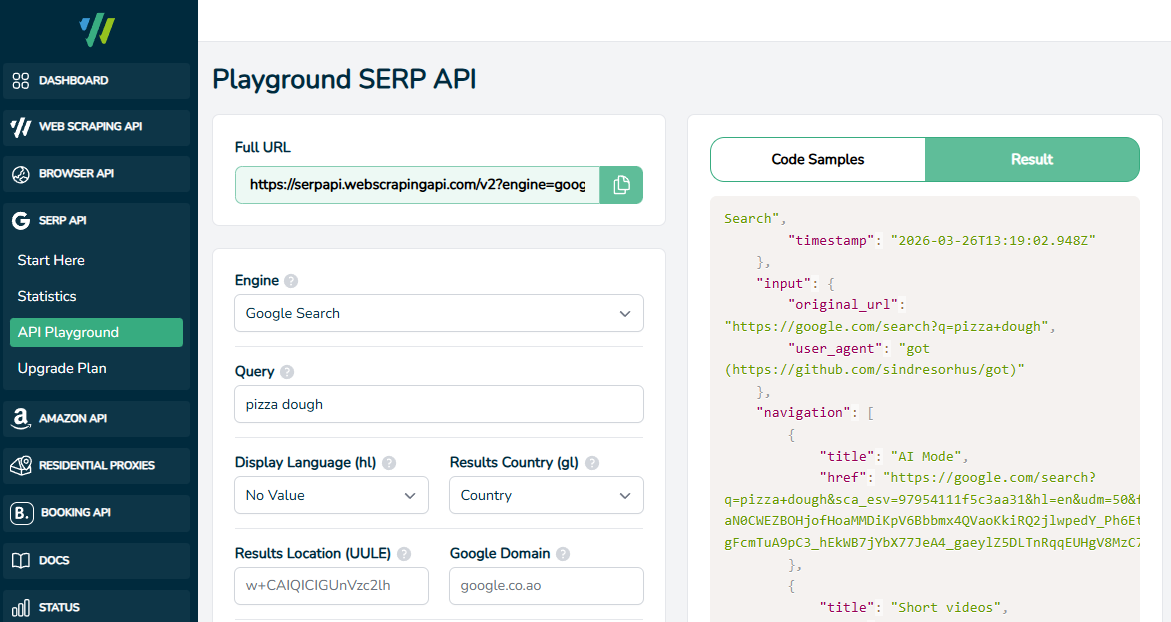
WebScrapingAPI runs its SERP API as a separate product from the main web scraping API. Different API key, different pricing structure. Each SERP request costs 1 credit (no multipliers), and the $28/month plan includes 10,000 requests.
The standout: strongest video result coverage among mid-tier providers, combined with solid AI Overview detection including reference links.
Benchmark numbers: $2.80 per 1,000 requests. 5.17s average. 100% success rate. 40% AI Overview detection. 2.8 output richness score.
Per-element breakdown: video results in 64% of queries (highest among mid-tier providers), PAA in 64%, AI Overview references in 40%, shopping results in 8%. No sitelinks, no publication dates, no discussion forums. The output centers on multimedia and AI-generated SERP features rather than organic result metadata.
The separate product structure means existing WebScrapingAPI customers need a new API key and potentially a separate subscription for SERP data. Not ideal, but the output quality at this price point is solid.
import requests

params = {
    "api_key": "<your_token>",
    "engine": "google",
    "q": "best web scraping api",
    "gl": "us",
    "hl": "en",
}
response = requests.get("https://serpapi.webscrapingapi.com/v2", params=params)
data = response.json()
print(data["organic_results"][0]["title"]){
"organic_results": [
{"title": "10 Best Web Scraping APIs in 2026", "link": "https://example.com/...", "position": 1},
...
],
"ai_overview": {"text": "Several APIs provide web scraping capabilities...", "references": [{"title": "...", "link": "..."}]},
"people_also_ask": [{"question": "What is the best web scraping tool?"}],
"video_results": [{"title": "Web Scraping Tutorial 2026", "platform": "YouTube", "link": "..."}],
"shopping_results": [{"title": "Web Scraping Proxy Plan", "price": "$49.99"}]
}Video results and shopping data appear in the response alongside AI Overview references. That combination is unique at the $2.80/1K price point.
Why Choose WebScrapingAPI
Best video coverage in the mid-tier. 64% of queries returned structured video carousel data. For tracking YouTube rankings or video SERP features, WebScrapingAPI captures video data that ScrapingDog, ScrapingBee, and ScraperAPI all miss entirely.
AI Overview with references. 40% detection rate includes reference links and source URLs, not text only. Valuable for tracking which sites Google cites in AI Overviews.
Flat credit pricing. 1 credit per SERP request, no premium proxy multipliers. The $2.80/1K cost stays predictable regardless of query complexity.
Shopping result detection. 8% of queries returned shopping carousel data. Minor coverage, but no other mid-tier provider parses shopping results at all.
6. ScraperAPI
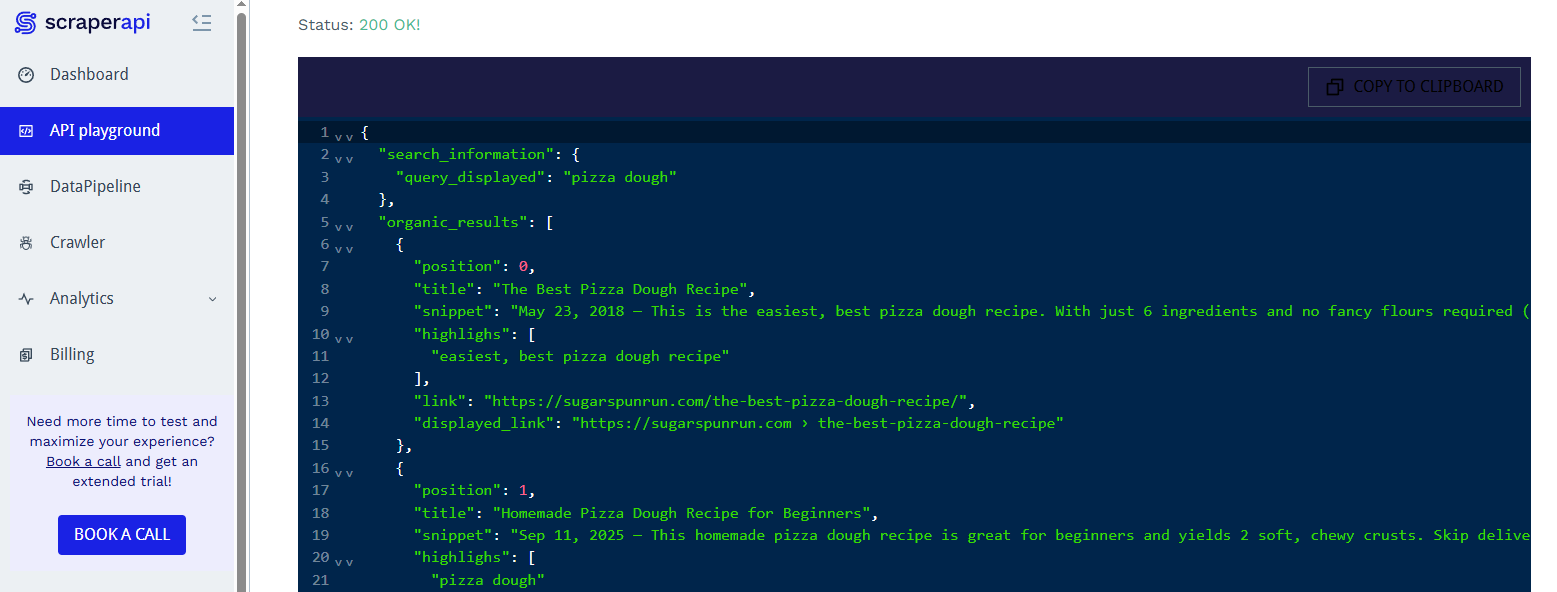
ScraperAPI offers a Google SERP structured data endpoint returning JSON with organic results, People Also Ask, and related searches. The API consumes 25 credits per SERP request, which is where the math gets uncomfortable.
The $49/month plan includes 100,000 credits. At 25 credits per SERP request, that provides 4,000 queries. Effective cost: $12.25 per 1,000 requests. That's 10x more than Scrape.do and 6x more than ScrapingDog for a narrower output.
Benchmark numbers: $12.25 per 1,000 requests. 11.20s average (slowest provider). 100% success rate. 0% AI Overview detection. 1.8 output richness score.
Per-element breakdown: PAA returned in 68% of queries, related searches in 100% (tied with ScrapingDog for highest). And that's it. No AI Overview, no sitelinks, no publication dates, no video carousels, no news results, no discussion forums, no shopping data. The 1.8 richness score reflects PAA + related searches and nothing more.
At 11.20s average response time, ScraperAPI is over 6x slower than Scrape.do (1.73s) and nearly 6x slower than SerpApi (1.96s).
import requests

params = {
    "api_key": "<your_token>",
    "query": "best web scraping api",
    "country_code": "us",
}
response = requests.get("https://api.scraperapi.com/structured/google/search", params=params)
data = response.json()
print(data["organic_results"][0]["title"]){
"organic_results": [
{"title": "10 Best Web Scraping APIs in 2026", "link": "https://example.com/...", "position": 1},
...
],
"people_also_ask": [{"question": "Which API is best for scraping?"}],
"related_searches": [{"query": "web scraping api comparison"}, {"query": "scraping api free trial"}]
}Organics, PAA questions, and related searches. That is the complete output. No AI Overview field, no video results, no sitelinks.
Why Choose ScraperAPI
100% success rate. Perfect reliability across all 25 test queries. For pipelines where every single request must return data, ScraperAPI does not drop requests.
Complete related searches. 100% related search coverage matches ScrapingDog for the highest rate. Valuable for keyword discovery and SERP landscape mapping.
Established infrastructure. ScraperAPI handles millions of requests with automatic proxy rotation and built-in retry logic. Rate limiting and blocks are managed without manual intervention.
The honest trade-off. At $12.25/1K with zero AI Overview data and 11.20s response times, ScraperAPI is hard to recommend for SERP-specific use cases. The platform's strengths (proxy management, retry logic, scraping templates) serve general web scraping better than structured SERP extraction.
7. ZenRows
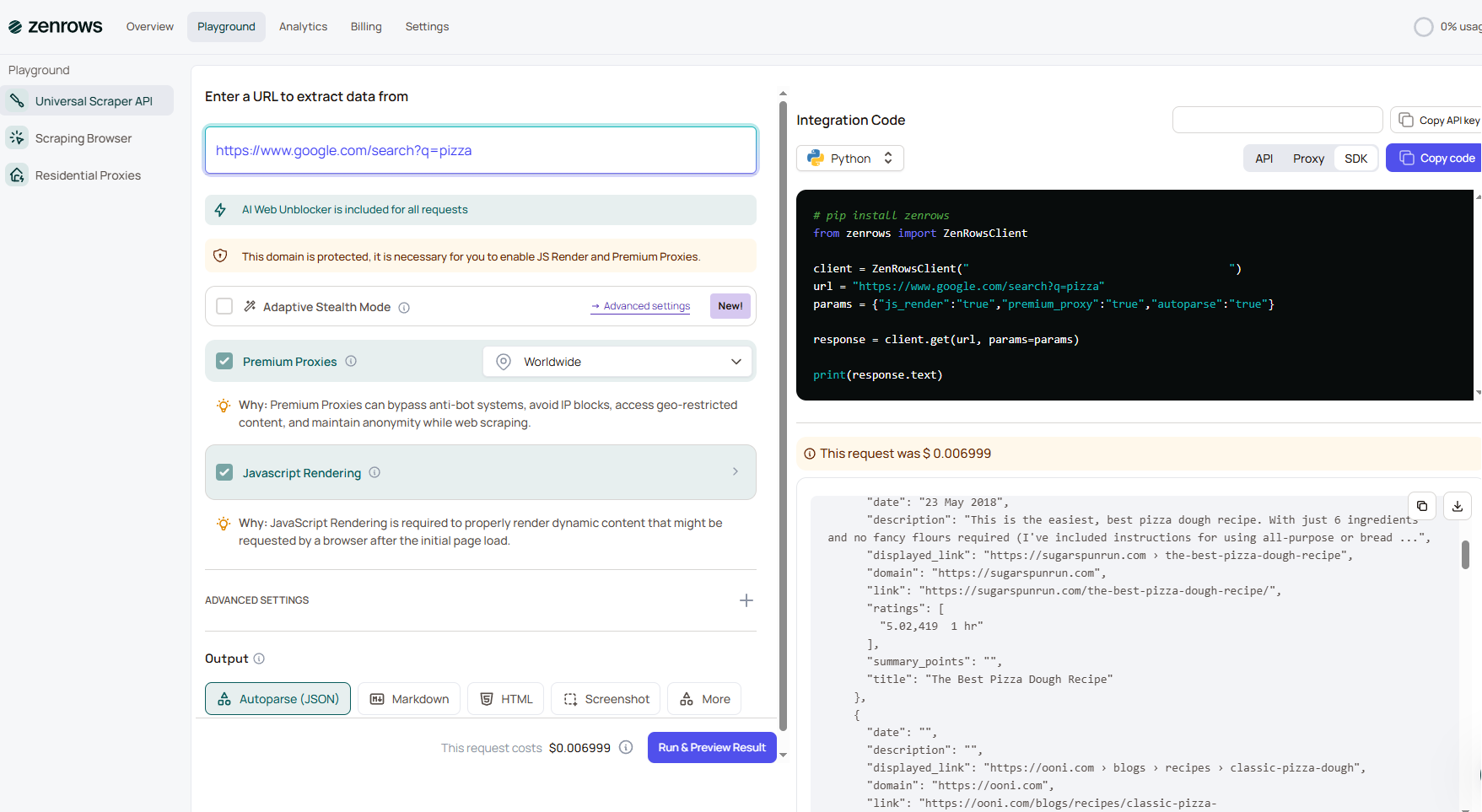
ZenRows provides a Google SERP scraper that returns structured JSON, but the output contains only organic results and occasional ad listings. No PAA, no related searches, no AI Overviews, no video carousels, no news, no sitelinks.
A detail worth knowing: Google searches require premium proxy mode, costing 10 credits per request instead of the standard 1 credit. This 10x multiplier makes the effective cost $2.80 per 1,000 SERP requests despite the pricing page suggesting otherwise.
Benchmark numbers: $2.80 per 1,000 requests. 8.84s average. 100% success rate. 0% AI Overview detection. 0.2 output richness score (second lowest).
Across all 25 test queries, ZenRows returned organic results and occasional ads. Zero additional SERP elements. The 0.2 richness score reflects rare ad detection alongside organics.
At 8.84s average response time (second slowest behind ScraperAPI at 11.20s), ZenRows is over 5x slower than Scrape.do for a fraction of the output depth. The starting price of $69.99/month for 250,000 credits translates to 25,000 SERP requests at 10 credits each.
import requests

response = requests.get(
    "https://serp.api.zenrows.com/v1/targets/google/search/best+web+scraping+api",
    params={"apikey": "<your_token>"},
)
data = response.json()
print(data["organic_results"][0]["title"]){
"organic_results": [
{"title": "10 Best Web Scraping APIs in 2026", "link": "https://example.com/...", "position": 1},
...
],
"ads": [
{"title": "ScrapingAPI - Enterprise Web Scraping", "link": "https://..."}
]
}Organics and ads. That is the full response. No PAA, no related searches, no AI Overview, no SERP features of any kind.
Why Choose ZenRows
100% success rate. Perfect reliability for pure organic extraction. If you need position tracking data without failures, ZenRows delivers consistently.
Clean organic extraction. The output focuses exclusively on organic results with minimal JSON structure. For rank tracking workflows that need positions and URLs only, there is less data to filter.
General scraping capability. Teams already using ZenRows for non-SERP targets can add basic organic extraction without a new vendor relationship.
The math problem. At $2.80/1K with organics-only output, ZenRows costs the same as WebScrapingAPI ($2.80/1K), which returns video results, PAA, AI Overview references, and shopping data. Same price, a fraction of the output.
8. Zyte
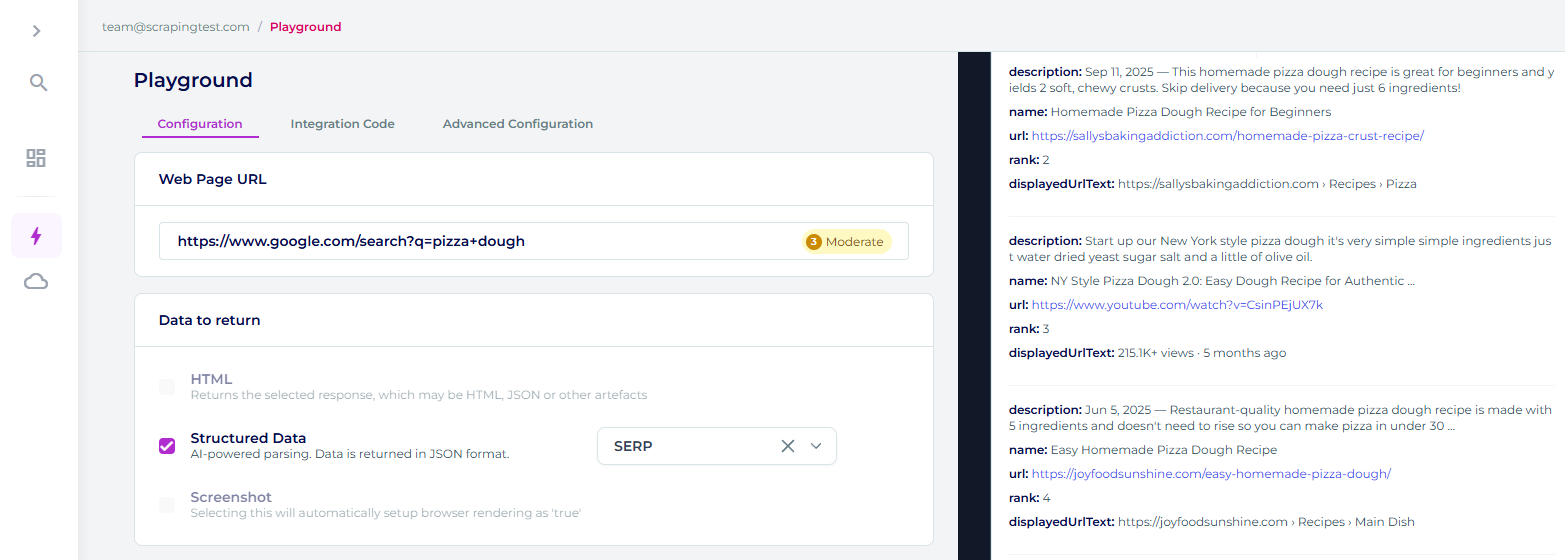
Zyte offers the cheapest SERP extraction at $0.43 per 1,000 requests through a pay-as-you-go model. The output is organics-only with zero extra SERP elements detected across all 25 benchmark queries.
Benchmark numbers: $0.43 per 1,000 requests (cheapest by far). 5.29s average. 0% AI Overview detection. 0.0 output richness score (the lowest).
That richness score is literal. No PAA, no related searches, no AI Overviews, no sitelinks, no dates, no videos, no news, no shopping results. Organic links and nothing else.
One actual failure occurred: a 520 server error on 1 of 25 queries, resulting in a 96% effective success rate. Zyte was the only provider that did not achieve 100% success across all test queries.
The pay-as-you-go model starts with a $5 free credit. No monthly commitment, making it accessible for one-off extraction jobs or low-volume use cases. Best suited for bulk organic link harvesting where SERP features and AI Overview data are irrelevant. At $0.43/1K, the cost is nearly 3x cheaper than Scrape.do ($1.16/1K).
import requests
from requests.auth import HTTPBasicAuth

response = requests.post(
    "https://api.zyte.com/v1/extract",
    auth=HTTPBasicAuth("<your_token>", ""),
    json={"url": "https://www.google.com/search?q=best+web+scraping+api&gl=us&hl=en", "serp": True},
)
data = response.json()
print(data["serpResult"]["organicResults"][0]["name"]){
"serpResult": {
"organicResults": [
{"name": "10 Best Web Scraping APIs in 2026", "url": "https://example.com/...", "rank": 1},
...
]
}
}Note the different response structure. Zyte uses serpResult as the wrapper with organicResults inside. No other SERP elements appear in the response.
Why Choose Zyte
Lowest cost per request. $0.43 per 1,000 requests is the cheapest option by a wide margin. For bulk organic position tracking at scale, the cost advantage compounds fast. At 1 million queries, Zyte costs $430 while SerpApi costs $25,000.
No monthly commitment. Pay-as-you-go with a $5 free starting credit. No subscription lock-in for teams that need SERP data intermittently.
Acceptable for organics-only workflows. SEO rank tracking tools that need organic positions and URLs can use Zyte without paying for SERP features they will discard anyway.
The clear limitation. The 96% success rate (only provider below 100%) and zero SERP feature coverage mean Zyte works only when organic links are the sole requirement. Any need for AI Overviews, PAA, news, or video data eliminates it from consideration.
What to Pick
Best overall value: Scrape.do. Fastest provider (1.73s), cheapest rich output ($1.16/1K), 60% AI Overview detection via inline + async, 3.6 richness score across 15+ element types. The speed-to-cost-to-depth ratio is unmatched.
Richest output: SerpApi. 3.8 richness score with the widest element coverage. Sitelinks, dates, discussions, videos, PAA answers. Justifiable if budget allows $25/1K and output completeness outweighs cost concerns.
Best budget with AI Overview: ScrapingDog. $2.00/1K with 48% AI Overview detection and 2.52s speed. The cheapest path to AI Overview data after Scrape.do.
Deepest organic details: ScrapingBee. The only mid-tier provider returning sitelinks (64%), publication dates (76%), and PAA answers (64%) together. Best for organic result metadata analysis.
Cheapest raw extraction: Zyte. $0.43/1K for organics-only output. Suitable for bulk rank tracking where SERP features do not matter.
Avoid for SERP features: ZenRows and Zyte. Both return organics-only data with zero SERP extras. ZenRows costs $2.80/1K for the same depth that Zyte provides at $0.43/1K. If you need organics-only, at least pick the cheaper one.
Conclusion
Eight SERP APIs. 25 queries each. 200 total requests measured on speed, cost, AI Overview detection, and output richness. The data speaks clearly.
Scrape.do delivered the best overall value: fastest at 1.73s, cheapest rich output at $1.16/1K, and 60% AI Overview detection.
Teams already scraping Google Search results with raw HTML can use the same Scrape.do token for structured SERP data.
SerpApi justified its $25/1K premium only when maximum output depth is non-negotiable.
Three providers (ScraperAPI, ZenRows, Zyte) returned zero AI Overview data. Zero. That is a critical gap. AI Overviews appear on an increasing percentage of Google SERPs, and any SERP monitoring pipeline built today should weight AI Overview support heavily. Choosing a provider that misses this data entirely means rebuilding the pipeline later.
Get 1000 free credits and start scraping with Scrape.do
FAQ
Why is SerpApi so expensive?
SerpApi charges $25 per 1,000 searches because it returns the richest structured output of any SERP API. The 3.8 richness score includes sitelinks (80%), publication dates (80%), discussions (48%), video results (76%), and PAA answers (48%).
The pricing model is 1 search = 1 credit with no tiered discounts on the starter plan. Higher plans reduce the per-search cost, but SerpApi remains significantly more expensive than alternatives at every tier.
For perspective: Scrape.do delivers a 3.6 richness score at $1.16/1K. That 0.2-point richness gap costs 21x more with SerpApi.
Which is the best search API?
Depends on the use case.
For the best combination of speed, cost, and output depth, Scrape.do ranks highest at $1.16/1K with 1.73s response time and 3.6 richness. For maximum output completeness regardless of cost, SerpApi at $25/1K returns the most parsed SERP elements. For budget AI Overview tracking, ScrapingDog at $2/1K captures 48% of AI Overviews. For cheapest possible organic extraction, Zyte at $0.43/1K handles bulk rank tracking.
What is the difference between Serper and SerpApi?
SerpApi is a standalone SERP data provider with a proprietary parsing engine that returns structured JSON across 15+ Google search element types. It has the richest output in this benchmark but costs $25/1K.
Serper (serper.dev) is a different service focused on speed and low cost, primarily serving LLM and AI agent use cases with a simpler output schema. The two are separate companies with separate products. SerpApi predates Serper and has broader SERP element coverage. Serper targets developers building AI applications that need fast, cheap search grounding.
How to get SERP data for free?
Scrape.do offers a freemium tier with 1,000 free credits monthly (approximately 100 SERP requests at 10 credits each). No expiration and no credit card required.
Zyte provides $5 in free credits on signup, enough for roughly 11,600 SERP requests at the $0.43/1K rate. Pay-as-you-go with no monthly commitment.
SerpApi includes 100 free searches per month on the free plan. Limited volume but sufficient for testing output quality.
Building a custom scraper with Python and rotating proxies is technically free, but the maintenance cost of handling CAPTCHAs, rate limiting, IP blocks, and constantly changing page structures typically exceeds API pricing within weeks.
Head of Marketing