Category:Scraping Tools
Best SerpApi Alternatives in 2026: 6 Cheaper SERP APIs Compared

Head of Marketing


$25 for 1,000 searches, are you kidding me?
That is SerpApi's Starter plan. The Developer tier bumps that to $75 for 5,000, Production to $150 for 15,000, and Big Data to $275 for 30,000. Even at the highest tier, the per-search cost only drops to $0.009. Run 100K queries a month and the bill crosses $2,500.
We're benchmarking six alternatives against the same 25 Google queries used in the full 8-provider SERP API comparison, measuring response speed, cost per request, AI Overview detection rate, and output richness across PAA, sitelinks, dates, videos, news, and discussions. The cheapest full-featured option costs 21.6x less per request. The cheapest overall drops to $0.43 per 1,000, though it strips everything except organic links.
The table below shows every provider side by side. SerpApi sits greyed out as the baseline.
| API Provider | Cost / 1K | Savings vs SerpApi | Avg Speed | AI Overview | PAA | Sitelinks | Dates | Videos | News | Discussions | Richness |
|---|---|---|---|---|---|---|---|---|---|---|---|
| SerpApi (baseline) | $25.00 | - | 1.96s | Yes | Yes | Yes | Yes | Yes | No | Yes | 3.8 |
| Scrape.do | $1.16 | 21.6x | 1.73s | Yes | Yes | No | No | Yes | Yes | No | 3.6 |
| ScrapingDog | $2.00 | 12.5x | 2.52s | Yes | Yes | No | No | No | No | No | 2.4 |
| ScrapingBee | $2.94 | 8.5x | 3.70s | Yes | Yes | Yes | Yes | No | No | No | 2.2 |
| WebScrapingAPI | $2.80 | 8.9x | 5.17s | Yes | Yes | No | No | Yes | No | No | 2.8 |
| ScraperAPI | $12.25 | 2x | 11.20s | No | Yes | No | No | No | No | No | 1.8 |
| Zyte | $0.43 | 58x | 5.29s | No | No | No | No | No | No | No | 0.0 |
Why Switch from SerpApi?
SerpApi remains one of the most recognized SERP scraping APIs on the market. Also one of the most expensive. The benchmark data above shows multiple alternatives matching or exceeding SerpApi's output quality at a fraction of the cost.
Three factors drive most migrations away from SerpApi: pricing that punishes scale, rigid rate limits, and gaps in modern SERP feature coverage.
Pricing at Scale
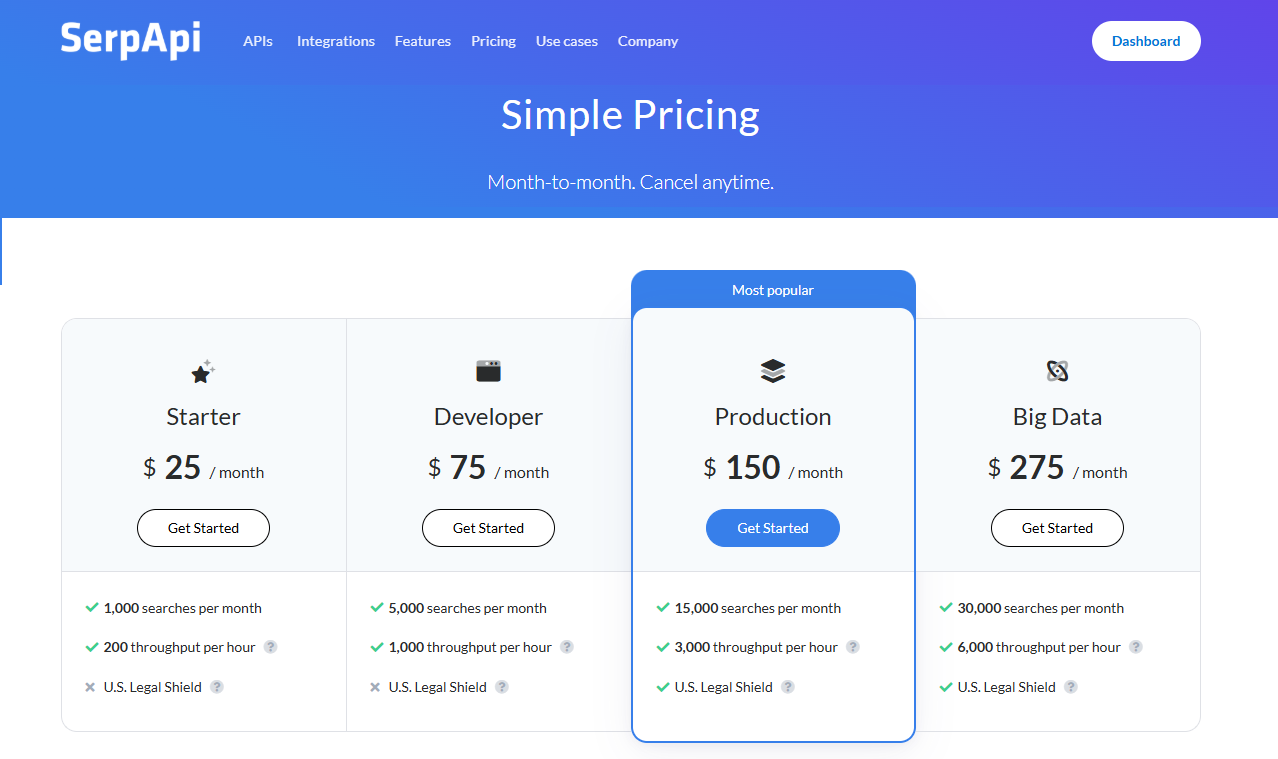
SerpApi's four tiers break down like this: Starter at $25/mo for 1,000 searches, Developer at $75/mo for 5,000, Production at $150/mo for 15,000, and Big Data at $275/mo for 30,000. The per-search cost across those tiers: $0.025, $0.015, $0.010, $0.009. Even at the highest tier, SerpApi still costs $9.17 per 1,000 searches.
The Big Data plan caps at 30,000 searches. Anything beyond that reverts to the per-search overage rate. At 100K requests per month, the bill reaches roughly $2,500. At 1M requests, it hits $25,000.
Alternatives in this benchmark range from $0.43/1K (Zyte, organics only) to $2.94/1K (ScrapingBee) for comparable SERP data. Scrape.do at $1.16/1K is 21.6x less expensive than SerpApi while returning a nearly identical richness score (3.6 vs 3.8). For teams building their own scrapers, scraping Google Search results with raw HTML is the alternative to any API.
Rate Limits and Plan Restrictions
SerpApi's Starter plan locks you into 1,000 searches per month. The Big Data plan caps at 30,000. A free tier exists but maxes out at 250 searches, enough for testing and nothing more.
There is no pay-as-you-go option. Once the plan limit is reached, requests fail until the next billing cycle or an upgrade. For teams with variable monthly volumes, this rigidity forces overprovisioning on higher tiers to avoid downtime.
Most competitors offer either freemium tiers with meaningful monthly credits or pure pay-as-you-go pricing with no hard caps. Scrape.do provides 1,000 free credits monthly. ScrapingDog and ScrapingBee both offer free tiers as well. Credit-based systems allow flexible allocation across different request types rather than a flat search count.
What to Look for in an Alternative
AI Overview support matters more in 2026 than it did a year ago. SerpApi detects AI Overviews in 68% of queries where Google shows them. Only three of six alternatives tested exceed 40% detection: Scrape.do at 60%, ScrapingDog at 48%, WebScrapingAPI at 40%. ScraperAPI and Zyte return 0%.
Output depth beyond organics separates a proper SerpApi replacement from a basic scraper. PAA boxes, sitelinks, publication dates, video carousels, news results, discussion forums. SerpApi scores 3.8 on the richness scale. Scrape.do is closest at 3.6, while Zyte scores 0.0.
Response speed varies dramatically. SerpApi averages 1.96s per request. Scrape.do is faster at 1.73s. ScraperAPI is the slowest at 11.20s, nearly 6x slower than SerpApi.
Pricing model also differs across providers: per-credit (Scrape.do, ScrapingBee), per-search (SerpApi), or pay-as-you-go (Zyte). Credit-based models tend to offer more flexibility since credits can apply to different request types within the same pool.
1. Scrape.do (Best Overall Alternative)
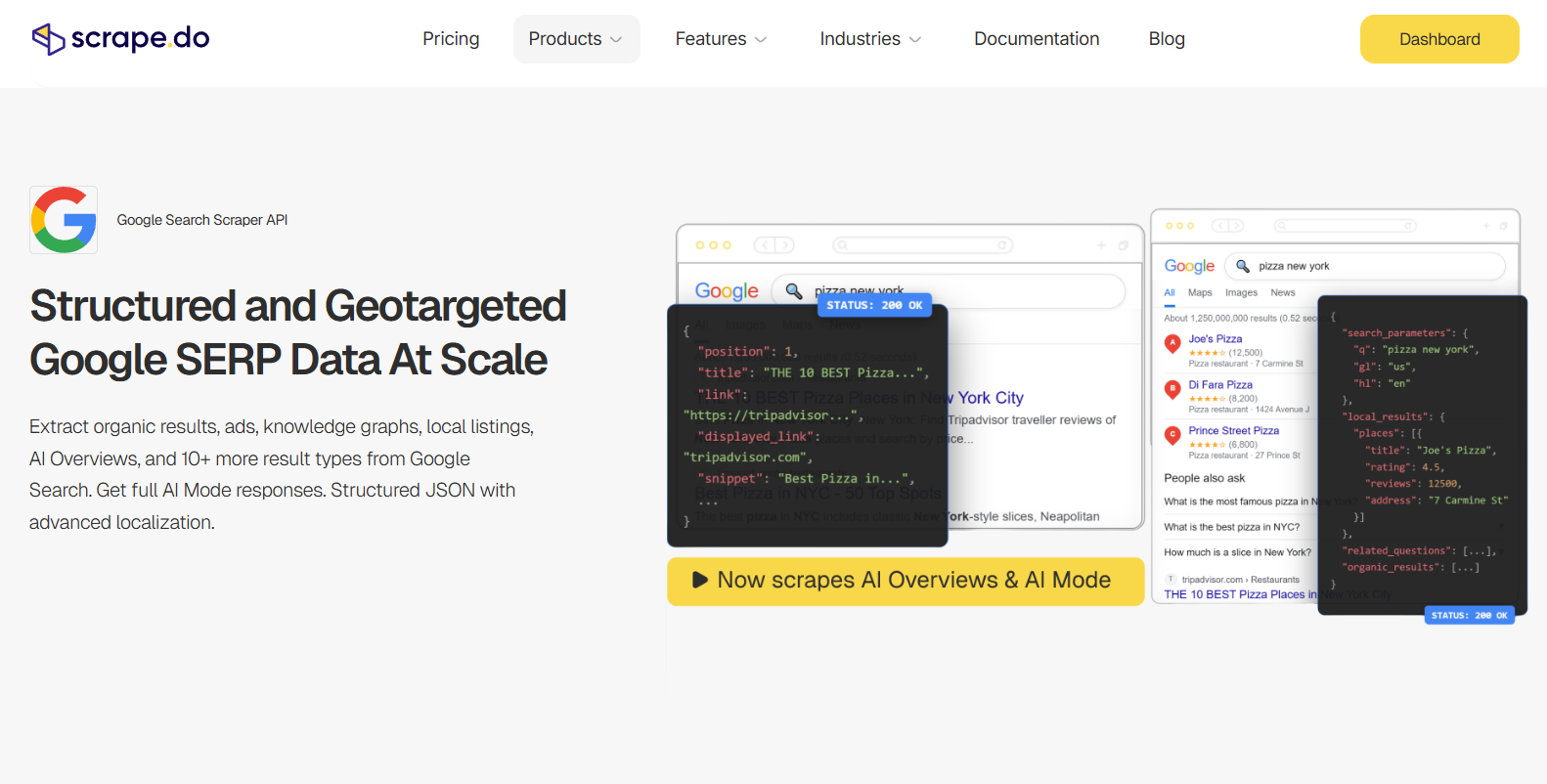
Scrape.do is 21.6x cheaper than SerpApi and actually faster, averaging 1.73s per request vs SerpApi's 1.96s. Among all six alternatives tested, it returns the richest SERP data with a 3.6 richness score, the closest to SerpApi's 3.8.
The Google Search API endpoint returns structured JSON with organic results, PAA, videos, related searches, local pack, and knowledge panels in a single call. No separate endpoints for different SERP features.
import requests

response = requests.get("https://api.scrape.do/plugin/google/search", params={
    "token": "<your_token>",
    "q": "best web scraping api",
    "gl": "us",
    "hl": "en"
})
data = response.json(){
"organic_results": [
{"title": "Best Web Scraping APIs in 2026", "url": "https://...", "position": 1}
],
"ai_overview": {"state": "complete", "text": "Web scraping APIs automate..."},
"people_also_ask": [{"question": "Which is the best web scraping API?"}],
"related_searches": [{"query": "web scraping api free"}],
...
}The response includes organic results, AI Overview content, PAA questions, video carousels, related searches, and local pack data. For queries with news intent, Scrape.do captures news results at a 68% detection rate vs SerpApi's 4%.
Scrape.do also offers an async AI Overview endpoint at /plugin/google/search/ai-overview that resolves deferred AI Overviews Google loads asynchronously. This costs 5 additional credits per request but captures AI Overview content that synchronous scraping misses.
Why Choose Scrape.do Over SerpApi
Cost: $1.16 per 1,000 requests vs $25.00. At 100K requests/mo, that is $116 vs $2,500.
Speed: 1.73s average response time vs 1.96s. 12% faster.
AI Overview: 60% detection rate vs SerpApi's 68%. An 8-percentage-point gap, not a dealbreaker for most monitoring use cases.
What you keep: AI Overview extraction, People Also Ask boxes, video carousels, related searches, local pack results, news results.
What you lose: sitelinks (8% vs 80%), publication dates (0% vs 80%), discussion forums (0% vs 48%). Teams that depend on sitelink or date data should look at ScrapingBee instead.
Free tier: 1,000 free credits monthly. That translates to 100 Google SERP requests at 10 credits each, enough for testing and low-volume projects.
Get 1000 free credits and start scraping with Scrape.do
2. ScrapingDog
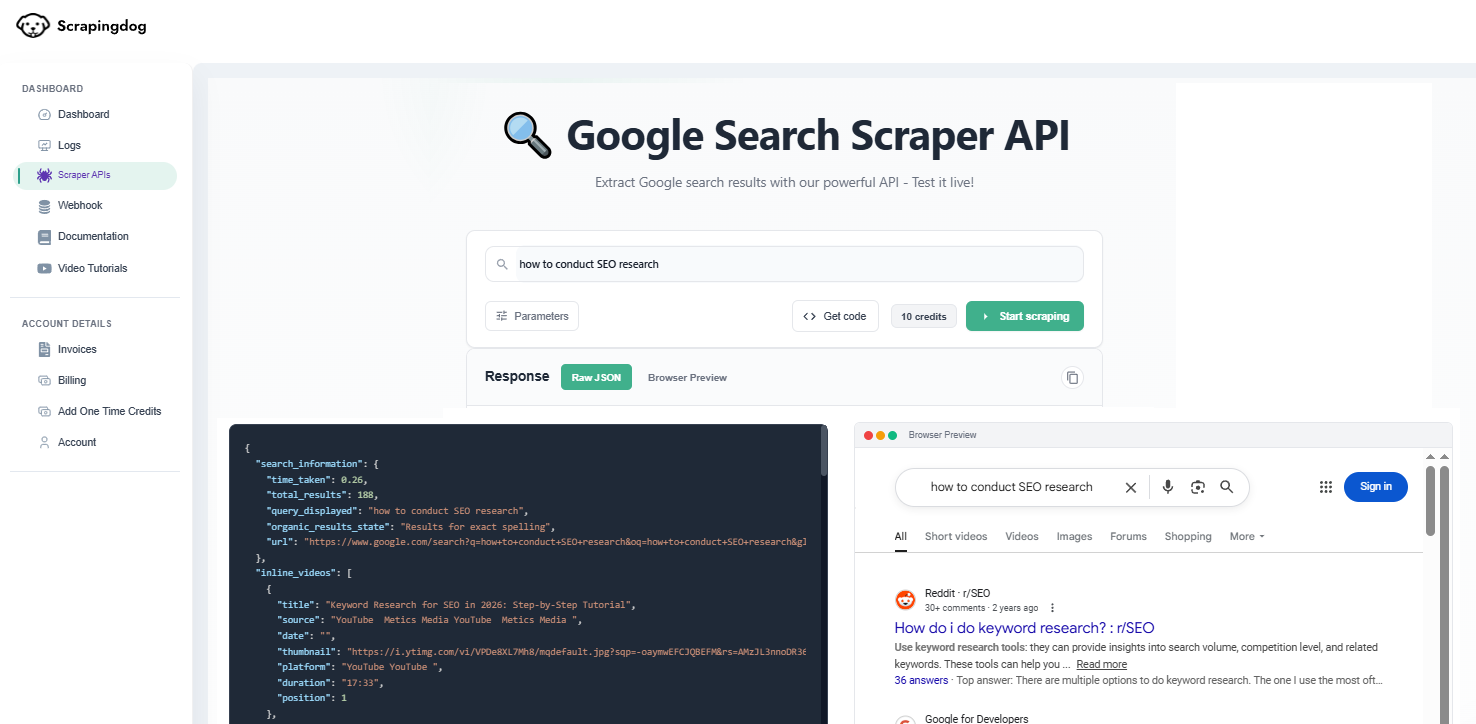
ScrapingDog offers a budget-friendly SERP API with 48% AI Overview detection at $2.00 per 1,000 requests. That makes it 12.5x cheaper than SerpApi. The output is leaner than Scrape.do or SerpApi, scoring 2.4 on richness, but it covers the essentials: organic results, AI Overview, PAA questions, and related searches.
ScrapingDog also has a "Google Light Scraper API" at 5 credits per request ($1.00/1K), but it returns significantly less structured content than the full SERP API. The benchmark used the 10-credit full endpoint for a fair comparison.
import requests

response = requests.get("https://api.scrapingdog.com/google", params={
    "api_key": "<your_token>",
    "query": "best web scraping api",
    "country": "us",
    "language": "en"
})
data = response.json(){
"organic_results": [
{"title": "Best Web Scraping APIs...", "link": "https://...", "position": 1}
],
"ai_overview": {"text": "Several APIs offer web scraping..."},
"people_also_ask": [{"question": "What is the best scraping tool?"}],
...
}The response covers organics, AI Overview text, and PAA questions without expanded answers. Related searches are included, but video carousels, news results, and sitelinks are not.
Why Choose ScrapingDog Over SerpApi
Cost: $2.00 per 1,000 requests vs $25.00. 12.5x cheaper.
Speed: 2.52s average. About 29% slower than SerpApi's 1.96s, still within acceptable range for batch processing.
AI Overview: 48% detection rate. Lower than SerpApi's 68% but still captures nearly half of AI Overview instances. Viable for trend monitoring.
What you keep: AI Overview, PAA questions, related searches, organic results with titles, URLs, and descriptions.
What you lose: sitelinks (0% vs 80%), publication dates (0% vs 80%), video carousels (0% vs 92%), news results (0% vs 4%), discussion forums (0% vs 48%), PAA answers (questions only, no expanded text).
Best suited for teams that need AI Overview detection at the lowest possible cost and can tolerate thinner SERP feature coverage.
3. ScrapingBee
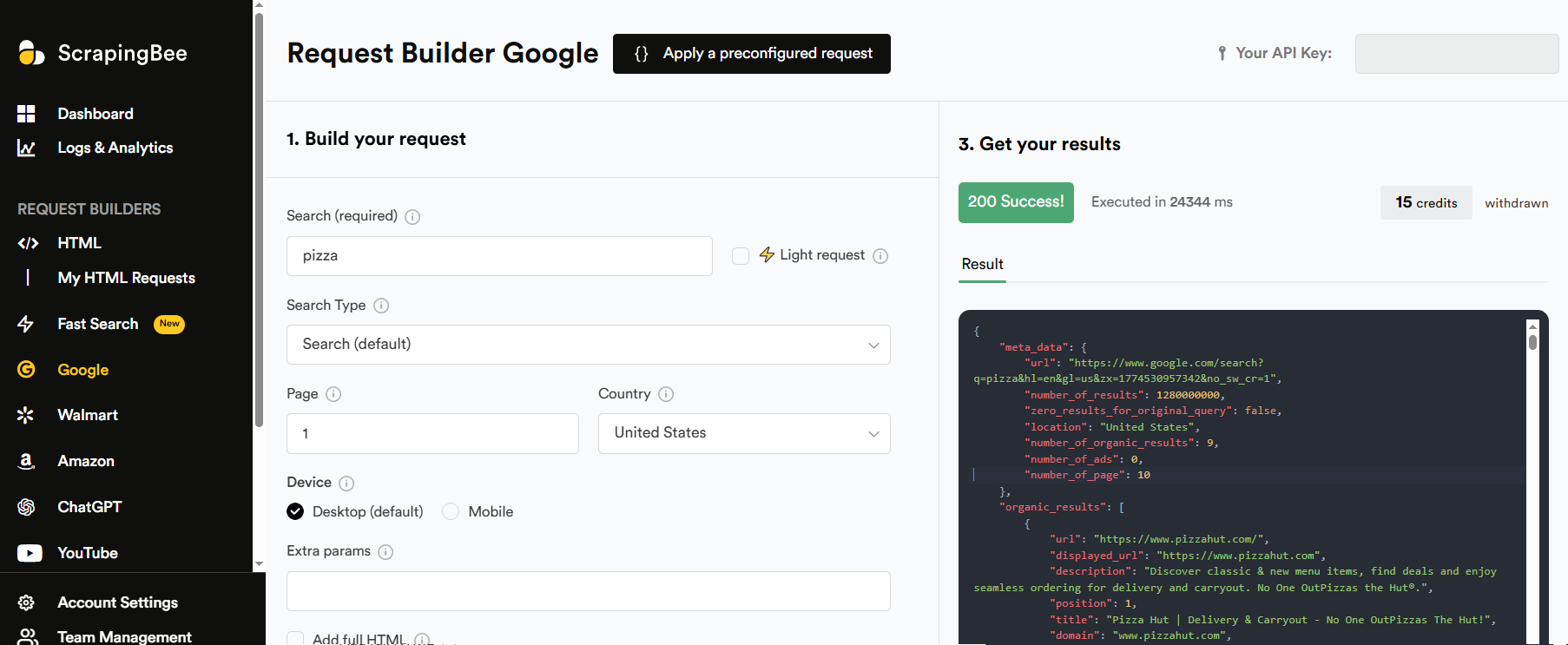
ScrapingBee returns the deepest organic result details among all mid-tier alternatives tested. It is the only alternative in the $2-3 range that extracts sitelinks, publication dates, and PAA answers simultaneously. If your workflow depends on the metadata depth SerpApi provides, ScrapingBee is the closest match at 8.5x less.
ScrapingBee offers two tiers: light requests (default, 10 credits) and regular requests (15 credits, light_request=false). The regular tier captures more organic results and better AI Overview detection on some queries. This benchmark used the default light tier. Effective cost: $1.96/1K for light, $2.94/1K for regular.
import requests

response = requests.get("https://app.scrapingbee.com/api/v1/store/google", params={
    "api_key": "<your_token>",
    "search": "best web scraping api",
    "country_code": "us",
    "language": "en"
})
data = response.json(){
"organic_results": [
{"title": "Best Web Scraping APIs...", "url": "https://...", "date": "Mar 15, 2026",
"sitelinks": [{"title": "Pricing", "url": "https://..."}]}
],
"ai_overview": {"text": "The best web scraping APIs include..."},
"people_also_ask": [{"question": "Which API is best?", "answer": "Several options..."}],
...
}Note the date and sitelinks fields nested inside organic results, and the answer field on PAA entries. Those details are what set ScrapingBee apart from the other mid-tier alternatives.
Why Choose ScrapingBee Over SerpApi
Cost: $2.94 per 1,000 requests vs $25.00. 8.5x cheaper.
Speed: 3.70s average. Roughly 89% slower than SerpApi's 1.96s. Noticeable, but manageable for non-real-time workloads.
AI Overview: 36% detection rate vs SerpApi's 68%. Still captures AI Overviews for over a third of qualifying queries.
Unique strength: the only mid-tier alternative returning sitelinks (64% detection), publication dates (76% detection), and PAA answers (64% detection) together. SerpApi hits 80%, 80%, and 88% respectively on those metrics. ScrapingBee is the closest match for teams that rely on deep organic metadata.
What you keep: AI Overview, PAA with full answers, sitelinks, dates on organic results, organic titles/URLs/descriptions.
What you lose: video carousels (0% vs 92%), news results (0% vs 4%), discussion forums (0% vs 48%).
4. WebScrapingAPI
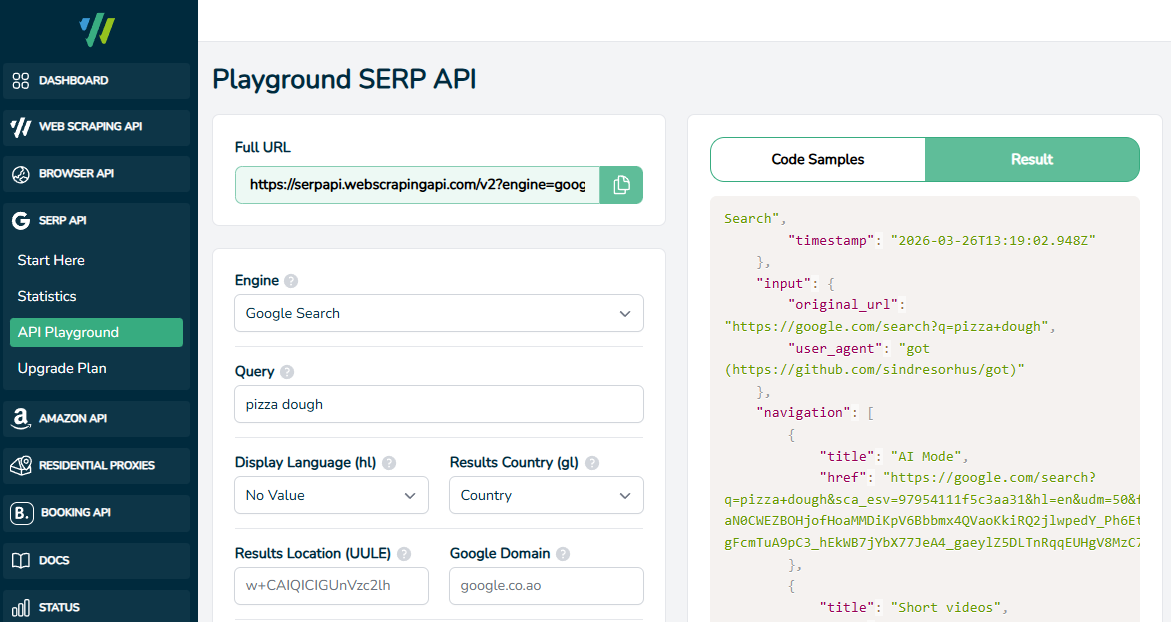
WebScrapingAPI balances AI Overview coverage with video carousel extraction at $2.80 per 1,000 requests. That is 8.9x cheaper than SerpApi. The richness score of 2.8 places it between ScrapingDog (2.4) and Scrape.do (3.6), making it a solid middle-ground for teams that need both AI Overview and video data.
One important detail: the SERP API is a separate product from WebScrapingAPI's general scraping API. It requires a different API key and subscription. Existing WebScrapingAPI customers need to factor in the additional onboarding.
import requests

response = requests.get("https://serpapi.webscrapingapi.com/v2", params={
    "api_key": "<your_token>",
    "engine": "google",
    "q": "best web scraping api",
    "gl": "us",
    "hl": "en"
})
data = response.json(){
"organic_results": [
{"title": "Best Web Scraping APIs...", "url": "https://...", "position": 1}
],
"ai_overview": {"text": "...", "references": [{"title": "...", "url": "https://..."}]},
"video_results": [{"title": "How to Scrape...", "platform": "YouTube"}],
...
}The AI Overview response includes reference links, a detail that some alternatives omit. Video results come through as structured objects with platform attribution.
Why Choose WebScrapingAPI Over SerpApi
Cost: $2.80 per 1,000 requests vs $25.00. 8.9x cheaper.
Speed: 5.17s average. 2.6x slower than SerpApi's 1.96s. The slowest among mid-tier alternatives.
AI Overview: 40% detection rate with reference links included. Lower than SerpApi's 68%, but the references add context that other alternatives skip.
What you keep: AI Overview with source references, PAA questions, video carousels, shopping results, organic results.
What you lose: sitelinks (0% vs 80%), publication dates (0% vs 80%), discussion forums (0% vs 48%), news results (0% vs 4%).
5. ScraperAPI
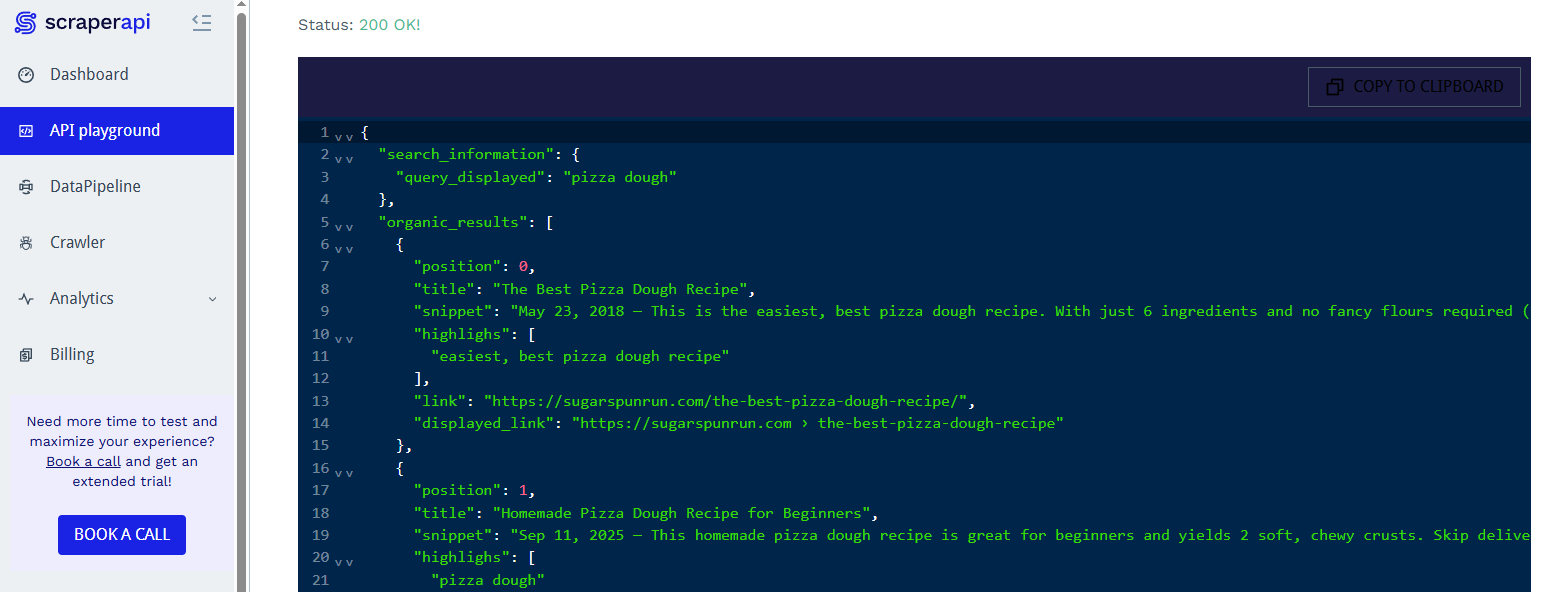
ScraperAPI is only 2x cheaper than SerpApi ($12.25 vs $25.00 per 1,000 requests) while being 5.7x slower (11.20s vs 1.96s). It also misses AI Overview entirely, returning 0% detection across all 25 test queries.
The pricing deserves closer inspection. Each SERP request costs 25 credits. The $49/mo plan advertises a large credit pool, but the per-SERP cost chews through that pool fast. The effective cost per 1,000 SERP requests is $12.25. That "savings" over SerpApi shrinks to the smallest gap among all six alternatives.
import requests

response = requests.get("https://api.scraperapi.com/structured/google/search", params={
    "api_key": "<your_token>",
    "query": "best web scraping api",
    "country_code": "us"
})
data = response.json(){
"organic_results": [
{"title": "Best Web Scraping APIs...", "link": "https://...", "position": 1}
],
"people_also_ask": [{"question": "What is the best web scraping tool?"}],
...
}No ai_overview field. No sitelinks, dates, videos, news, or discussion data. The response is organic results and PAA questions. That is it.
Why Choose ScraperAPI Over SerpApi
Honestly? There are very few reasons to pick ScraperAPI over SerpApi, and even fewer reasons to pick it over the other five alternatives.
Cost: $12.25 per 1,000 requests vs $25.00. A 2x savings sounds fine until you compare it to Scrape.do's 21.6x or ScrapingDog's 12.5x.
Speed: 11.20s average. The slowest API in this benchmark by a wide margin. Nearly 6x slower than SerpApi.
AI Overview: 0% detection. For teams tracking AI Overview rollout, ScraperAPI is not viable.
What you keep: PAA questions, organic results with titles/URLs/descriptions.
What you lose: AI Overview (0% vs 68%), sitelinks (0% vs 80%), dates (0% vs 80%), videos (0% vs 92%), news (0% vs 4%), discussions (0% vs 48%).
Richness score of 1.8 is the second lowest, above only Zyte's 0.0. Every other alternative in this list offers better value.
6. Zyte
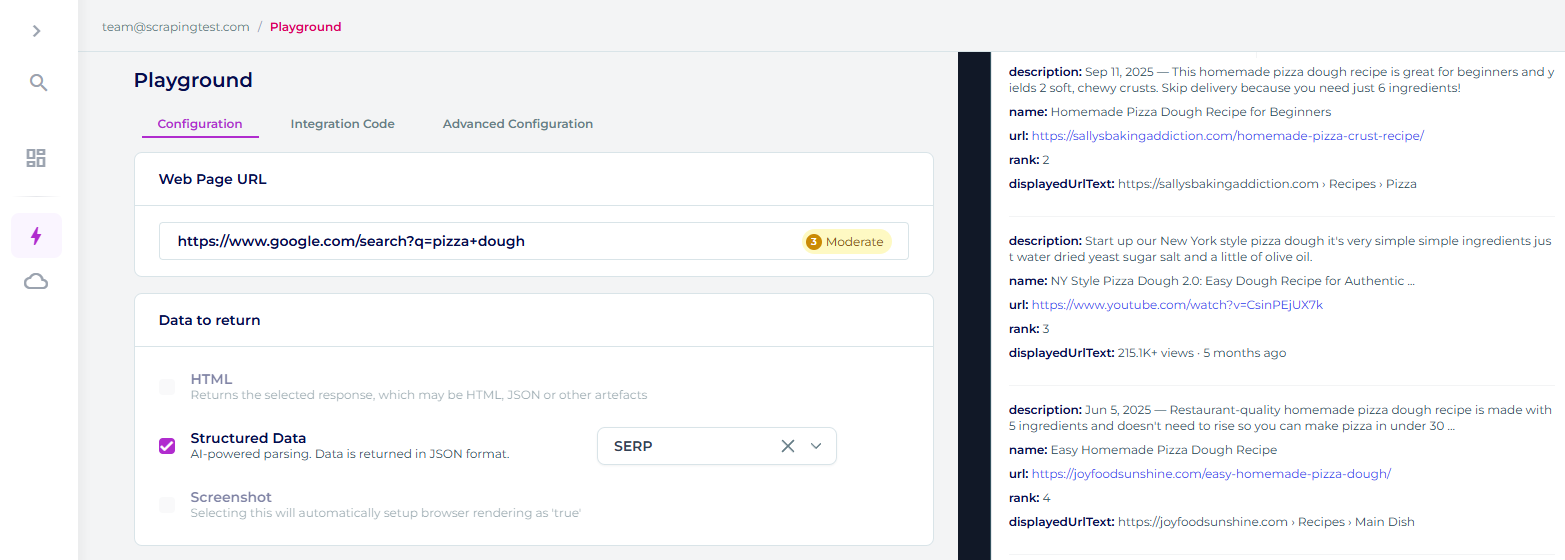
Zyte is the cheapest option at $0.43 per 1,000 requests, a 58x cost reduction over SerpApi. But that number needs context. Zyte returns organic results only. Zero SERP features were detected across all 25 test queries: no AI Overview, no PAA, no sitelinks, no dates, no videos, no news, no discussions. Richness score: 0.0.
Reliability also dipped slightly. One 520 error appeared in 25 queries (96% success rate). Every other API in the benchmark returned 100% success.
import requests

response = requests.post("https://api.zyte.com/v1/extract",
    json={"url": "https://www.google.com/search?q=best+web+scraping+api&gl=us&hl=en",
          "serp": True},
    auth=("<your_token>", "")
)
data = response.json(){
"serpResult": {
"organicResults": [
{"name": "Best Web Scraping APIs...", "url": "https://...", "rank": 1}
]
}
}No ai_overview. No people_also_ask. No sitelinks. The response is a list of organic URLs, titles, and descriptions. Nothing else.
Why Choose Zyte Over SerpApi
Only one scenario makes sense: bulk organic link harvesting where the use case is collecting ranking URLs at the lowest possible cost, and no SERP features are needed.
Cost: $0.43 per 1,000 requests vs $25.00. 58x cheaper. The largest cost reduction in this benchmark.
Speed: 5.29s average. 2.7x slower than SerpApi.
What you get: organic URLs, titles, descriptions, and ranking positions.
What you lose: everything else. AI Overview, PAA, sitelinks, dates, videos, news, discussions. All missing.
Teams running large-scale rank tracking on a tight budget where only position and URL matter will find the 58x savings worthwhile. For any workflow that depends on SERP features, AI Overviews, or structured metadata beyond basic organics, Zyte is not a SerpApi replacement.
What to Pick
Best overall SerpApi replacement: Scrape.do. 21.6x cheaper, 12% faster, 60% AI Overview detection, richest output among all alternatives at a 3.6 richness score. Covers AI Overview, PAA, videos, news, related searches, and local pack.
Best budget alternative with AI Overview: ScrapingDog. $2.00/1K requests, 48% AI Overview detection. Leaner output but captures the essentials at 12.5x less than SerpApi.
Best for organic result detail: ScrapingBee. Closest match to SerpApi's sitelinks (64%), dates (76%), and PAA answers (64%). The only mid-tier option that extracts all three.
Cheapest raw extraction: Zyte. $0.43/1K, but organics only. Zero SERP features. Makes sense for bulk URL harvesting and nothing else.
Not recommended: ScraperAPI. Only 2x cheaper than SerpApi, 5.7x slower, and missing AI Overview entirely. Every other alternative in this list offers better value.
FAQ
Why is SerpApi so expensive?
SerpApi charges per search, not per credit. The $25/mo Starter plan includes only 1,000 searches. The pricing model targets low-volume enterprise users and researchers, not developers running tens of thousands of queries monthly.
Alternatives use credit-based systems where SERP requests cost 1 to 25 credits drawn from larger pools. This makes the per-request cost 2x to 58x lower depending on the provider. SerpApi also invests in broad search engine coverage (Google, Bing, Yahoo, Baidu, and more) and structured JSON for dozens of SERP features, which factors into the premium.
How to get SerpApi for free?
SerpApi offers 250 free searches per month on its free plan. No credit card required for signup. That allocation is enough for testing and prototyping, but production workloads will exceed 250 searches quickly.
For more free SERP data, Scrape.do provides 1,000 free credits monthly, which translates to 100 Google SERP requests at 10 credits each.
Is there an open source SerpApi alternative?
Open source options exist: SerpStack (limited free tier), Google Search Results gem (Ruby), and serp-parser (JavaScript). These parse Google HTML directly.
The tradeoff is infrastructure. Open source tools require managing proxy rotation, handling CAPTCHAs, maintaining parsers when Google changes its HTML, and scaling request throughput. Managed alternatives like Scrape.do handle all of that while costing 21.6x less than SerpApi. The operational overhead of self-hosting, from proxy rotation to rate limit management, often exceeds the cost savings from avoiding a paid API.
What is the cheapest SERP API?
Zyte at $0.43 per 1,000 requests for organics-only extraction. No SERP features included. Scrape.do at $1.16 per 1,000 requests for full SERP data including AI Overview, PAA, videos, news, and related searches.
The "cheapest" depends on data requirements. Zyte wins on raw price. Scrape.do wins on cost per feature.
Conclusion
SerpApi's $25/1K pricing made sense when it was one of the few structured SERP APIs available. In 2026, that is no longer the case. Six alternatives deliver comparable data at 2x to 58x lower cost.
Scrape.do comes out as the strongest overall replacement: faster response times, 60% AI Overview detection, and the richest output among alternatives at $1.16/1K. For teams with specific needs, ScrapingBee matches SerpApi's organic detail depth, ScrapingDog offers AI Overview on a budget, and Zyte handles bulk organic extraction at rock-bottom pricing.
The benchmark data covers 25 identical queries across all seven APIs.
For a hands-on scraping guide, see scraping Google Search results.
The comparison table at the top of this article is the quickest reference for the metrics that matter most to your use case.
Head of Marketing