Category:Scraping ToolsView as Markdown
Best Bing SERP API in 2026: 5 Providers Benchmarked on 560 Live Searches

Head of Marketing


Microsoft shut off the Bing Search API on 11 August 2025. Endpoints that had been running for years started returning 410 Gone, and there was no drop-in replacement waiting.
What Microsoft points you to instead is Grounding with Bing, inside Azure AI Agent Service, at roughly $35 per 1,000 queries. It returns agent-style answers, not ranked results. If you track rankings, monitor ads, or build SEO tooling, that is not a replacement. It is a different product wearing the same brand.
So everyone who still needs Bing results now buys them from somebody else. We ran 560 live searches across 9 providers to find out who actually delivers, scoring on four things that matter: does the request succeed, how fast does it come back, what does it cost, and do you get parsed data or a page to parse yourself.
1. ScrapingDog
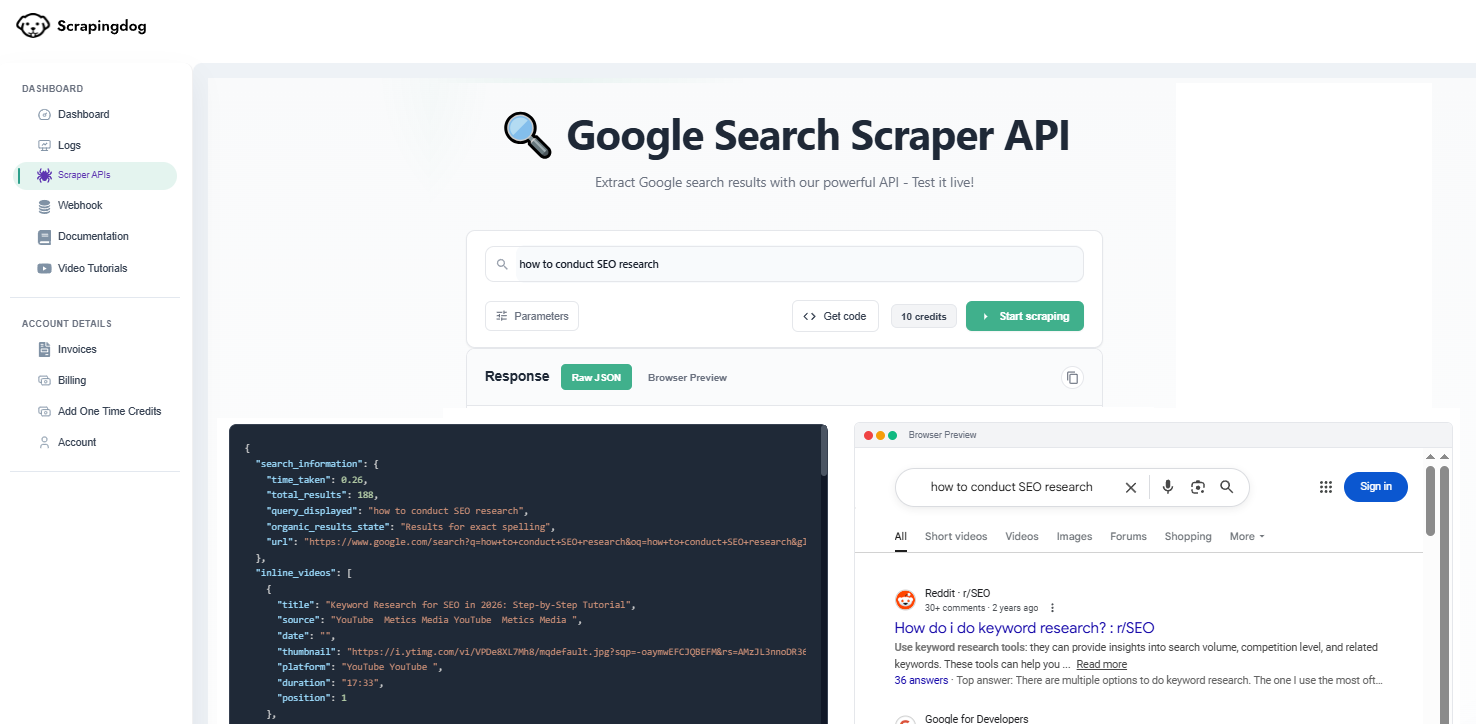
100% success. Around 800 ms. $1.00 per 1,000. Structured JSON.
ScrapingDog won on every axis at once, which almost never happens in these tests. Forty requests, forty clean responses, averaging under a second. The results arrive parsed, with real destination URLs already resolved.
That last part matters more than it sounds, and I'll come back to it further down.
The comparison that says the most: ScrapingDog is roughly 16 times faster than SerpApi at one twenty-fifth of the price, returning the same ten organic results per query. Not a marginal win. A different category of product at a different price.
If you want one recommendation and no further reading, this is it.
2. Scrape.do
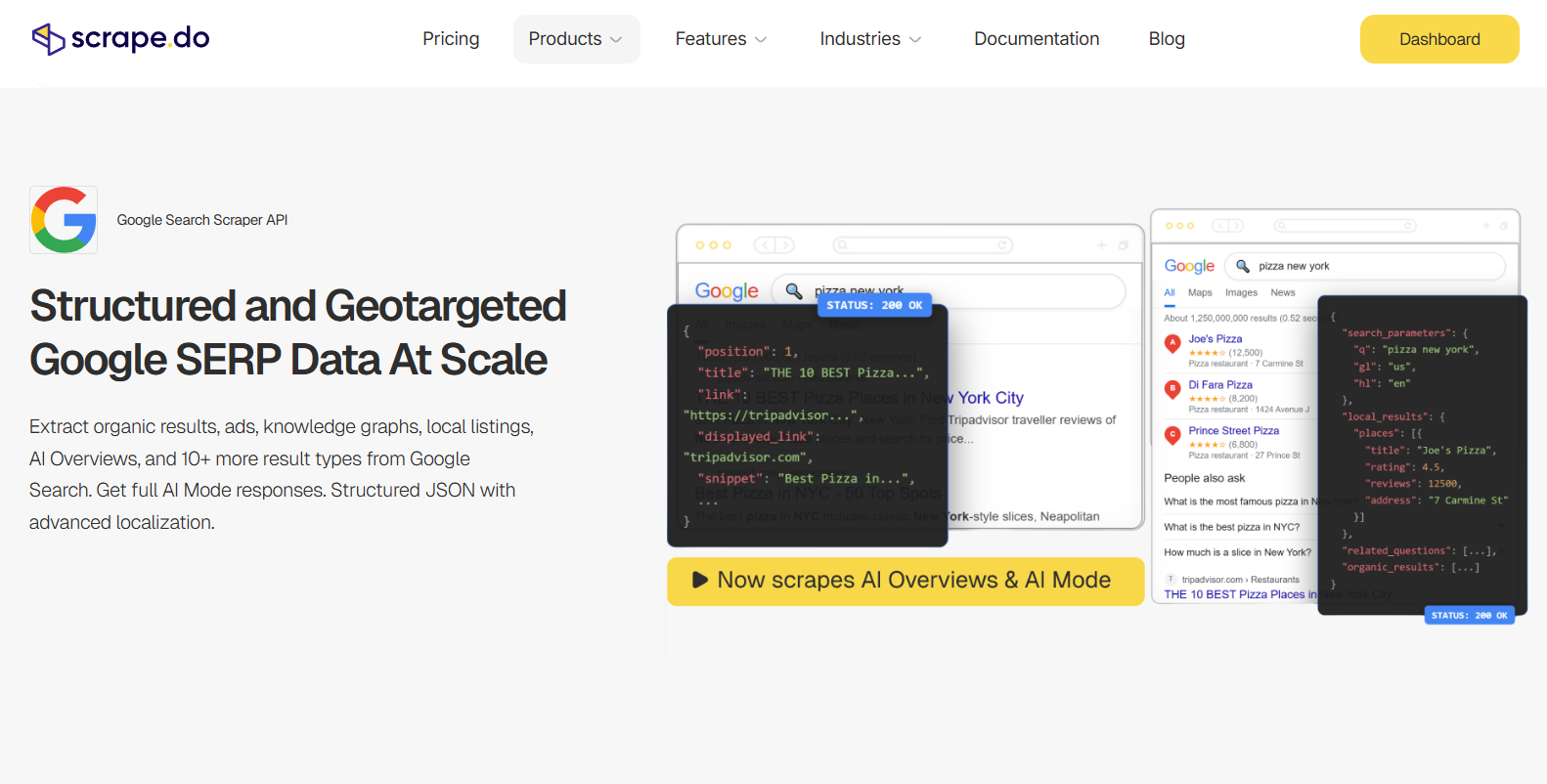
95% success. Around 1.8 seconds. $0.11 per 1,000. Raw HTML.
Full disclosure, this is our blog and Scrape.do is our product. So let me be specific about why it is second and not first.
The price is the lowest measured here by a wide margin. At $0.11 per 1,000 it undercuts ScrapingDog roughly nine to one, and nothing else in the test comes close.
But it returns raw HTML, not structured JSON. You get a Bing page and you parse it yourself, which means two ongoing costs. You maintain the parser. And every destination URL arrives wrapped in Bing's click-tracking redirect, looking like bing.com/ck/a?... rather than the site that actually ranked. Resolving those means one extra HTTP request per result, and at ten results a query that is ten times the requests. The sticker price stops being the real price.
The 95% is worth naming precisely too. Four failures across 80 requests, all of them thin result sets rather than blocks or bot walls. Bing never shut us out. It occasionally returned a shallow page.
For high-volume work where you already own a parser and do not need destination URLs, this is the cheapest way to get Bing at scale. For rank tracking, buy structured output from ScrapingDog and skip the redirect problem entirely.
3. SerpApi
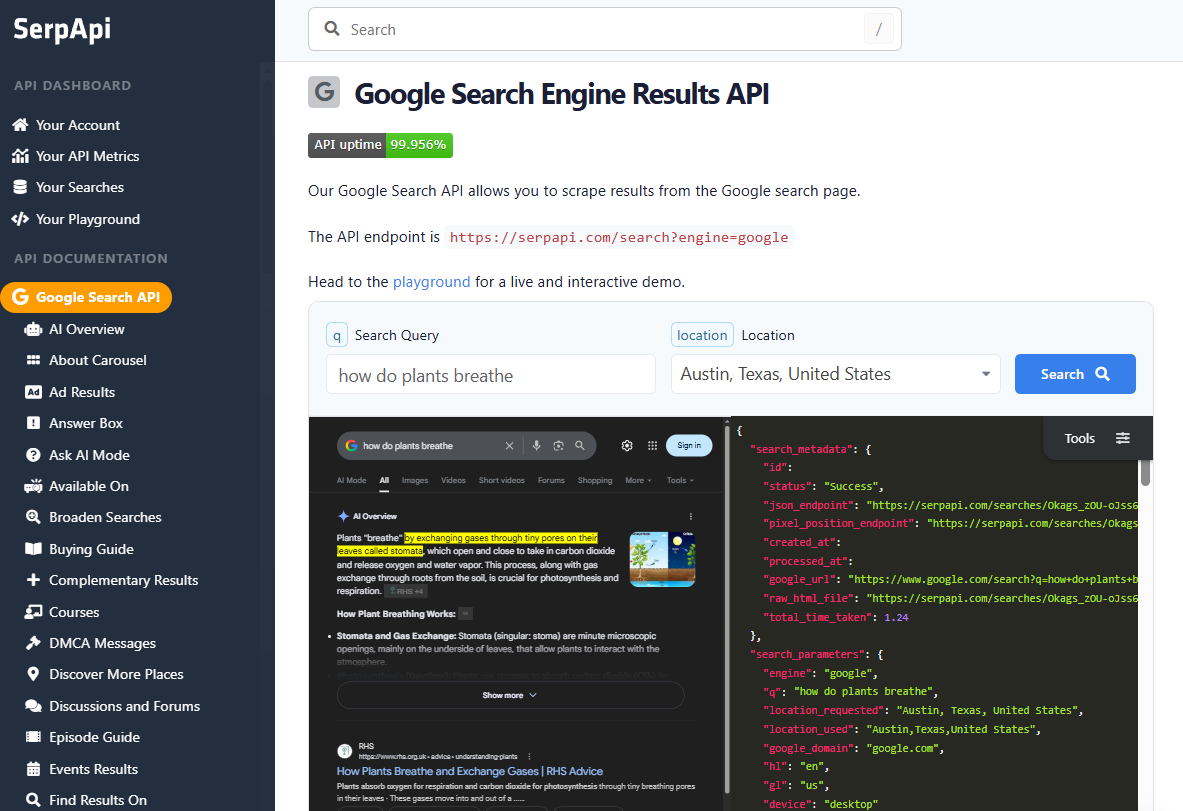
100% success. Around 13 seconds. $25.00 per 1,000. Structured JSON.
SerpApi is reliable. Forty for forty, parsed output, resolved URLs, and 9.9 organic results per query, which is the deepest in the test by a hair.
It is also the slowest thing here by a factor of three, and the most expensive by a factor of twenty-five.
The Cache Problem
Here is the thing that nearly broke our benchmark, and the reason every speed number here is what it is.
Run a query against SerpApi twice and the second response comes back in 149 milliseconds. Run the same query with caching explicitly disabled and it takes 16,651 milliseconds. That is a 110x difference between the number you see in a casual test and the number you get in production on a query nobody has run before.
Every figure we publish uses unique queries with cache-busting forced on. If you have benchmarked SerpApi yourself and got a much friendlier result, check whether you were measuring the cache.
SerpApi covers 25-plus search engines, and that breadth may well justify the price if you need Google, Bing, Baidu, and Yandex behind one contract. On Bing alone, you are paying 25 times ScrapingDog's price for a slower response and no extra SERP features. We make the same argument about its Google pricing in our SerpApi alternatives comparison.
4. WebScrapingAPI
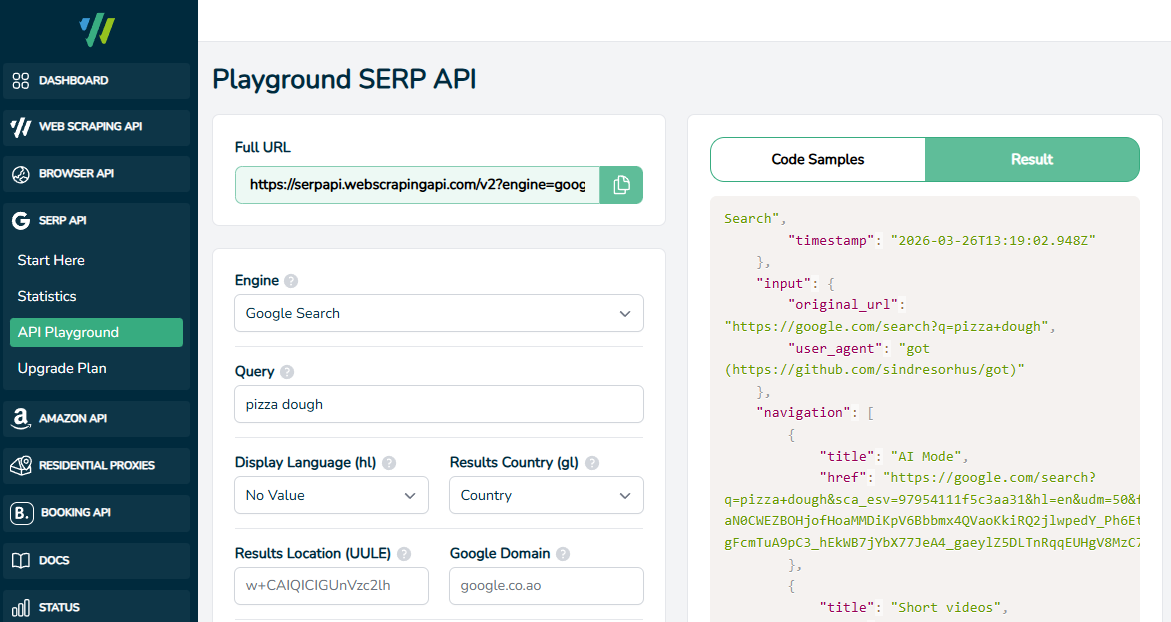
85% success. Around 12 seconds. $2.88 per 1,000 verified. Structured JSON.
Six failures in forty requests, all thin results. Structured output with resolved URLs, which puts it on the right side of the redirect problem.
The number that should shape how you use it is not in the average. Some responses took over 50 seconds. A typical call lands around four seconds, so the spread between usual and worst case is roughly thirteen to one. Any client you point at it needs a timeout above 60 seconds, or you will manufacture failures that are really just slow successes.
Note the price column carefully. The sticker is $2.45, but failed requests still bill, so 85% success makes the real cost of a thousand usable results $2.88.
5. BrightData
70% success. Around 7 seconds. $4.64 per 1,000 verified. Structured JSON.
Twelve failures out of forty. Nearly one request in three came back unusable, which is the weakest reliability we measured on Bing by a clear margin. The failures were thin result sets on navigational queries, two to four organic results where other providers returned ten.
I would not run production Bing tracking on this.
There is exactly one reason it is on the list rather than off it. BrightData was the only provider that returned related searches, averaging 4.7 per query. Nobody else returned any. Nobody at all, including BrightData, returned People Also Ask.
So if you specifically need Bing SERP features rather than the ten blue links, BrightData is currently the only option that gives you any, and you accept a 70% success rate to get them. That is a narrow, real use case. For everything else, look higher up this list.
Why This List Is Mostly Structured APIs
We tested nine providers. Five are here. The rule that decided it is worth stating openly, because it also explains the ordering.
Structured JSON providers return resolved destination URLs. Raw HTML scrapers return Bing's redirect wrappers. Here is the same result from both classes:
structured → https://www.rtings.com/headphones/reviews/best/wireless-earbuds
html       → https://www.bing.com/ck/a?!&&p=80d2d23803c04a85c1e75f3113203e17...
If you need to know which site ranked, and for rank tracking or competitor monitoring that is the entire point, the HTML version costs you an extra request per result to unwrap. Ten results, ten extra requests. The cheap per-request price stops meaning what it looks like it means.
That is why four HTML-only providers we tested (ZenRows, ScrapingBee, Scrapfly, ScraperAPI) are not covered in depth here, despite ZenRows and ScrapingBee both posting 100% success rates. They work. They just hand you a parsing job and a redirect problem alongside the data.
Scrape.do is the exception, included because this is its blog. And it sits at number two rather than number one for precisely the reason above, despite having the lowest price in the entire test.
The Bing Search API Is Gone
The official API retired on 11 August 2025. Existing integrations did not degrade gracefully; endpoints began returning 410 Gone.
Microsoft's suggested path forward is Grounding with Bing Search, which lives inside Azure AI Agent Service and runs about $35 per 1,000 queries. It is built to feed an AI agent a synthesized answer. It does not hand you ranked organic results with positions and URLs, so rank trackers, ad monitors, and SEO platforms cannot migrate to it at any price.
That leaves third-party SERP APIs, or scraping Bing yourself. If you would rather build it, we have a full walkthrough on scraping Bing with Python covering search, images, news, and shopping.
Worth knowing while you decide: Bing is substantially easier to scrape than Google. Every failure in this entire benchmark was a thin result set. Not one provider hit a bot wall or a CAPTCHA. In our Google sweep earlier this year, one provider scored 0% and another 42%. Nothing collapsed like that here.
How We Tested
Forty unique queries per provider, 560 live requests in total, run on 2026-09-21.
Success was measured on content, not status codes. A 200 response carrying an empty or two-result page is a failure, and counting it as a success is how vendor benchmarks end up claiming 100% across the board.
Cache-busting was mandatory on every request, for the reason laid out in the SerpApi section. Without it the speed rankings are fiction.
Two disclosures, because a benchmark you cannot poke holes in is a benchmark nobody should trust:
Oxylabs is excluded, not scored zero. Its domain failed the TLS handshake from our test machine while all nine other providers connected normally. That reads as a local network or DNS interception problem on our side, not an Oxylabs fault, and scoring it 0% would have been dishonest. Untested, not failed.
Three bugs in our own harness surfaced mid-run and were fixed. A title-length check was rejecting the legitimate three-character result "Git". A URL-based consensus check was invalid across output classes, comparing resolved URLs against redirect wrappers, and was replaced with title-based comparison within each class. And the first full run was contaminated by cached smoke tests, so we threw it away and ran it again.
One more thing the repeat runs taught us. We measured five providers twice, in independent runs. Success rates held within 0 to 7.5 points. Latency moved by as much as 79%. Treat any single-run speed figure, including ours, as directional. Success rate is the metric that reproduces.
Providers We Could Not Test
No credentials in our lab, so these are published prices rather than measured results:
| Provider | Bing $/1K | Note |
|---|---|---|
| DataForSEO | $0.60 standard, $2.00 live | Queue model, live mode around 6 s |
| Serper | ~$1.00, to $0.30 at volume | |
| Olostep | ~$1.80, to $0.40 at volume | Dedicated Bing endpoint |
| SERPHouse | $0.62 to $0.75 | |
| Brave Search | ~$5.00 | Independent index, not Bing |
Brave deserves the bold. It is a genuinely good search API, and it is not a Bing substitute. Brave runs its own index, so if you are tracking Bing rankings, Brave answers a different question and the numbers will not match.
Which One to Pick
Rank tracking, or anything that needs destination URLs: ScrapingDog. Structured output, resolved URLs, 100% success, and fast enough that you will not build a queue around it.
Highest volume, lowest cost, parser already in place: Scrape.do at $0.11 per 1,000, as long as you have budgeted for resolving redirect wrappers.
Multiple search engines on one contract: SerpApi, on breadth rather than Bing performance. Just go in knowing what you pay for it.
Bing SERP features: BrightData is the only source of related searches we found, and you accept a 70% success rate to get them.
Conclusion
Microsoft leaving the market did not break Bing data. It moved it.
The replacement market is healthier than the shutdown noise suggests: two providers hit 100% success in our tests, the fastest returned results in under a second, and prices run from eleven cents to twenty-five dollars per thousand for what is fundamentally the same ten links.
The spread is the story. Know whether you need parsed output before you shop on price, because that single decision changes which end of this list you should be reading.
Get 1000 free credits and start scraping with Scrape.do
FAQ
Does Bing have a free API?
Not anymore. The Bing Search API retired on 11 August 2025 and its free tier went with it. Microsoft's Grounding with Bing Search runs around $35 per 1,000 queries and returns agent answers rather than ranked results. Several third-party providers offer free trial credits, and Scrape.do includes 1,000 free credits monthly, but there is no free official Bing search endpoint in 2026.
Is the Bing Search API still available?
No. Microsoft announced the retirement in May 2025 and decommissioned the endpoints on 11 August 2025. Requests now return 410 Gone. Existing integrations had to migrate to third-party SERP APIs or to scraping Bing directly, because the official replacement serves a different purpose.
Can I use a SERP API for free?
Most providers offer trial credits rather than a permanent free tier. Typical trials run a few hundred to a few thousand requests, which is enough to benchmark a provider against your own queries before committing. For ongoing production use at any real volume, expect to pay, and note that effective cost matters more than sticker price since failed requests still bill.
What is a SERP API?
A SERP API returns search engine results as data rather than as a web page. Send a query, get back the ranked results with titles, URLs, and positions. Structured providers hand you parsed JSON with destination URLs resolved. Raw HTML providers hand you the search page and leave the parsing, and the redirect unwrapping, to you.
Head of Marketing