Category:Scraping BasicsView as Markdown
Web Scraping vs API: When to Use Each for Getting Data

Software Engineer


Every data project starts with the same question: does the site I need already publish an API, and if it does, is that API actually good enough?
The answer decides your architecture, your monthly bill, and how many pages you will be repairing six months from now. Getting it wrong in either direction is expensive. Teams that scrape a site with a perfectly good free API burn engineering time on parsers they never needed. Teams that build on an official API sometimes wake up to a pricing page that changed overnight.
This is a practical comparison of the two approaches, with the tradeoffs that actually matter once you are past the prototype.
What Each Approach Actually Is
An official API is a contract. The site operator exposes specific endpoints, documents the fields, publishes a rate limit, and issues you a key. You send an authenticated request, you get back JSON that follows a schema they promised to keep stable. When they change it, they usually version it and tell you first.
Web scraping takes the same data from the surface the site shows to human visitors. You request the HTML a browser would receive, then pull values out of it with selectors, or you call the internal JSON endpoints the site's own frontend uses. No key, no contract, no schema guarantee. Just whatever is on the page.
That middle case is worth flagging early, because it blurs the line. Plenty of sites with no public API still ship a fully structured JSON payload to their own frontend, embedded in the page or fetched by an XHR call you can watch in DevTools.
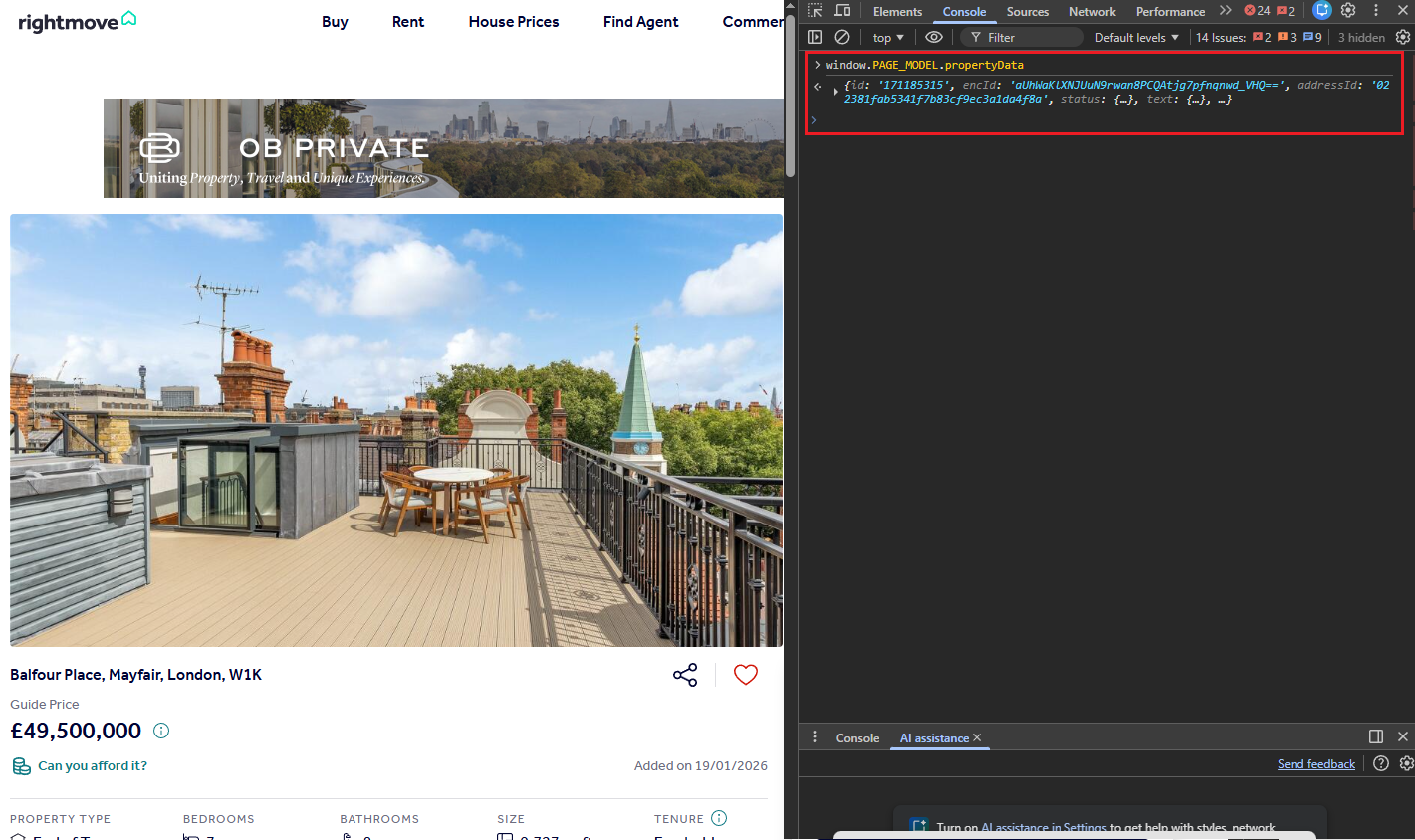
Finding one of these turns a parsing job into something that looks almost exactly like an API call, minus every guarantee.
The mental model that helps: an API is the front door with a guest list, and scraping is reading the public notice board. Both get you information the site chose to publish. One of them requires permission and gives you structure in exchange.
The Case for the Official API
Start here every single time. Check the docs before you write a selector.
The data comes back structured. No parsing, no selector maintenance, no guessing whether the price element is .a-price or .a-offscreen this week. You get typed fields with names.
Authentication buys you private data. Your own orders, your own analytics, your own account state. Scraping cannot reach any of it without credentials you would be putting at risk anyway.
Writes are only possible through an API. Posting a listing, updating inventory, sending a message. Scraping is read-only by nature.
The contract is enforceable in both directions. Versioned endpoints, deprecation notices, a status page when things break, and a support channel when the response looks wrong.
Rate limits are published, so capacity planning is arithmetic. If the API allows 100 requests per minute and you need 1M records at 50 per page, you know exactly how long the job takes before you write any code.
If the official API covers your fields, at a volume you can afford, at a price that makes sense, use it. This is not a close call.
The Case for Scraping
The problems start when one of those conditions fails, and in practice at least one usually does.
Coverage gaps
APIs expose what the operator wants exposed, which is rarely everything visible on the page. Search rankings, competitor listings, review text, seller names, promotional badges, "customers also bought" blocks. All of it renders in the browser. Almost none of it appears in a typical public API response. If the field you need is on the page but not in the docs, the decision has already been made for you.
Pricing that moves under you
This is the risk that burned the most teams in recent years, and Reddit is the textbook case.

For years Reddit's API was free and generous. In June 2023 the company introduced paid pricing that landed at roughly $0.24 per 1,000 API calls. For most hobby projects that was survivable. For Apollo, a popular third-party Reddit client, the developer publicly estimated the new terms would cost around $20 million a year. Apollo shut down. So did several other clients. Nothing about the underlying content changed. The access terms did.
Twitter/X ran a similar play the same year, retiring free API access and moving to tiers where meaningful volume costs thousands of dollars a month.
The lesson is not "APIs are traps." It is that an API is a business decision owned by someone else, and business decisions get revised. Scraping the public page has no vendor pricing page attached to it.
Rate limits that do not match your job
Public APIs are sized for typical integrations, not for backfills. An endpoint capped at 60 requests per minute makes a 5M-record job take weeks. Scraping through a distributed proxy pool moves that same job into hours because concurrency is a function of your infrastructure rather than a number in someone's terms of service.
Rate limits also bite scrapers, of course, just in a different shape. Instead of a documented quota you get a 429 with no explanation.

The difference is that an API rate limit is a hard ceiling you cannot exceed, while a scraping rate limit is an engineering problem with known solutions. We cover those in detail in rate limit in web scraping.
No API exists at all
Most of the web has no API. Local business directories, regional retailers, government portals, job boards, forums. If you need that data, scraping is not one option among several.
Side by Side
| Dimension | Official API | Web Scraping |
|---|---|---|
| Data structure | JSON with a documented schema | HTML or internal JSON you parse yourself |
| Coverage | Only fields the operator chose to expose | Anything rendered on the page |
| Access control | API key, often with an approval process | No key, but anti-bot systems in the way |
| Rate limits | Published hard ceiling per key | Soft, defeated by proxy rotation and pacing |
| Cost model | Per call or per tier, set by the vendor | Per request through your own infrastructure |
| Price stability | Can change with notice, sometimes 10x or more | Stable, driven by your proxy and compute costs |
| Breakage cause | Version bumps, usually announced | Layout changes, never announced |
| Maintenance | Low, occasional migration work | Ongoing selector and anti-bot upkeep |
| Private/account data | Yes, with authentication | No |
| Writes | Yes | No |
| Legal footing | Terms of service you accepted explicitly | Public data, jurisdiction-dependent |
Two Approaches in Code
Here is what a public API call looks like. Clean, short, and entirely dependent on the endpoint staying where it is.
import requests

# Public API: structured response, documented fields, published rate limit
resp = requests.get(
    "https://api.example-store.com/v2/products",
    headers={"Authorization": "Bearer YOUR_API_KEY"},
    params={"category": "laptops", "limit": 50},
)

for product in resp.json()["products"]:
    print(product["name"], product["price"], product["stock"])
And here is the scraping equivalent for a field the API does not return. Note that the hard part is not parsing, it is getting a clean response back at all, which is what the scraping API layer handles.
import requests
from bs4 import BeautifulSoup
from urllib.parse import quote

TOKEN = "YOUR_TOKEN"
TARGET = quote("https://example-store.com/category/laptops", safe="")

# Scraping: proxy rotation, headers and anti-bot handled by the endpoint
resp = requests.get(
    f"https://api.scrape.do/?token={TOKEN}&url={TARGET}&super=true"
)

soup = BeautifulSoup(resp.text, "html.parser")

for card in soup.select("div.product-card"):
    name = card.select_one("h3.title").get_text(strip=True)
    price = card.select_one("span.price").get_text(strip=True)
    # Fields no public API exposes:
    rank = card.get("data-search-position")
    badge = card.select_one("span.promo-badge")
    print(name, price, rank, badge.get_text(strip=True) if badge else None)
The second block is longer because it is doing more. It is also the only one of the two that can return search position and promotional badges.
A Decision Framework
Run these in order and stop at the first clear answer.
1. Does an official API exist and cover every field you need? If yes, use it. Do not scrape a site that hands you the data for free.
2. Do you need private or account-scoped data, or do you need to write? API only. Scraping cannot do either.
3. Is the API price acceptable at your real volume, not your prototype volume? Multiply by 12 months and by your growth plan. Reddit's 2023 change turned a $0 line item into an eight-figure one for the largest consumers. If a 10x price move would kill the project, treat the API as a dependency risk rather than a foundation.
4. Do the published rate limits let you finish the job on schedule? Divide total records by the limit. If the answer is measured in weeks and you need days, scraping is the only path to your deadline.
5. Is the data you need actually on the page but missing from the docs? Scrape. This is the most common outcome in competitive intelligence, price monitoring, and SERP work.
6. Do you need both? Very often the right answer is a hybrid. Pull authenticated and structured data from the API, scrape the public surface for the fields the API omits, and reconcile on a shared key like SKU or listing ID. Most mature pipelines look like this.
The Maintenance Question Nobody Asks Early
Cost comparisons usually stop at price per request, which understates the real difference.
An API costs you money and almost no engineering time. A self-managed scraper costs you less money and considerably more engineering time: proxies to rotate, headers and fingerprints to keep current, CAPTCHAs to solve, JavaScript to render, and selectors that break whenever the target ships a redesign.
That maintenance load is the actual argument against DIY scraping, and it is also the reason web scraping APIs exist. They put an API-shaped interface in front of scraping so you get one endpoint and structured retries, while still reading the full public page rather than a curated subset of it. You keep the coverage advantage and hand off the infrastructure.
If you are going the self-managed route, budget seriously for the proxy layer. It is the single largest source of silent failure. Rotating proxies are not optional at any real volume.
FAQ
Is scraping legal if an official API exists? The existence of an API does not by itself make scraping illegal, but it does strengthen a site's argument that you had a sanctioned path and chose not to use it. Public data collection has generally held up in US courts, while terms of service, copyright, and personal data rules all still apply. See our breakdown of web scraping legality before you scale anything sensitive.
Should I check robots.txt before scraping? Yes. It is not legally binding in most places, but it tells you what the operator considers off limits, and ignoring it is the fastest way to end up on a block list. Details in our robots.txt guide.
Which is cheaper at scale? Depends entirely on the vendor's pricing. Scraping through a good scraping API often lands well under a dollar per thousand requests. Official APIs range from free to several dollars per thousand calls, and social platform APIs at enterprise tiers run into thousands of dollars per month. Price out both against your actual monthly volume.
Do internal JSON endpoints count as an API? Functionally they behave like one, and they are usually much easier to work with than HTML. But they are undocumented and unversioned, so the site can change or remove them without warning. Treat them as scraping targets with better ergonomics, not as a stable contract.
Can scraping replace an API for real-time data? For read-only public data, yes. Latency is comparable once you have a warm proxy pool. What scraping cannot replace is webhook-style push, where the API notifies you the moment something changes. Polling a page is not the same thing.
Where That Leaves You
Check for an official API first, always. Use it when it covers your fields at a volume and price you can live with, and when you need authentication or writes.
Scrape when the API leaves out the data you actually need, when its rate limits will not let you finish, when the pricing is a business risk you do not control, or when no API exists in the first place. Most production pipelines end up running both.
Ready to pull the fields the official docs left out? Start scraping free with Scrape.do and get 1,000 credits, no credit card required.
Software Engineer