Category:ProxyView as Markdown
Best Web Scraping Proxy Providers and Why You Need One

Web Scraping Expert


No matter which real-world website you want to scrape, once your operation scales, you will likely need proxies. This is why dozens of proxy providers offer solutions built around web data collection scenarios.
In this article, you will learn why proxies are needed in the first place, which proxy types are best suited for data retrieval, and which web scraping proxy providers are worth considering. You will also see how to configure proxies for scraping and verify the IP addresses they use.
Let’s dive in!
TL;DR: Web Scraping Proxy Comparison Table
| Provider | Best for | Proxy IP pool | Country coverage | Geotargeting | Success rate | Reviews (Trustpilot) | Free forever plan | Residential entry price |
|---|---|---|---|---|---|---|---|---|
| Scrape.do | Scraping API integrations with built-in proxy management | 150M+ | 142 | ✅ | 99.98% | 4.8/5 | ✅ (1K credits a month) | Included in API plans (29/mo for the entry price) |
| Bright Data | Enterprise-scale scraping and data collection | 400M+ | 195 | ✅ | 99.95% | 4.4/5 | ❌ | $4.00/GB |
| Oxylabs | Shared and dedicated datacenter proxies | 177M+ | 195 | ✅ | 99.95% | 4.0/5 | ❌ | $6.00/GB |
| Decodo | Dedicated ISP proxies | 125M+ | 195+ | ✅ | 99.92% | 4.2/5 | ❌ | $4.00/GB |
| Webshare | Private datacenter and ISP proxies | 80M+ | 195+ | ✅ | 99.7% | 4.1/5 | ✅ (1 GB/mo) | $3.50/GB |
| Rayobyte | Cost-effective static ISP proxies | 40M+ | 163+ | ✅ | ~99% | 4.1/5 | ❌ | $3.50/GB |
| IPRoyal | Mobile proxy use cases | 69M+ | 195+ | ✅ | 99.4% | — (removed for fake reviews) | ❌ | $7.35/GB |
| SOAX | Flexible sessions and multi-protocol scraping | 155M+ | 195 | ✅ | 99.95% | 3.4/5 | ❌ | $5.00/GB |
Why Use Proxies for Web Scraping
Web scraping involves sending automated requests to web pages to extract data from them. Target servers can monitor incoming traffic and block your IP address if you send too many requests or if your IP does not appear to originate from a specific region.
Proxies help address these issues by routing traffic through intermediary servers that relay requests to the destination. As a result, the website sees requests coming from the proxy IP rather than your own. This approach can help avoid rate limits, IP blocks, and other access restrictions.
Best Type of Proxy for Web Scraping
Web scraping requires different proxy types to handle various site protections and scenarios. At a high level, there are four main categories you need to know.
Residential Proxies
Real ISP-registered IPs from legitimate residential networks worldwide. Residential traffic appears as genuine users, bypassing most IP-based blocking and anti-bot detection systems.
🌐 Origin: Real home computers, smartphones, laptops, and smart devices from volunteer network participants who opt in
📌 Main use cases:
- Scraping heavily protected sites
- Accessing geo-restricted content by location
- Avoiding rate limiting issues
👍 Pros:
- Highest legitimacy
- Millions of IPs globally
- Automatic IP rotation prevents detection and blocking
👎 Cons:
- Slower speeds and higher latency due to reliance on end-user connections
- Disconnections and session changes
Datacenter Proxies
IPs hosted on datacenter servers, not tied to ISPs or real devices. Fastest and most affordable option for basic web scraping tasks.
🌐 Origin: Datacenter facilities housing servers and networking equipment for data processing and storage
📌 Main use cases:
- Large-scale data collection from unprotected sites
👍 Pros:
- Lightning-fast response times and exceptional performance
- Most cost-effective proxy option available
- Unlimited concurrent connections for high-volume scraping
👎 Cons:
- Easily detected and blocked by anti-bot systems
- Reliable datacenters may not be available in all countries
ISP Proxies
Static residential-grade IPs from ISP servers in datacenters. Combines datacenter speed with residential legitimacy for reliable, long-term sessions.
🌐 Origin: Networks backed by ISPs and hosted on datacenter infrastructure, not end-user devices
📌 Main use cases:
- Long-duration sessions from high-reputation residential IPs, without rotation needs
👍 Pros:
- Highly stable IPs
- Datacenter-level speed with residential legitimacy
- Trusted by enterprises for compliance-heavy operations
👎 Cons:
- Limited availability and rotation options
- High prices
Mobile Proxies
Real 3G/4G/5G mobile carrier IPs from legitimate mobile devices. Highest legitimacy level for accessing mobile-first platforms and apps.
🌐 Origin: Mobile devices connected to cellular carrier networks worldwide
📌 Main use cases:
- Social media platform scraping
- Bypassing mobile-specific anti-bot verification systems
👍 Pros:
- Maximum legitimacy from real mobile carrier networks
- Most effective for social media and mobile platforms
- Eliminates verification prompts on mobile-first sites
👎 Cons:
- Highest cost among all proxy types
- More difficult to source
How to Choose a Web Scraping Proxy Service
There is a plethora of services offering proxies for web scraping. Each comes with different proxy pools, pricing options, and supported scenarios.
Selecting the best scraping proxy provider among them is not easy. That is why you need a structured set of criteria. Here are the main factors you should take into account before making a decision:
- Types: Proxy types supported for web scraping, including residential, datacenter, ISP, and mobile proxies.
- IP pool: The number of IPs offered by the provider, either overall or by proxy type.
- Country coverage: The countries where you can route requests for each type of proxy for web scraping.
- Geotargeting options: The available targeting levels, such as country, region, city, ZIP code, and ASN.
- Success rate: The provider's advertised success rate for requests made through its proxy network.
- Reviews: Ratings and review volumes from Trustpilot and G2.
- Pricing: Current pricing for each proxy type, including usage-based and subscription options.
Web Scraping Proxy Services: Comparing the 8 Top Providers
Review the list of the best proxy providers for web scraping, carefully ranked and selected according to the criteria presented earlier.
1. Scrape.do
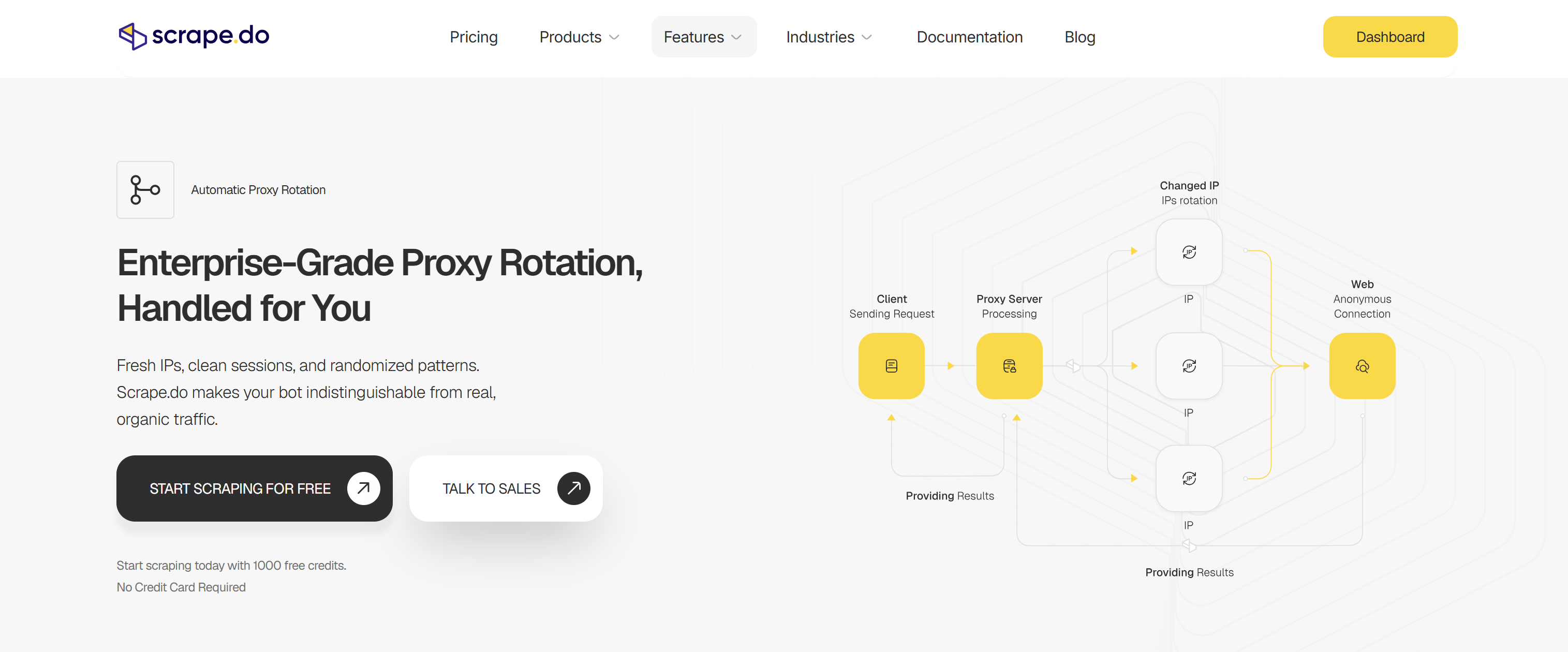
Scrape.do offers web scraping solutions designed to simplify web data extraction by handling proxy integration, CAPTCHAs, JavaScript rendering, and other challenges for you. Its proxy network includes more than 150 million IPs, with support for global geotargeting.
The company takes a web scraping-focused approach to proxy infrastructure. It integrates proxy management directly into its Web Scraping API, which includes a Proxy Mode that allows the API to operate as a passthrough proxy.
You send your scraping requests through the Web Scraping API and Scrape.do automatically rotates across residential, mobile, and datacenter proxies, selected automatically based on your request type and target domain. That means you do not need to specify additional setup or parameter configuration.
Altogether, these aspects make Scrape.do the best web scraping proxy service on the market.
Best for: Scraping API integrations, with built-in proxy integration and advanced geotargeting options
Types: Residential, datacenter, mobile
IP pool: 150M+ IPs
Country coverage:
- Residential: 142 countries
- Datacenter: 45 countries
Geotargeting options: Country, region, ZIP
Success rate: 99.98%
Reviews:
- Trustpilot: 4.8/5 (69 reviews)
- G2: 5/5 (5 reviews)
Pricing:
| Plan | Price | API credits | Concurrent requests | Key features |
|---|---|---|---|---|
| Free | $0/mo | 1K | 5 | Residential & mobile proxies, JS rendering, browser interactions, geotargeting, sticky sessions, and unlimited bandwidth |
| Hobby | $29/mo ($0.11/1K credits) | 250K | 10 | Email support |
| Pro | $99/mo ($0.08/1K credits) | 1.25M | 50 | Priority email support |
| Business | $249/mo ($0.07/1K credits) | 3.5M | 100 | Premium residential & mobile proxies, dedicated support, team management |
| Advanced | $699/mo ($0.06/1K credits) | 10M | 200 | Custom WAF bypass strategies, custom SLA, dedicated Slack support |
Note: You are charged credits only for successful requests
2. Bright Data
Bright Data is the leading option for enterprise-ready web data collection. Its web scraping solutions, including the Web Unlocker API, SERP API, and Web Scraping APIs, are backed by a proxy network of more than 400 million IPs across 195 countries. This infrastructure supports unlimited scalability and concurrency, with 99.99% uptime. Bright Data also features a dataset marketplace with petabytes of regularly updated web data.
Best for: Enterprise-scale web scraping, data collection, and proxy operations
Types: Residential, datacenter, ISP, and mobile proxies
IP pool:
- Residential: 400M+ IPs
- Datacenter: 1.3M+ IPs
- ISP: 1.3M+ IPs
Country coverage:
- Residential: 195 countries
- Datacenter: 98 countries
- ISP: 35 countries
Geotargeting options: Country, state/region, city, ZIP code, and ASN-level targeting available for residential proxies
Success rate: 99.95%
Reviews:
- Trustpilot: 4.4/5 (1,015 reviews)
- G2: 4.7/5 (346 reviews)
Pricing:
| Proxy type | Price range |
|---|---|
| Residential | $2.50/GB – $4.00/GB |
| Datacenter (Shared) | $0.90/IP – $1.40/IP |
| Datacenter (Dedicated) | $1.30/IP – $2.20/IP |
| Datacenter (Pay/GB) | $0.42/GB – $0.60/GB |
| ISP (Shared) | $1.30/IP – $1.80/IP |
| ISP (Dedicated) | $2.50/IP – $3.50/IP |
| ISP (Pay/GB) | $5/GB – $8/GB |
Notes:
- All proxy types offer pay-as-you-go plans with no long-term commitment
- A free Limited Trial is available to new users who add a valid payment method, giving them a $5 credit to use across the proxy services for 30 days
- Special promotions are available through which Bright Data matches your first deposit, up to $500
3. Oxylabs
Oxylabs is a premium web scraping proxy provider offering residential, datacenter, ISP, and mobile proxies. The company has an extensive pool of almost 200 million IPs, along with fast response times. It also provides a range of other web scraping products, including ready-to-use web datasets containing previously collected data.
Best for: Shared and dedicated datacenter IPs for high-volume scraping
Types: Residential, datacenter (shared and dedicated), ISP (shared and dedicated), mobile
IP pool:
- Residential: 175M+
- Mobile: 20M+
- Datacenter: 1M+ IPs
- ISP: Hundreds of thousands of IPs
Country coverage:
- Residential: 195 countries
- Mobile: 140+ countries
- Datacenter: 188 countries
- ISP: 28 countries
Geotargeting options: Continent, country, state/region, city, ZIP code, coordinates (latitude/longitude), ASN
Success rate: 99.9% (datacenter and ISP) - 99.95% (residential)
Reviews:
- Trustpilot: 4.0/5 (758 reviews)
- G2: 4.5/5 (423 reviews)
Pricing:
| Proxy type | Price range |
|---|---|
| Residential | $2.50/GB – $6/GB |
| Datacenter (Shared (pay per GB)) | From $0.59/GB |
| Datacenter (Shared (pay per IP)) | From $1.20/IP |
| Datacenter (Dedicated (pay per IP)) | From $2.25/IP |
| ISP (Dedicated) | $2.50/IP – $3.20/IP |
| ISP (Shared) | $1.20/IP – $1.60/IP |
| Mobile | $3.50/GB – $7.50/GB |
Note: Free trials are available for all types of proxies for web scraping
4. Decodo
Decodo is a web scraping and proxy platform offering 125M+ residential, datacenter, ISP, and mobile proxies, combined with scraping APIs. Formerly known as Smartproxy, the service serves thousands of clients globally with enterprise-grade infrastructure including ISO/IEC 27001:2022 certification, 99.99% uptime SLA, and integrations with AI tools like LangChain and MCP servers.
Best for: Dedicated ISP proxies for unlimited traffic
Types: Residential, datacenter (shared and dedicated), ISP (shared and dedicated), mobile
IP pool:
- Residential: 115M+ IPs
- Datacenter: 500K+ IPs
- ISP: — (Undisclosed)
- Mobile: 10M+ IPs
Country coverage:
- Residential: 195+ countries
- Datacenter: 18 countries (US, CA, BR, UK, DE, IT, NL, RO, FR, TR, IL, AU, JP, HK, CN, IN, KR, SG)
- ISP: 17 countries (US, CA, BR, CO, UK, DE, FR, NL, IT, BE, PL, SE, ES, RO, IE, AU, JP, HK, IN, KR)
- Mobile: 160+ countries
Geotargeting options: Country, state/region, city, ZIP code, ASN, carrier (for mobile)
Success rate: 99.92%
Reviews:
- Trustpilot: 4.2/5 (2,052 reviews)
- G2: 4.6/5 (723 reviews)
Pricing:
| Proxy type | Price range |
|---|---|
| Residential (Regular) | $2.75/GB – $4.00/GB |
| Datacenter (Pay/GB) | $0.45/GB - $0.60/GB |
| Datacenter (Pay/IP) | $0.02/IP - $0.035/IP |
| Datacenter (Dedicated) | $1.35/IP - $1.85/IP |
| ISP (Pay/GB) | $1.8/GB - $3.0/GB |
| ISP (Pay/IP) | $0.3/IP - $0.47/IP |
| ISP (Dedicated) | $2.5/IP - $3.33/IP |
| Mobile | $3.75/GB – $4.00/GB |
Notes:
- A 3-day free trial for residential and datacenter proxies is available
- All plans include a 14-day money-back guarantee
- Special pricing options for enterprises are available
5. Webshare
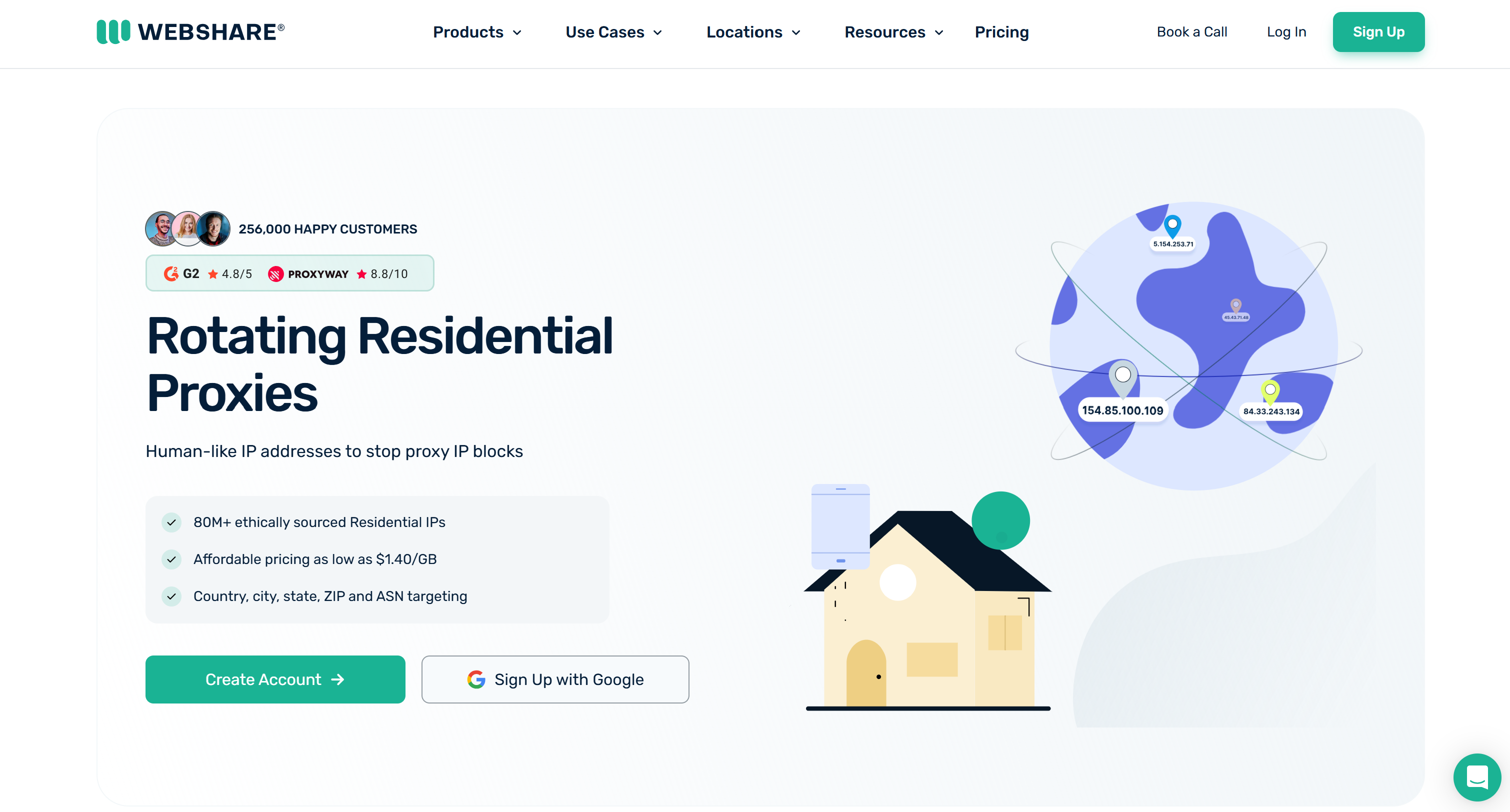
Webshare is a provider of proxies for web scraping and other use cases. The service offers more than 80 million ethically sourced residential IPs across 195 countries, with 99.97% uptime. Beyond its general proxy offerings, it provides dedicated proxies for YouTube and a browser extension. It also features a free academy for learning how to scrape web data in JavaScript and Python.
Best for: Private (up to 2 users at the same time) datacenter and ISP proxies
Types: Residential, datacenter, ISP
IP pool:
- Residential proxies: 80M+ IPs
- Datacenter proxies: 400K+ IPs
- ISP: 60K+ IPs
Country coverage:
- Residential: 195+ countries
- Datacenter: 50+ countries
- ISP: 15+ countries
Geotargeting options: Country, state/region, city, ZIP code, ASN
Success rate: 99.7%
Reviews:
- Trustpilot: 4.1/5 (1,402 reviews)
- G2: 4.0/5 (5 reviews)
Pricing:
| Proxy type | Price range |
|---|---|
| Residential | $1.40/GB – $3.50/GB |
| Datacenter | $0.0179/IP – $0.0299/IP |
| Dedicated datacenter | $0.77/proxy - $1.33/proxy |
| Private datacenter | $0.429/proxy - $0.798/proxy |
| ISP | $0.225/IP – $0.30/IP |
| Dedicated ISP | $1.47/proxy - $2.10/proxy |
| Private ISP | $0.5363/proxy - $0.9262/proxy |
Note: A free plan with access to 10 free proxies for web scraping (1 GB of traffic per month) is available
6. Rayobyte
Rayobyte is a specialized web scraping proxy service. The company offers ethically sourced residential, ISP, datacenter, and mobile proxies. Also, they come with dedicated scraping tools including Web Unblocker, Web Scraping API, and the Docker-based rayobrowse. The provider has 10+ years of experience, serving both small companies and large enterprises.
Best for: Cost-effective static ISP proxies with unlimited bandwidth
Types: Residential, datacenter (static and rotating), ISP (static and rotating), mobile
IP pool:
- Residential: 40M+ IPs
- Datacenter: 300K+ IPs
- ISP: — (Undisclosed)
- Mobile: — (Undisclosed)
Country coverage:
- Residential: 163+ countries
- Datacenter: 29+ countries
- ISP: 6 countries (US, UK, CA, DE, FR, IT)
- Mobile: 1 country (US)
Geotargeting options: Country, state/region, city, ZIP, ASN
Success rate: ~99%
Reviews:
- Trustpilot: 4.1/5 (138 reviews)
- G2: 4.8/5 (2 reviews)
Pricing:
| Proxy type | Price range |
|---|---|
| Residential | $3.50/GB – $0.50/GB |
| Datacenter | $5.00/IP/month – $0.15/IP/month* |
| Rotating datacenter | $0.30/GB – $0.23/GB |
| ISP | $5.00/IP – $4.60/IP |
| Rotating ISP | $3.75/GB – $2.50/GB |
| Mobile | $0.50/GB - $0.95/GB |
- Depending on the proxy type, location, rotation, and other factors
7. IPRoyal
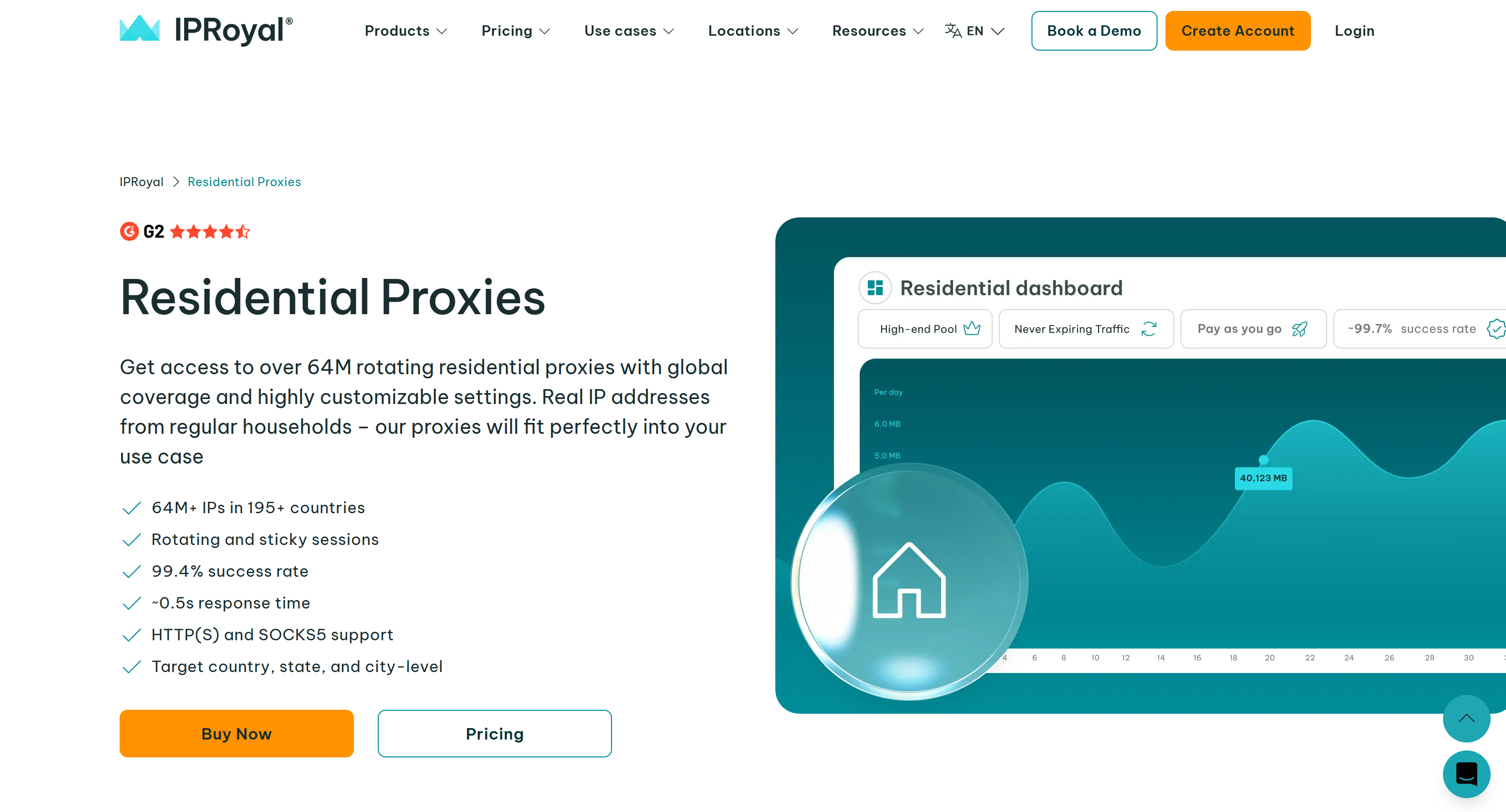
IPRoyal is a popular proxy provider for web scraping, travel fare aggregation, price monitoring, SERP access, stock market research, and AI training data collection. The company sells residential, datacenter, ISP, and mobile proxies, with a combined pool exceeding 69 million IPs across 195 countries. It also comes with a Web Unblocker for automated scraping and a Video Scraper API for YouTube automation.
Best for: Scraping scenarios requiring 5G, 4G, 3G, or LTE mobile proxies
Types: Residential, datacenter, ISP, mobile
IP pool:
- Residential: 64M+ IPs
- Datacenter: Hundreds of thousands of IPs
- ISP: 500K+ IPs
- Mobile: 4.5M+ IPs
Country coverage:
- Residential: 195+ countries
- Datacenter: 60+ countries
- ISP: 31+ countries
- Mobile: 15+ countries
Geotargeting options: Country, state/region, and city-level targeting, with options for specifying longitude, latitude, and radius
Success rate: 99.4% (residential proxies) - 99.99% (ISP proxies)
Reviews:
- Trustpilot: — (review score unavailable due to issues with fake reviews)
- G2: 4.7/5 (858 reviews)
Pricing:
| Proxy type | Price range |
|---|---|
| Residential (Pay-as-you-go) | $1.84/GB – $7.35/GB |
| Residential (Subscription) | $1.75/GB - $7.00/GB |
| Datacenter | $1.39/proxy (90 days) - $1.57/proxy (30 days) |
| ISP | $1.80/proxy (24h) – $2.40/proxy (90 days) |
| Rotating mobile | $5.20/GB - $6.80/GB |
| Dedicated mobile | $10.11/day – $117/month (90 days) |
8. SOAX
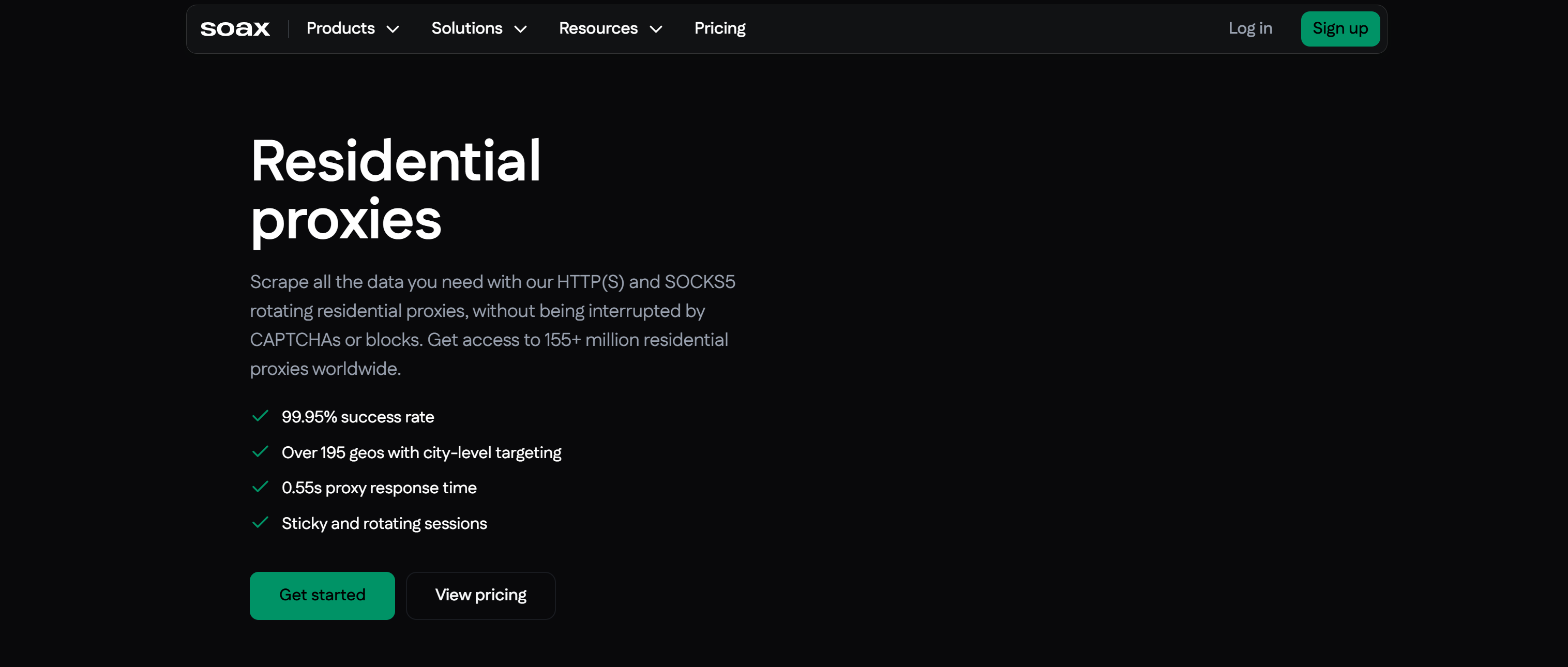
SOAX is a proxy provider operating a distributed network of proxies focused mainly on residential and mobile IPs. Datacenter proxies are also available, but with less visibility (at least, as of this writing). The platform emphasizes flexible session management, city-level geotargeting, and support for protocols. SOAX also offers managed data scraping services.
Best for: Multi-protocol (HTTP(S), SOCKS5, UDP/QUIC) web scraping use cases
Types: Residential, mobile, datacenter
IP pool:
- Residential: 155M+ IPs
- Mobile: 33M+ IPs
- Datacenter: 300K+ IPs
Country coverage:
- Residential: 195 countries
- Mobile: 195 countries
- Datacenter: 5 countries (US, CA, UK, DE, FR)
Geotargeting options: Country, region, and city targeting + ASN and ZIP options (available from the Scale subscription onward).
Success rate: 99.95%
Reviews:
- Trustpilot: 3.4/5 (149 reviews)
- G2: 4.8/5 (66 reviews)
Pricing: From $0.35/GB to $5.00/GB, depending on the subscription and geo-tier
How to Use a Proxy for Web Scraping
The workflow for getting a proxy for web scraping typically involves these simple steps:
- Subscribe to a proxy service.
- Select and configure the proxy type that best fits your needs.
- Receive an authenticated proxy URL.
A web scraping proxy URL follows this format:
<PROTOCOL>://<USERNAME>:<PASSWORD>@<PROXY_PROVIDER_DOMAIN>:<PORT>Each part serves a specific purpose:
<PROTOCOL>: The protocol used to connect to the proxy, such ashttp,https, orsocks5.<USERNAME>: The username provided by the proxy service for authentication.<PASSWORD>: The corresponding authentication password.<PROXY_PROVIDER_DOMAIN>: The hostname of the proxy gateway or server.<PORT>: The network port used to connect to the proxy.
Depending on the provider, you might be able to customize the proxy connection by adding query parameters to the URL or modifying the username/password. For example, a provider may let you specify a geo query argument to control the location of the target proxy servers. Some services also support sticky sessions, allowing you to keep the same IP for a defined period, along with other settings.
IP rotation depends on the proxy type and provider. Rotating residential and mobile proxies usually rotate IPs automatically. Static residential and ISP proxies tend to maintain the same IP for the duration of a session or until you switch to another proxy. With dedicated proxies, the assigned IP remains yours until you release it or the provider's allocation period ends.
Once you have the proxy URL, you need to pass it to your HTTP client or browser automation library. The tool will then route your automated scraping requests through the proxy.
Proxy Integration in Requests
In Requests, you can set a proxy using the dedicated proxies argument:
# pip install requests

import requests

# Replace with the URL of your proxy for web scraping
proxy = "<PROTOCOL>://<USERNAME>:<PASSWORD>@<PROXY_PROVIDER_DOMAIN>:<PORT>"

proxies = {
    "http": proxy,
    "https": proxy,
}

# Retrieve the target page to scrape via the proxy server
response = requests.get("https://example.com", proxies=proxies)

# Scraping logic...
For more guidance, follow our article on setting proxies in Requests.
Proxy Integration in Playwright
With Playwright, you can specify the proxy option when launching the browser:
# pip install playwright
# python -m playwright install

from playwright.sync_api import sync_playwright

with sync_playwright() as p:
    browser = p.chromium.launch(
        # Replace with the connection info from your proxy for web scraping
        proxy={
            "server": "<PROTOCOL>://<PROXY_PROVIDER_DOMAIN>:<PORT>",
            "username": "<USERNAME>",
            "password": "<PASSWORD>",
        }
    )

    # Connecting to the target page to scrape via the proxy server
    page = browser.new_page()
    page.goto("https://example.com")

    # Scraping logic...

    browser.close()
For more information, read our guide for web scraping with Playwright.
Testing a Web Scraping Proxy: Step-by-Step Real-World Scenario
Scrape.do can operate as a web scraping proxy service through the Proxy Mode feature of its Web Scraping API. This allows you to use the Web Scraping API as a passthrough proxy server that routes your requests while handling IP rotation, WAF bypass, and more.
To verify how Scrape.do operates as a proxy server for web scraping, you will apply this workflow:
- Retrieve your Scrape.do API key.
- Use the API key to authenticate a Proxy Mode request through the
httpbin.co/ipendpoint, using Requests in Python. This endpoint returns the caller's IP address, which should correspond to the IP used by the proxy. - Check the characteristics of the proxy IP using the What Is My IP Address service.
Follow the instructions below!
Prerequisites
To go through this integration section, make sure you have:
- A Scrape.do account.
- Python installed locally, with a project set up and Requests installed:
pip install requestsStep #1: Get the Scrape.do API Token
Log in to your Scrape.do account, or create a new one if you have not already done so. You will then be redirected to the “Playground” page.
Retrieve your Scrape.do API token by clicking the “Copy to clipboard” button in the “Your API Token” section:
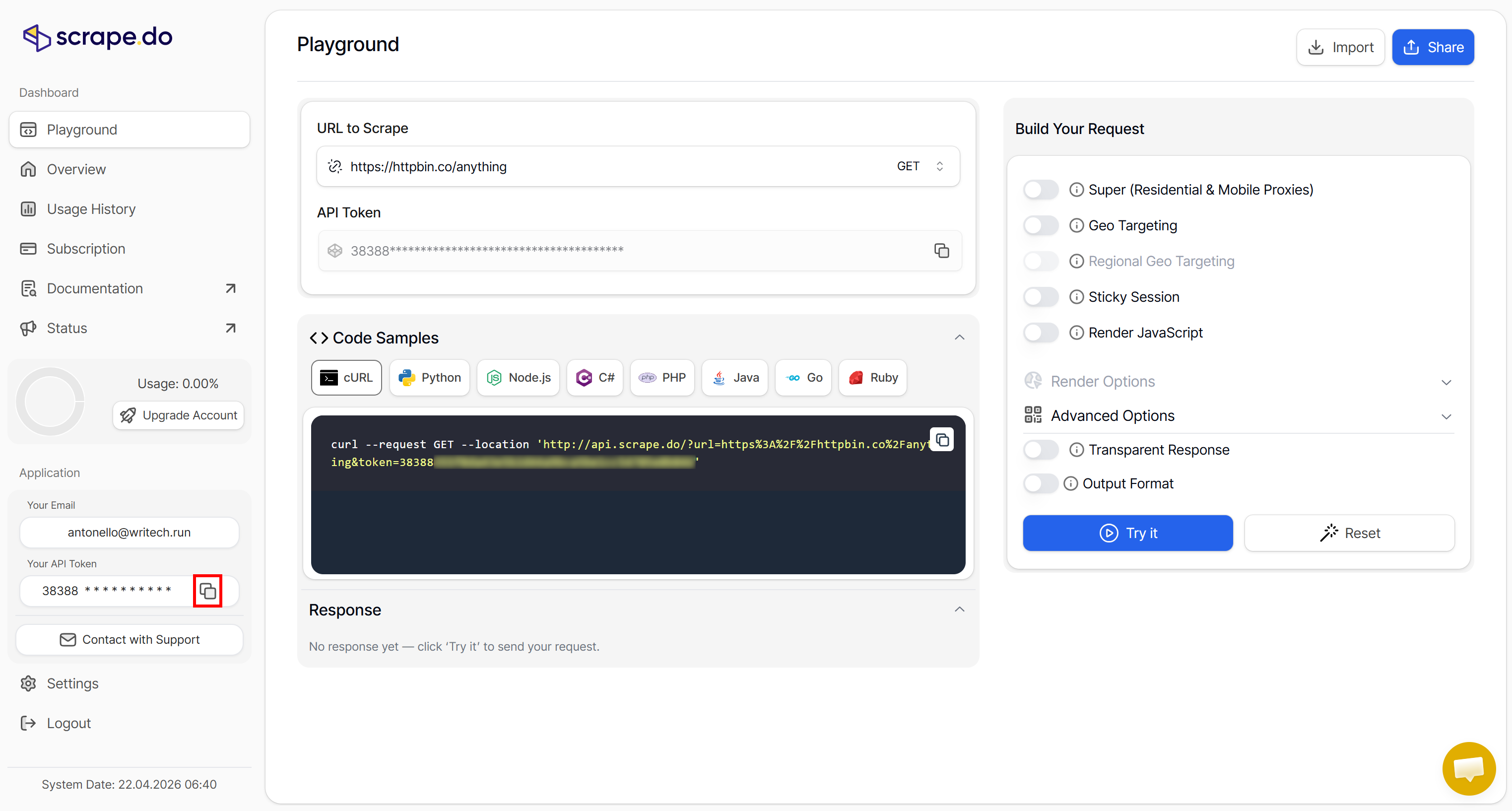
The Scrape.do API token allows you to authenticate requests to the Web Scraping API, either directly or in Proxy Mode.
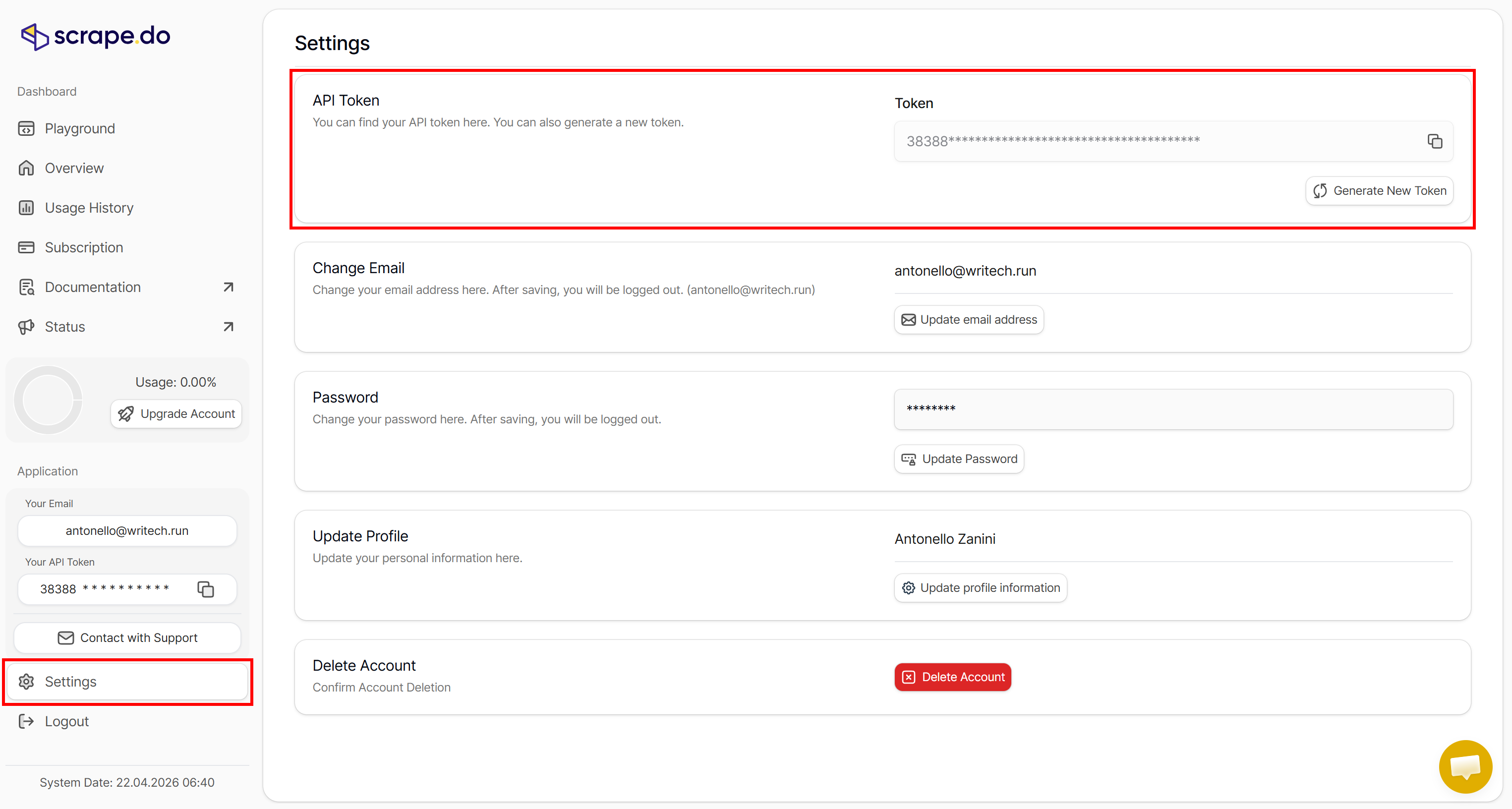
An API token is generated for you when you subscribe. To manage your existing tokens or create a new one, visit the “Settings > API Token” page:
Well done!
Step #2: Retrieve the Proxy IP
Connect to httpbin.co/ip through Scrape.do's Web Scraping API in Proxy Mode as follows:
# pip install requests

import requests

# Replace with your actual Scrape.Do API token
SCRAPE_DO_API_TOKEN = "<YOUR_SCRAPE_DO_API_TOKEN>"

# Scrape.do Web Scraping API proxy mode URL
PROXY_URL = f"http://{SCRAPE_DO_API_TOKEN}:super=true&geoCode=us@proxy.scrape.do:8080"

# Proxy configuration for requests
proxies = {
    "http": PROXY_URL,
    "https": PROXY_URL,
}

# Retrieve the IP of the proxy server
response = requests.get(
    "https://httpbin.co/ip",
     proxies=proxies,
     verify=False,
)
print(response.json())
In detail, the Proxy Mode URL uses this format:
http://{SCRAPE_DO_API_TOKEN}:super=true&geoCode=us@proxy.scrape.do:8080Here, the configuration parameters are:
super=true: To enable Scrape.do's residential and mobile proxy pool.geoCode=us: To route the request through a proxy in the United States.
To avoid SSL verification issues with Proxy Mode, you can temporarily disable SSL verification by setting verify=False. In production, install the Scrape.do CA certificate on the deployment server and keep SSL verification enabled.
Execute the script, and you should receive a response containing the IP address used by the proxy:

Great! Time to verify if the returned IP belongs to a residential network and is located in the United States.
Step #3: Check the Proxy IP
Paste the retrieved IP address into the What Is My IP Address IP Lookup form and submit it. You will get information like this:
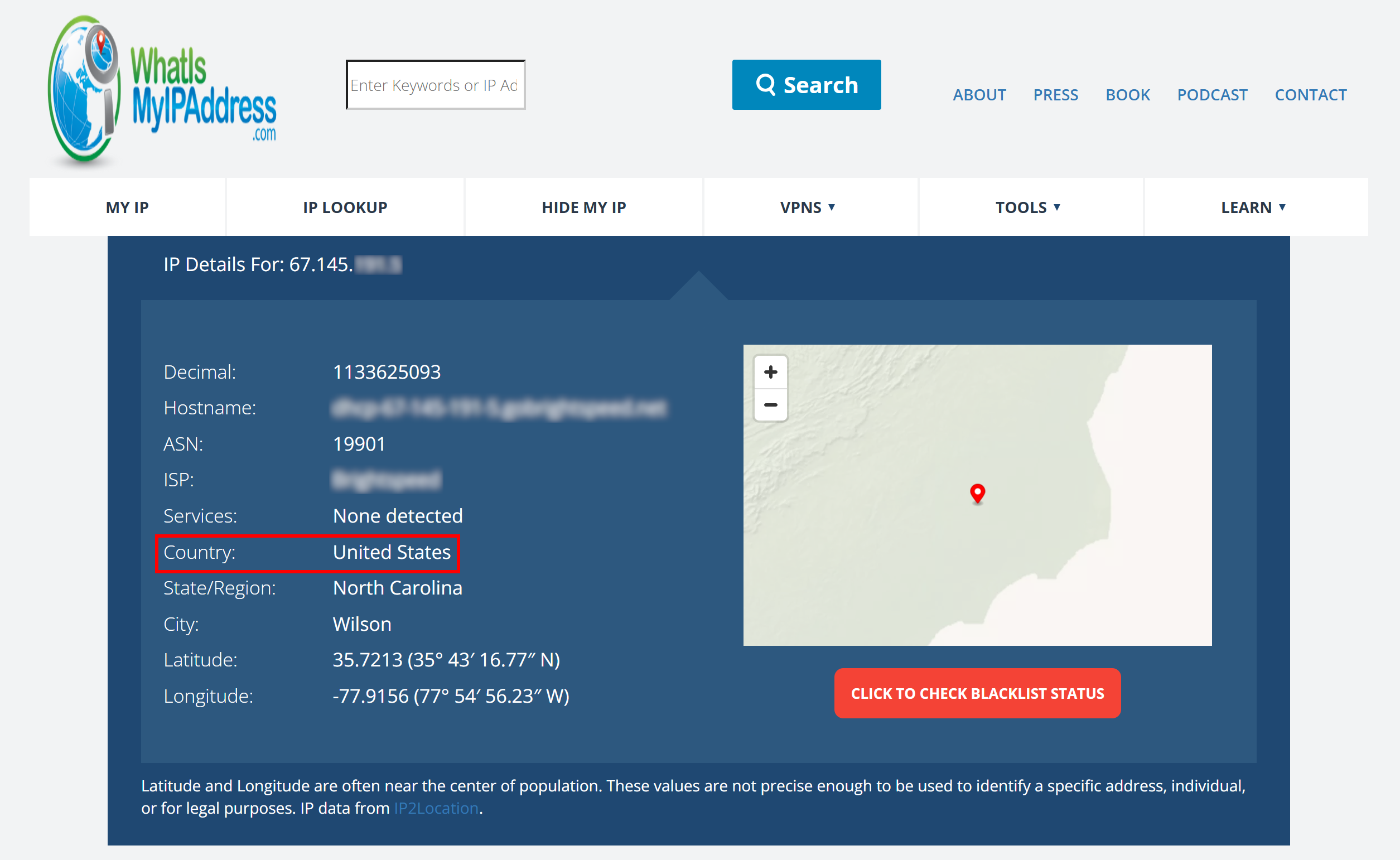
As shown above, the IP address used by the Scrape.do Scraping API proxy is located in the United States. It also belongs to a residential network, as the specified latitude and longitude do not correspond to a known datacenter farm location.
Fantastic! This confirms that the Scrape.do proxy integration is working as expected.
Conclusion
In this blog post, you explored why proxies are fundamental to web scraping and the main proxy types available for this purpose. Then, you reviewed some of the most relevant web scraping proxy services: Scrape.do, Bright Data, Oxylabs, Decodo, Webshare, Rayobyte, IPRoyal, and SOAX.
As demonstrated here, Scrape.do provides a large proxy pool, automatic IP rotation, support for multiple proxy types, and global coverage. Most importantly, it stands out for features specifically optimized for scraping workflows, such as WAF bypass, CAPTCHA avoidance, and dynamic TLS fingerprint management.
Create a new account and get started with Scrape.do for free today!
Frequently Asked Questions
Are there free proxies for web scraping?
Yes, free proxies for web scraping exist, including some offered by established proxy providers. However, they are generally limited in bandwidth, duration, or both. Completely free proxies should generally be avoided because operating proxy servers costs money, meaning they may offer poor quality or even log your traffic.
Should you trust free proxies for web scraping?
Generally, you should be cautious. Free proxies can be unreliable, slow, overloaded, or potentially unsafe. Some may monitor your traffic or collect data, creating privacy risks. Free proxies from reputable providers are a safer option, although they usually come with usage limitations.
What is the best proxy service for web scraping US websites?
There is no single best option for every project. The right provider depends on factors such as proxy type, US coverage, geotargeting, rotation, success rates, concurrency, and pricing. That being said, Scrape.do offers full US coverage, while Bright Data provides millions of US IPs for enterprise use.
What is the difference between web scraping proxies and regular proxies?
Web scraping proxies are optimized for automated data collection and typically offer features such as large IP pools, automatic rotation, extensive geotargeting, and high concurrency. Regular proxies may provide basic IP masking but often lack the scale, geographic coverage, and automation features required for scraping.
Does Scrape.do Web Scraping API come with web scraping proxy integration?
Yes. Scrape.do's Web Scraping API includes a Proxy Mode that lets you use the API as a passthrough proxy. It handles aspects such as IP rotation, residential, datacenter, and mobile proxy access, geotargeting, CAPTCHA handling, and WAF bypass while your application sends requests through a standard proxy configuration.
Web Scraping Expert