Category:Scraping ToolsView as Markdown
Top 6 ScrapingAnt Alternatives for Web Scraping in 2026

Head of Marketing


ScrapingAnt is one of the cheapest ways to get a headless browser behind an API call. Send a URL, get rendered HTML back, pay per credit. For a side project pulling a few thousand pages off unprotected sites, that is a fine deal.
The trouble starts when the targets get harder. ScrapingAnt runs a comparatively small proxy pool, ships no per-domain parsers, and gives you little control over request fingerprinting. On sites behind Cloudflare Turnstile, DataDome, or Akamai, retries pile up, credits drain, and success rates land nowhere near what the marketing page implies.
Volume is the second breaking point. Rendering and residential proxies both multiply the credit cost, so the 10,000-credit free tier disappears faster than it looks.
Here are 6 alternatives that fix ScrapingAnt's biggest weaknesses, each aimed at a different kind of project.
| Tool | Best For | Starting Price | Open Source |
|---|---|---|---|
| Scrape.do | Anti-bot bypass at predictable cost | Freemium (1,000 credits/mo) | No |
| Bright Data | Enterprise scale and ready-made datasets | Pay-as-you-go | No |
| Oxylabs | Compliance-heavy enterprise scraping | $49/mo (free trial) | No |
| Apify | Pre-built scrapers and full workflows | Freemium | Partial |
| Scrapfly | Deep request-level debugging | $30/mo (free tier) | No |
| Decodo | Budget residential proxies | $7/mo (free trial) | No |
These tools were picked by mapping each of ScrapingAnt's documented limitations (proxy pool size, bypass reliability, credit multipliers, lack of parsers, thin observability) against providers that solve at least one of them well. Pricing figures reflect published entry plans as of September 2026 and shift often, so verify before committing.
What ScrapingAnt Does Well
ScrapingAnt is not a bad product. It is a narrow one, and here is where it earns its keep.
Cheap Headless Browser Rendering
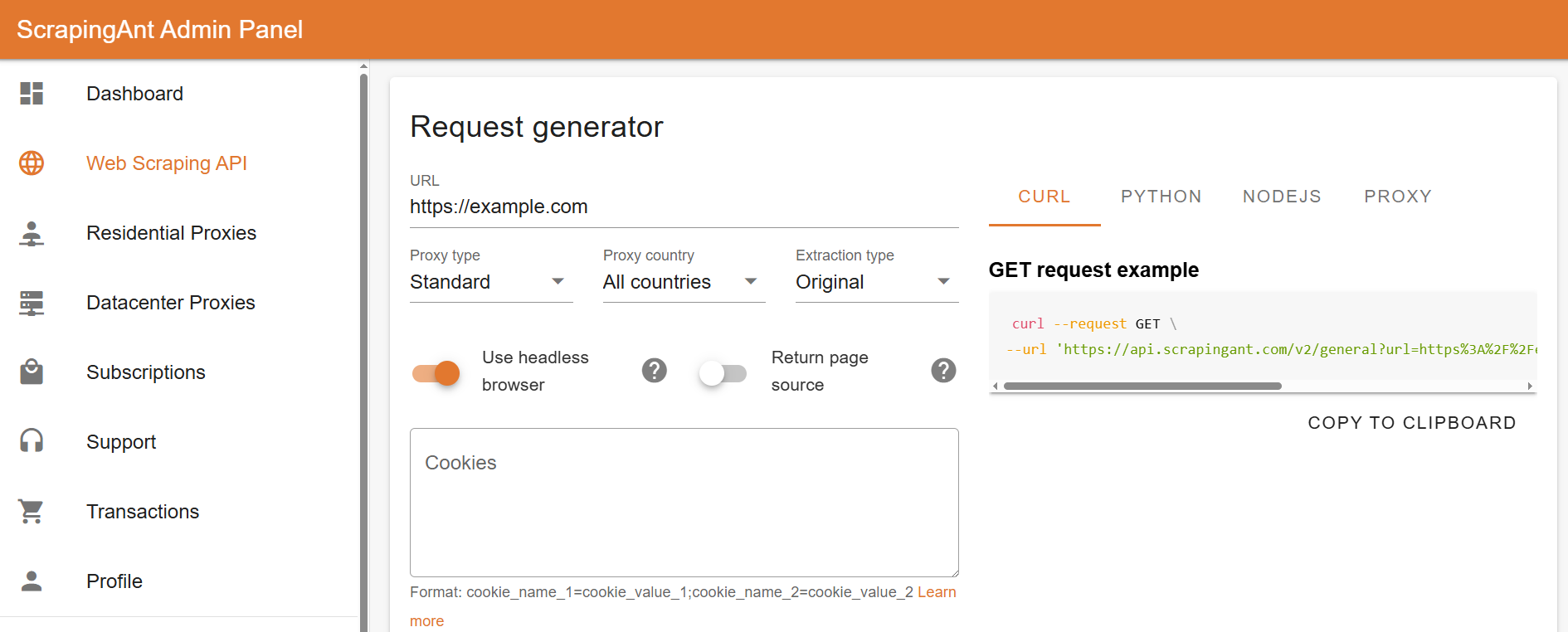
Chrome rendering behind a single GET request is genuinely convenient. You skip Playwright installs, container images, and memory tuning. For React or Vue sites with no bot protection, the price per rendered page is among the lowest in the category.
A Free Tier You Can Actually Prototype On
10,000 credits per month with no card required beats most competitors' trials. It is enough to validate whether a target works before you spend anything.
Simple, Small API Surface
A handful of parameters: URL, proxy type, country, browser toggle, wait selector. No SDK ceremony, no actor model, no compute units. Signup to working request takes about five minutes.
Downsides of ScrapingAnt
A Small Proxy Pool Against Big Anti-Bot Vendors
ScrapingAnt advertises a pool in the low millions of IPs. Bright Data and Oxylabs each run networks north of 150 million. Pool size matters because anti-bot vendors score IP reputation at the ASN and subnet level. When Cloudflare or DataDome flags a range, a small provider has fewer clean addresses to rotate into, so blocks cluster instead of scattering. That is the usual complaint from teams who outgrow ScrapingAnt: a target works, then stops, and never recovers.
Credit Math That Punishes Hard Targets
The base credit cost looks cheap until you enable what hard targets require. Residential proxies and rendering each multiply the charge, and a request needing both costs an order of magnitude more than the headline rate. Failed requests still consume credits during retries, so the pages you most need are the ones you pay most for and are least likely to get.
No Domain-Specific Parsers
Competitors ship structured endpoints for Amazon, Google, and other high-value targets that return clean JSON. ScrapingAnt returns raw HTML and leaves parsing to you: writing selectors, then maintaining them after every layout change. On a large e-commerce project that maintenance often costs more than the scraping itself. Our Amazon scraping guide shows how much layout churn you are signing up for.
Thin Observability
When a request fails you get a status code, not the request chain, the TLS fingerprint used, the proxy selected, or a replayable trace. Debugging a systematic block becomes guesswork, and support turnaround is slow relative to larger vendors.
1. Scrape.do
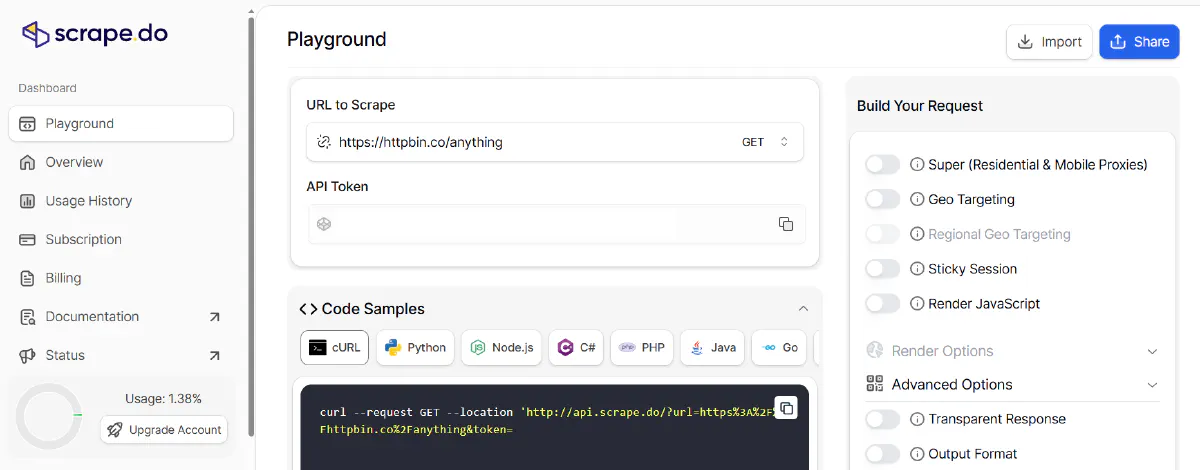
Scrape.do is the best alternative when the sites you actually care about are protected and ScrapingAnt keeps returning blocks.
The core difference is the unblocking layer. Scrape.do handles TLS fingerprinting, header ordering, session persistence, and challenge solving on its side, then rotates across a residential pool sized for production traffic. In our benchmarks across Amazon, Indeed, GitHub, Zillow, Capterra, Google, and X, it posted near-perfect success rates with the fastest average response time in the field, and it bills only for successful requests.
Pros
- Bypass that holds on hard targets: Cloudflare Turnstile, DataDome, PerimeterX, and Akamai are handled by the API, not pushed back onto your code. Our Cloudflare bypass guide shows what you are offloading.
- You pay only for successful responses: failed requests are not charged, which changes the economics on protected domains compared to ScrapingAnt's retry-and-burn model.
- Transparent multipliers: 5x for rendering, 10x for premium proxies, 25x for both. No hidden per-domain surcharges, so a sample run forecasts the month.
- A free tier that renews: 1,000 credits monthly, no card, plus a proxy-mode endpoint that drops into existing Scrapy, requests, or Puppeteer code in one line.
- Geotargeting to city and postal code: useful for pricing work where country-level targeting is too coarse.
Cons
- No visual or no-code builder: it is an API, so non-developers cannot self-serve.
- No marketplace of prebuilt scrapers: you write the parsing. Apify covers that gap if you would rather buy than build.
ScrapingAnt vs Scrape.do
Scrape.do wins on the thing that decides most projects: whether the page comes back. ScrapingAnt is cheaper per unprotected page and looks better on free credits. But once a target sits behind a serious anti-bot vendor, ScrapingAnt's small pool and retry billing turn a cheap plan into an expensive one that still fails.
Start free with 1,000 monthly credits and test your hardest target first.
2. Bright Data
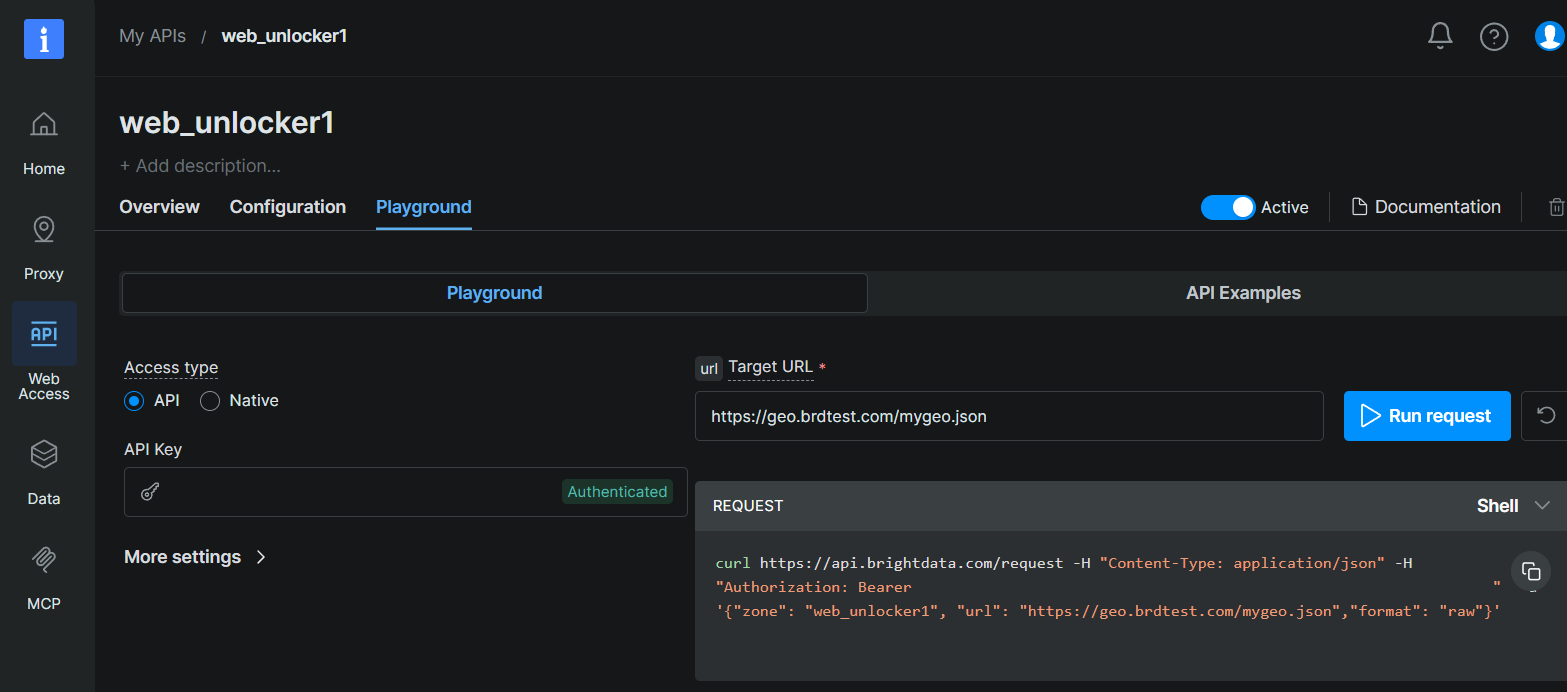
Bright Data is the largest player in the category, and the contrast with ScrapingAnt is about scale. Where ScrapingAnt gives you one endpoint and a few million IPs, Bright Data gives you a 150M+ residential network, Web Unlocker, a Scraping Browser, dozens of dataset APIs, and pre-collected datasets you can buy outright. That last option matters: if your target is a common one, buying the dataset skips the whole engineering problem ScrapingAnt was failing to solve.
Pros
- Network scale that changes block rates: 150M+ IPs with ASN and carrier-level targeting. Reputation blocks that kill a small pool barely register.
- Ready-made datasets: buy e-commerce, social, and business listing data instead of building a pipeline.
- Web Unlocker handles challenges automatically: CAPTCHA solving, fingerprint management, and retry logic in one endpoint.
- Compliance posture built for legal review: KYC on the network, documented sourcing, and contracts that survive procurement.
Cons
- Genuinely complicated: dozens of overlapping products and a dense dashboard. Picking the right one takes real time.
- Easy to overspend: pay-as-you-go residential rates add up fast, and the cheapest configurations are not the defaults.
- KYC friction: identity verification gates some products, slowing down evaluation.
ScrapingAnt vs Bright Data
These sit at opposite ends of the market. ScrapingAnt is the cheap option for small jobs. Bright Data is the heavy platform you graduate to when block rates cost you revenue. Under a hundred dollars a month, Bright Data is overkill. At millions of pages, ScrapingAnt was never going to hold.
3. Oxylabs
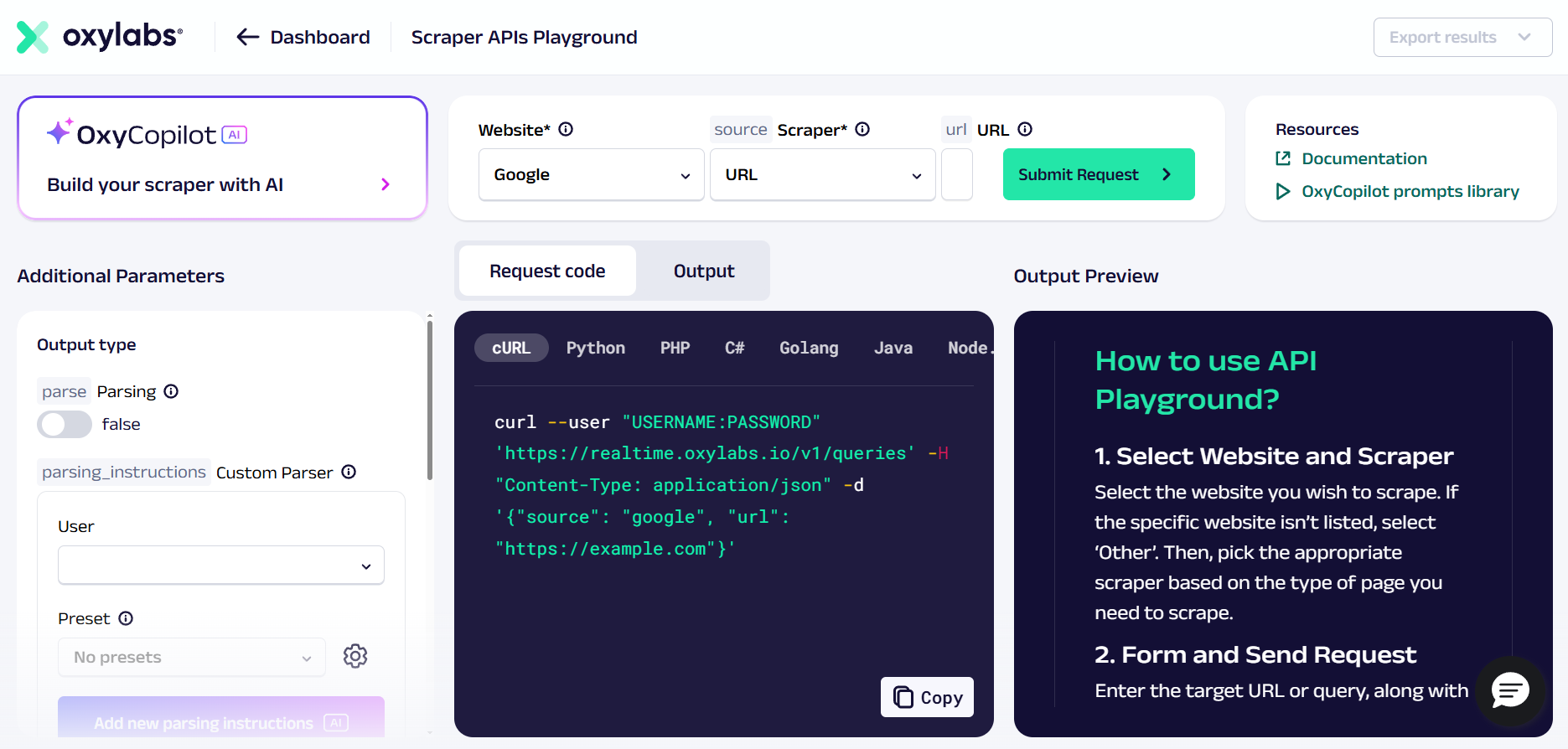
Oxylabs covers similar ground to Bright Data but leans harder on compliance and enterprise support. Its residential network runs past 175M IPs, and it carries ISO/IEC 27001 and SOC 2 Type 2 certifications, which is usually what unblocks a security review at a larger company.
The product split is clean: raw proxy pools for teams that want control, Web Unblocker for teams that want challenge handling done for them, and dedicated Web, E-Commerce, and SERP Scraper APIs returning parsed JSON instead of HTML.
Pros
- Structured output on high-value targets: E-Commerce and SERP APIs return parsed JSON, removing the selector maintenance ScrapingAnt leaves to you.
- Very high measured success rates: independent proxy benchmarking puts Oxylabs residential connection success above 99.8%.
- Certifications and account support: ISO 27001, SOC 2 Type 2, and a named account manager on larger plans.
- OxyCopilot for scaffolding: turns plain-English descriptions into scraping and parsing code.
Cons
- No lasting free tier: entry plans start around $49/month with only a trial before that.
- More decisions up front: choosing between raw proxies, Web Unblocker, and a domain API is a setup step ScrapingAnt users skip.
ScrapingAnt vs Oxylabs
Choose Oxylabs when procurement and legal are in the room. The certifications, the support contract, and the parsed endpoints are what you pay for, not just the IPs. ScrapingAnt fits better while you are still validating whether a project is worth building at all.
4. Apify
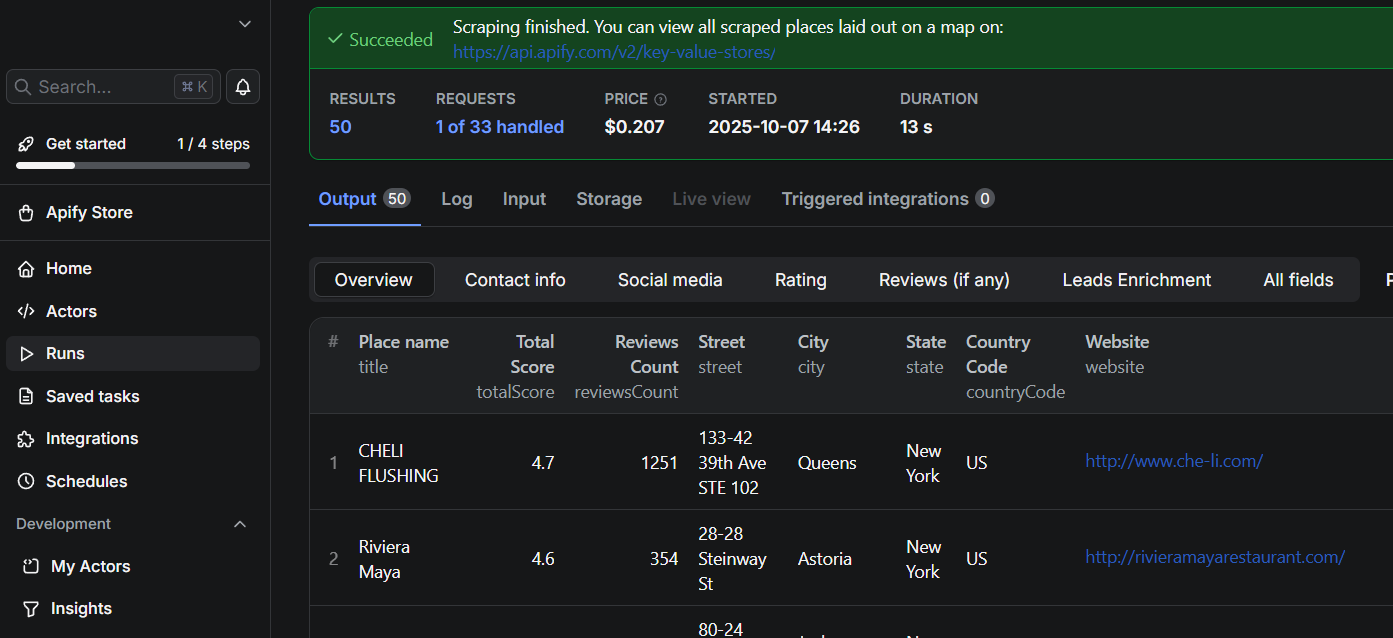
Apify solves a different half of the problem. ScrapingAnt hands you HTML and wishes you luck. Apify hands you a marketplace of several thousand prebuilt scrapers, called Actors, covering Google Maps, Instagram, TikTok, Amazon, and most other targets people want. On top of that it is a full platform: scheduling, dataset storage, webhooks, proxy integration, and a runtime for your own Node.js or Python code.
Pros
- Thousands of maintained Actors: someone else already wrote the scraper for your target and absorbs the selector churn.
- Scheduling and storage included: cron runs, dataset retention, and webhook delivery, none of which ScrapingAnt offers.
- Run your own code: a full SDK for custom Actors when nothing in the store fits.
- Integrations everywhere: LangChain, Make, Zapier, and Google Sheets connectors make it usable by non-engineers.
Cons
- Compute-unit pricing is hard to forecast: cost tracks memory and runtime, not requests, so a slow Actor is an expensive one.
- Actor quality varies: community Actors are unevenly maintained, and an abandoned one fails silently.
- Slower per-page than a plain API: platform overhead shows on simple, high-volume fetches.
ScrapingAnt vs Apify
Apify wins when you would rather buy a scraper than build one. ScrapingAnt wins when you know exactly what to extract and want the cheapest possible fetch. If your team keeps rewriting parsers after site redesigns, Apify removes that work, and the cost difference favors it once you price in engineering hours.
5. Scrapfly
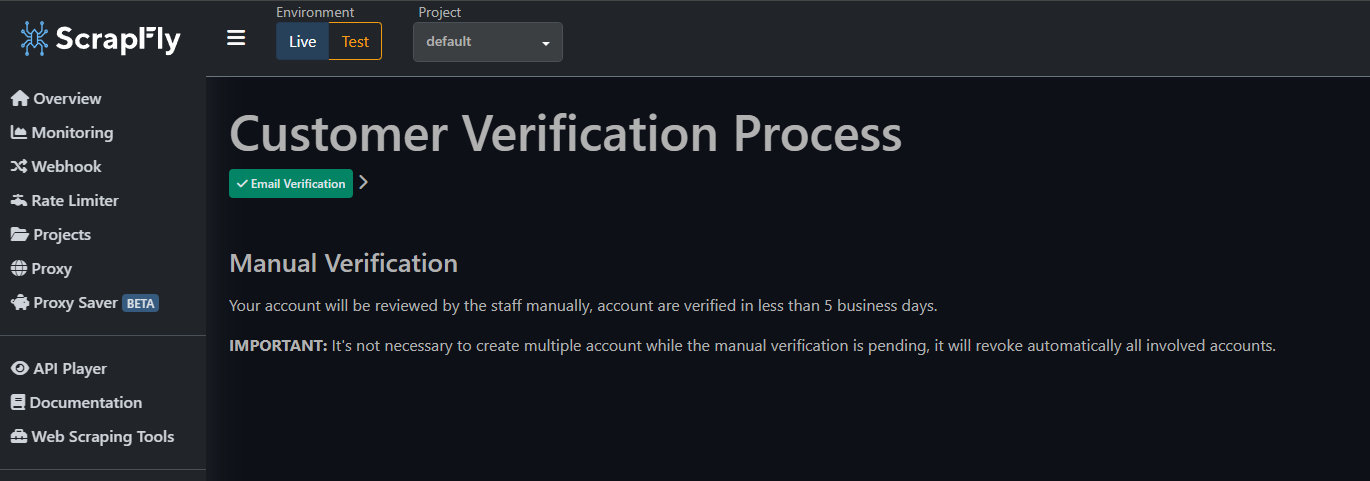
Scrapfly is the closest structural peer to ScrapingAnt here: a single scraping API with anti-bot bypass, rendering, and proxy rotation. The difference is depth of tooling. Scrapfly logs every request in a way you can inspect and replay, which turns "it stopped working" from a mystery into a diagnosis. It also ships an Extraction API with LLM-backed and template-based parsing, plus session persistence for multi-step flows behind logins.
Pros
- Real request-level observability: full logs with fingerprint, proxy, and response details for every call, plus replay. The single biggest upgrade over ScrapingAnt.
- Anti-bot bypass as a first-class feature: dedicated handling for Cloudflare, DataDome, PerimeterX, and Kasada rather than a generic browser toggle.
- Extraction API included: AI and template-based parsing to JSON.
- Good Python and TypeScript SDKs: with Scrapy middleware that swaps into an existing spider cleanly.
Cons
- Pricier entry point: paid plans start around $30/month, and the free tier is small next to ScrapingAnt's 10,000 credits.
- Credit costs escalate on hard targets: bypass plus rendering plus residential lands in a high per-request bracket.
- Smaller proxy network: not in the same tier as Bright Data or Oxylabs on raw pool size.
ScrapingAnt vs Scrapfly
Scrapfly is the natural step up for a developer who likes ScrapingAnt's shape but needs to know why things fail. Same one-endpoint simplicity, better bypass and debugging. You pay more per request and spend far less time guessing.
6. Decodo
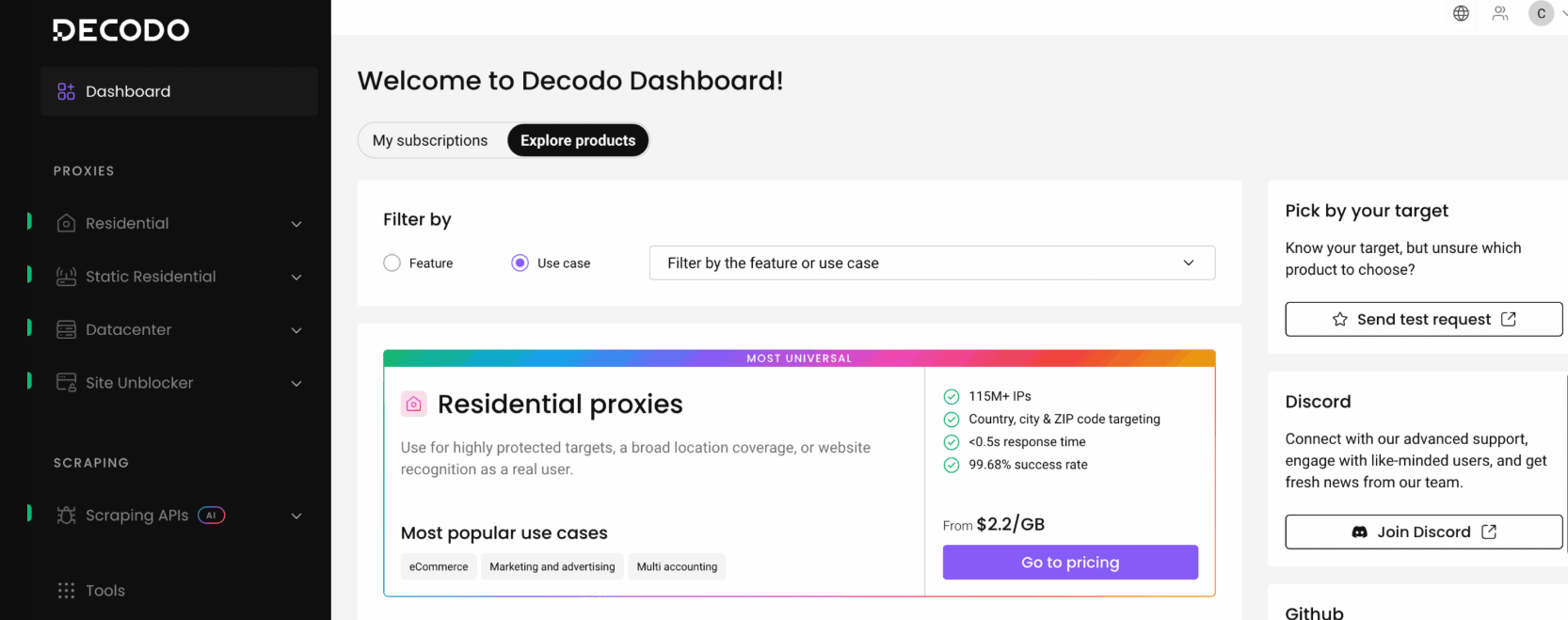
Decodo, previously Smartproxy, is the budget pick. It is primarily a proxy provider with a 115M+ residential pool, wrapped with scraping APIs for e-commerce, SERPs, and social platforms. If your issue with ScrapingAnt is purely IP quality, and you are willing to handle rendering and parsing yourself, Decodo gives you a much larger pool at a lower price than the enterprise vendors.
Pros
- Cheapest credible residential access: entry pricing around $7, with per-GB rates well under Bright Data and Oxylabs.
- Large pool for the price: 115M+ residential IPs with country, state, and city targeting.
- Fast to start: no KYC gate, self-serve dashboard, free trial on most products.
- Support better than the price suggests: responsive, with solid documentation.
Cons
- Weaker on the hardest anti-bot systems: fine on moderate protection, less consistent against Kasada or aggressive DataDome.
- Fewer parsed endpoints: narrower scraping API coverage than Oxylabs or Bright Data.
- Bandwidth billing on residential: heavy pages cost more, which surprises teams used to per-request pricing.
ScrapingAnt vs Decodo
Decodo is the value upgrade when your only real problem is IP quality. A much larger pool at a lower price, with the tradeoff that rendering and parsing fall back on you. If the blocks come from serious anti-bot vendors rather than plain rate limiting, a bigger pool alone will not fix it, and Scrape.do or Oxylabs is the better move.
What to Pick?
- Scrape.do: Best overall replacement. Strongest bypass on protected targets, success-only billing, and a free tier that renews monthly. Start here if ScrapingAnt is returning blocks.
- Bright Data: Best at true enterprise scale, and the only option that lets you buy a finished dataset instead of scraping it.
- Oxylabs: Best when compliance and support contracts matter as much as success rates. Parsed endpoints and certifications, no free tier.
- Apify: Best when you would rather use a maintained scraper than write one. Watch the compute-unit pricing.
- Scrapfly: Best for developers who want ScrapingAnt's simplicity plus real debugging. Logs and replay make systematic blocks solvable.
- Decodo: Best on budget. A far larger pool than ScrapingAnt at a lower price, provided you handle rendering and parsing yourself.
For a broader view of the category, our roundup of the best web scraping APIs compares these providers on success rate and response time head to head.
For most teams leaving ScrapingAnt because pages stopped coming back, Scrape.do is the shortest path to a working pipeline: bypass that holds on protected sites, billing that only charges for successes, and a drop-in proxy mode that fits your existing code.
Get 1,000 free credits and test your hardest target right now.
Head of Marketing